
Study in Netherlands offers international students access to a high-quality education system with over 2,100 English-taught programs across various levels. The country is known for its innovative teaching methods that emphasize interactive learning, critical thinking, and practical application, so Immigration to Netherlands is a wise decision.
With 13 universities consistently ranking in the global top 200, the Netherlands attracts around 12% international students in its higher education population. The academic year typically runs from September to June/July.
Key highlights about study in Netherlands:
- Affordable tuitions
- Safe and multicultural environment (95% of locals speak English)
- Efficient public transportation
- Post-study work opportunities
Netherlands Education System
The Dutch higher education system is divided into two main types:
- Research universities (focusing on theoretical knowledge and research, offering three-year bachelor’s and one- or two-year master’s)
- Universities of applied sciences (emphasizing practical, profession-oriented learning with four-year bachelor’s degrees, including internships)
- University colleges for liberal arts-style education
The system promotes student-centered learning, with small class sizes and access to modern facilities. Programs are accredited by the NVAO, ensuring quality. The academic calendar is semester-based, with options for study abroad or internships.
➜ Bachelor’s Degree
- Duration:
- 3 years (research universities)
- 4-5 years (applied sciences)
- Entrance exam: None for most; selection for Numerus Fixus (e.g., exams, interviews)
- SAT and ACT requirements: SAT/ACT for some internationals; 1100+ SAT for UAS if diploma doesn’t match
- Possibility of studying in English: Yes, over 180 programs
- Language score: IELTS 6.0-7.0; TOEFL 80-100; Cambridge C1 Grade C+
- Number of course units:
- 180 ECTS (3-year)
- 240 ECTS (4-year)
- Cost: Non-EU: €6,000-€20,000/year; EU: €2,530.
- Prerequisites: Equivalent diploma (VWO/HAVO); funds; insurance.
Bachelor’s emphasize interactive learning; research universities for theory, UAS for practice with internships. Affordable, innovative, with post-study work options.
➜ Master’s Degree
- Duration: 1-2 years
- Entrance exam: None typically; tests for Numerus Fixus
- SAT and UAS requirements: Not applicable; work experience for UAS
- Possibility of studying in English: Yes, over 1,600 programs
- Language score: IELTS 6.5-7.0; TOEFL 90-100; Cambridge C1 Grade B+
- Number of course units:
- 60 ECTS (1-year)
- 120 ECTS (2-year)
- Cost: Non-EU: €8,000-€20,000/year; EU: €2,530
- Prerequisites: Relevant Bachelor’s, motivation/CV; funds/insurance
Master’s focus on research/practice; strong industry ties in tech/sustainability. English-dominant, with job market access via visas.
➜ PhD Degree
- Duration: 4+ years (full-time employee)
- Entrance exam: None; proposal/interviews
- SAT and UAS requirements: Not applicable (research universities only)
- Possibility of studying in English: Yes, most programs
- Language score: IELTS 6.5; TOEFL 90
- Number of course units: Not ECTS-based; research-focused
- Cost: Often free/salaried (€2,500-€3,000/month); €5,000-€15,000 for self-funded
- Prerequisites: Relevant Master’s, proposal, supervisor
PhDs as paid jobs with research/teaching; English theses, funding via grants. Competitive, globally recognized in innovation fields.
Who is Eligible to study in Netherlands? Complete Checklist
This checklist covers all essential eligibility requirements for non-EU/EEA international students to study at Dutch universities or universities of applied sciences.
EU/EEA/Swiss students generally skip the visa/finance steps but must meet academic and language criteria.
1. Academic Qualifications
- For Bachelor’s: Secondary Education Diploma equivalent to Dutch VWO (pre-university level)
- Verified via Nuffic or the university’s diploma evaluation tool
- US students: High school diploma + specific AP scores or SAT/ACT may be required
- For Master’s: Bachelor’s Degree from a recognized institution
- Must be in a related field; GPA often ≥ 3.0/4.0 or equivalent
- For PhD: Master’s Degree + Research Proposal
- Strong academic record and supervisor acceptance
- Preparatory Year (if diploma is insufficient)
- Some universities offer foundation/propaedeutic programs
2. Language Proficiency (for English-taught programs)
- IELTS Academic: Minimum 6.0–7.0 overall (no band below 5.5–6.0)
- TOEFL iBT: 80–100
- Cambridge English: C1 Advanced (CAE) or C2 Proficiency (CPE) – Grade C or higher
- PTE Academic: 58–76
- Exemption possible if:
- Previous education fully in English (in US, UK, AUS, NZ, etc.)
- IB Diploma in English A
- Dutch VWO diploma with English
Note: Some programs (esp. Medicine, Law) require higher language scores.
3. Age & Health
- Minimum Age: Typically 17+ for Bachelor’s (no upper limit)
- Good Health: No serious contagious diseases (TB screening applies)
4. Program-Specific Requirements
- Portfolio (Art, Design, Architecture)
- GMAT/GRE (Business, Economics, some Master’s)
- GMAT: 600+
- GRE: 300+ combined
- Motivation Letter, CV, References (Master’s/PhD/selective Bachelor’s)
- Entrance Exam (e.g., Medicine, Dentistry – via UMC universities)
5. Admission to a Recognized Institution
- Unconditional Offer Letter from a NVAO-accredited Dutch university
- Applied via Studielink and the university portal
- Numerus Fixus Programs (limited spots):
- Participated in the selection process (essays, interviews, exams)
- Met ranking cutoff (if applicable)
Note: NVAO stands for the Accreditation Organisation of the Netherlands and Flanders
6. Financial Proof (for Visa & Residence Permit)
- Minimum €13,944 per year (2025 rate: €1,162/month × 12) in a blocked bank account or sponsor affidavit
- Must cover tuition + living costs
- Tuition Fees Paid (at least first installment)
- Bachelor’s: €6,000–15,000/year (non-EU)
- Master’s: €8,000–20,000/year
- Health Insurance (mandatory)
- Dutch public insurance (~€120/month) or an international policy meeting IND standards
7. Visa & Residence Permit (Non-EU/EEA Only)
- MVV (Entry Visa) + VVR (Residence Permit) applied by the university
- Valid Passport (at least 6 months validity beyond stay)
- TB Test (required for citizens of certain countries – check IND list)
- No Criminal Record (police clearance may be requested)
- Visa Fee Paid: €207 (2025 rate)
EU/EEA/Swiss students: Register with the municipality within 5 days of arrival.
Best Universities in Netherlands
1. Research universities
- Delft University of Technology
- Rank: =47
- City: Delft
- University of Amsterdam
- Rank: 53
- City: Amsterdam
- Utrecht University
- Rank: =103
- City: Utrecht
- Leiden University
- Rank: =119
- City: Leiden
- Eindhoven University of Technology
- Rank: =140
- City: Eindhoven
- Erasmus University Rotterdam
- Rank: =140
- City: Rotterdam
- University of Groningen
- Rank: =147
- City: Groningen
- Wageningen University & Research
- Rank: =153
- City: Wageningen
2. Universities of applied sciences
- Windesheim University of Applied Sciences
- Rank: Top overall (Keuzegids 2026)
- City: Zwolle
- HZ University of Applied Sciences
- Rank: Top 3 medium-sized (73 points, Keuzegids 2026)
- City: Vlissingen
- HAN University of Applied Sciences
- Rank: Top position (Keuzegids 2026)
- City: Arnhem/Nijmegen
- NHL Stenden University of Applied Sciences
- Rank: Top large UAS (Keuzegids 2026)
- City: Leeuwarden/Emmen
- Breda University of Applied Sciences (BUas)
- Rank: 6th medium-sized (66 points, Keuzegids 2026)
- City: Breda
- HAS green academy
- Rank: 5th medium-sized (Keuzegids 2026)
- City: ‘s-Hertogenbosch
- Rotterdam University of Applied Sciences
- Rank: Notable (Keuzegids 2026)
- City: Rotterdam
3. University colleges
- University College Utrecht
- Rank: =103 (parent Utrecht University)
- City: Utrecht
- Amsterdam University College
- Rank: 53 (parent University of Amsterdam)
- City: Amsterdam
- Leiden University College The Hague
- Rank: =119 (parent Leiden University)
- City: The Hague
- University College Roosevelt
- Rank: =103 (parent Utrecht University)
- City: Middelburg
- Erasmus University College
- Rank: =140 (parent Erasmus University Rotterdam)
- City: Rotterdam
❓ How to Choose the Best University in the Netherlands?
Choosing the best university in the Netherlands as an international student involves evaluating several key factors tailored to your academic goals, lifestyle preferences, and practical needs. With over 50 higher education institutions offering more than 2,100 English-taught programs, the process can be streamlined by following these steps:
- Define Your Study Goals and Preferences
- Research Rankings and Reputation
- Evaluate Location and Student Life
- City vibe and cost of living
- Campus facilities and support
- Assess Admission and Eligibility
- Factor in Costs, Funding, and Career Prospects
- Tuition and living costs
- Post-study opportunities
- Gather Insights and Make a Decision
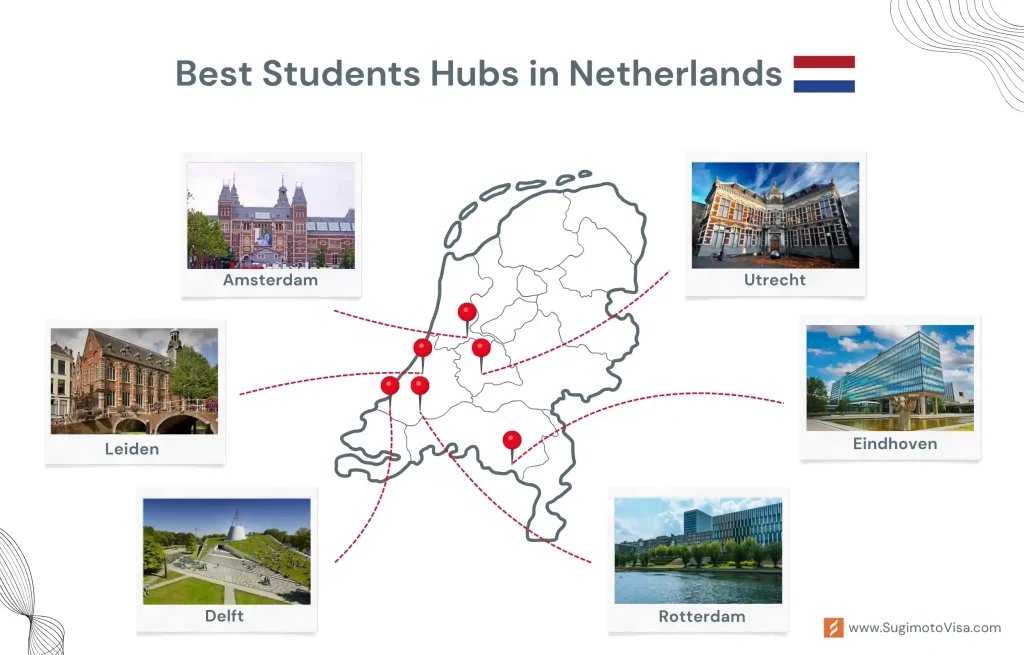
Best Student City (Students Hubs)
The Netherlands is home to several excellent student cities, attracting over 90,000 international students annually. These hubs combine academic excellence, vibrant social scenes, efficient public transport, and multicultural environments where 95% of locals speak English.
Key cities include:
- Amsterdam: Rated 3.61/5 but QS global #20; capital with the University of Amsterdam.
- Pros: Museums, canals, nightlife, and multinational companies.
- Cons: High costs (€1,000-1,500/month), tourist crowds. Cosmopolitan for humanities/business, despite lower local satisfaction due to expenses.
- Leiden: Rated 3.70/5; scientific center with Leiden University (Europe’s oldest).
- Pros: Individual attention, research quality; near Amsterdam/The Hague.
- Cons: Accommodation shortages. Excellent for law/psychology, with English options.
- Rotterdam: Rated 4.04/5; multicultural port city with Erasmus University (top 100 worldwide).
- Pros: Modern architecture, electronic music, diverse community.
- Cons: Less traditional Dutch feel. Strong for business/governance internationals.
- Utrecht: Rated 4.15/5; central hub with Utrecht University (Nobel laureates).
- Pros: Cultural events, terraces; easy nationwide access.
- Cons: Underrated globally. Vibrant for arts/sciences internationals.
- Delft: Rated 4.20/5; picturesque canals with TU Delft (top 15 globally for engineering).
- Pros: Historic charm, industry links.
- Cons: Small size limits variety. Highly international for tech/architecture.
- Eindhoven: Rated 4.29/5; tech innovation center with Eindhoven University of Technology.
- Pros: Start-up scene, Dutch Design Week; cheap airport flights.
- Cons: Housing challenges. Perfect for STEM students, all courses in English.
Tuition Fees in the Netherlands (2025/2026)
EU/EEA/Swiss/Surinamese Students
- Statutory fee: €2,601/year for most programs (halved to €1,300.50 in the first year for new Bachelor’s/Associate’s)
- Specialized programs: Up to €5,600
Non-EU/EEA Students
- Bachelor’s: €6,000–€20,000/year
- Master’s: €8,000–€30,000/year
- PhD: Often €0 (salaried position); €5,000–€15,000 for self-funded
Fees vary by university/program; scholarships are available. Check specific institutions for exact costs.
Work While Study in Netherlands
Your Student Residence Permit allows you to work, but with restrictions:
- You may work a maximum of 16 hours per week during the academic year
- You can work full-time during the summer months (June, July, and August)
- Your employer must apply for a separate work permit (TWV) for you
- Working as a self-employed person is permitted without a TWV
Scholarships in Netherlands
The Netherlands offers numerous scholarships for international students, particularly non-EU/EEA, to offset tuition (typically €6,000–€30,000/year for non-EU) and living costs. Many are merit-based, with deadlines often February–May for September intake. Over 100 options exist via government, universities, and organizations like Nuffic. Key ones for 2025/2026 include:
| Scholarship Name | Amount | For | Eligibility | Deadline |
|---|---|---|---|---|
| NL Scholarship (formerly Holland Scholarship) | €5,000 one-time grant | Non-EEA Bachelor's/Master's students | Excellent academics, first Dutch degree | Feb 1–May 1, 2025 |
| Maastricht University NL-High Potential Scholarship | €34,000 (tuition waiver + €12,350 living stipend + visa/insurance); 21 available | Non-EU Master's | Top 5% academics, under 35, no prior Dutch study | Feb 1, 2025 |
| HAN NL Scholarship | €12,500 (€5,000 year 1 + €2,500/year after) | Non-EEA Bachelor's/Master's at HAN University | Strong motivation, academics | April 1, 2025 |
| Radboud Scholarship Programme | Partial/full tuition waiver + €12,350 living costs | Non-EEA Master's | Outstanding results, English-taught programs | Feb 28, 2025 |
| Amsterdam Merit Scholarship | €6,000–€25,000/year | Non-EU Master's at UvA | Excellent GPA, motivation letter | Vary by faculty (Jan–April 2025) |
| Orange Knowledge Programme (OKP) | Full funding (tuition, visa, travel, insurance) | Mid-career professionals from 50+ developing countries in short courses/Master's | 2+ years work experience, employer endorsement | March/June/Sept 2025 rounds |
| University of Twente Scholarship (UTS) | €3,000–€22,000/year | Non-EU Master's | High academics, specific fields | Feb 1/May 1, 2025 |
| Leiden University Excellence Scholarship (LExS) | €10,000–€15,000 tuition reduction | Non-EU Master's | Top 10% academics | Feb 1/Oct 1, 2025 |
❓ Study in Netherlands for Free: Is This Possible?
Studying in the Netherlands isn’t entirely free for most international students, but it’s affordable compared to the US/UK, with options to minimize costs through scholarships and low fees for eligible groups.
- EU/EEA/Swiss students, statutory tuition is just €2,601/year (2025/2026), often covered by grants/loans via DUO, making it nearly free with part-time work.
- Non-EU/EEA students face €6,000–€30,000/year tuition (recent 50% hikes at some unis to €24,000), but full-coverage scholarships like Maastricht’s (€34,000) or OKP can make it effectively free if awarded, covering tuition.
Apply to a University in the Netherlands (Admission)

Step 1
Research and Choose Program
- Use platforms like Study in NL’s Studyfinder or Mastersportal
- Check if the program is at a research university (WO, theoretical) or a university of applied sciences (HBO/UAS, practical)
- Determine tuition fees
- Explore scholarships and assess visa needs

Step 2
Prepare Required Documents
- Valid passport/ID copy
- Passport photos
- High school diploma/transcripts (for Bachelor’s) or Bachelor’s degree/transcripts (for Master’s)
- Proof of language proficiency
- Motivation letter/personal statement (500-800 words)
- CV/resume
- Proof of application fee payment (€50-100, if required)
- Optional/additional: Sample academic work, GMAT/GRE for business programs. For non-EU: Also prepare financial proof and health insurance for visa.

Step 3
Register and Apply via Studielink
- Create a Studielink account (www.studielink.nl)
- Select up to 4 programs (changeable before deadlines).
- Submit your enrollment request
- For numerus fixus: Apply by January 15, 2025 (23:59 CET); selection occurs January 15-April 15, with ranking notified April 15
- For regular programs: Apply by May 1, 2025 (non-EU, to allow visa time); some unis have February/March deadlines, apply by mid-April latest
- If the program isn’t in Studielink (rare for internationals), apply directly via the university’s portal

Step 4
Complete University-Specific Application
- After Studielink, log in to the university’s online portal to upload documents and complete forms.
- For selective programs: Submit essays, interviews, or tests
- Pay any application fee
- Track your status in Studielink and the university portal

Step 5
Receive Decision and Accept Offer
- Universities notify via Studielink/email
- For numerus fixus: Accept within 2 weeks of April 15 offer; if not selected initially, wait for possible spots from declines
- Pay tuition (first installment) to confirm enrollment
- If rejected, apply to alternatives (Studielink allows changes)

Step 6
Handle Visa, Housing, and Final Preparations
- Non-EU/EEA: University applies for your MVV entry visa/residence permit (€207 fee); provide docs like acceptance letter, finances, and insurance
- Arrange health insurance: EU use EHIC; non-EU buy Dutch policy (~€100-160/month)
- Secure housing early (university halls or private via platforms like Kamernet)
- Upon arrival: Register at the municipality for a BSN number; non-EU collect a residence permit
- Enroll officially before classes start (September)
Visa and Residence Options
A study stay in the Netherlands for international students is primarily regulated by the Student Residence Permit (VVR for study) and, for certain nationalities, an initial entry visa called the Provisional Residence Permit (MVV).
| Document | Who Needs It? | Purpose | Duration |
|---|---|---|---|
| MVV ($\text{Entry Visa}$) | Most non-EU/EEA/Swiss citizens staying >90 days (exceptions exist, e.g., US, Canada, UK citizens). | Allows entry into the Netherlands for a long-term stay. | Valid for 90 days. |
| Student Residence Permit ($\text{VVR for study}$) | All non-EU/EEA/Swiss citizens staying >90 days. | Grants legal residency for the purpose of study. | Generally issued for the duration of the study program plus 3 months. |
Post-Graduation Options
A significant advantage for international graduates is the Residence Permit for Orientation Year: Zoekjaar
- Purpose: This is a one-year permit for highly educated non-EU/EEA graduates of a Dutch higher education institution (or certain top-tier foreign institutions) to search for a job or start a business in the Netherlands.
- Benefit: During this year, you have unrestricted access to the Dutch labor market, and employers do not need to apply for a separate work permit ($\text{TWV}$) for you.
- Pathway: This permit often serves as a crucial bridge to a highly skilled migrant residence permit, which then has a lower income requirement.
Final Note
The Netherlands offers international students a highly attractive study experience characterized by world-class universities and an exceptionally international setting. Key benefits include:
- Academic Excellence: Dutch universities frequently rank in global top 100 lists, and the education system is noted for its innovative, student-centered approach that focuses on practical skills, teamwork, and critical thinking.
- English Proficiency: The Netherlands offers the most English-taught programs in continental Europe, and over 95% of the Dutch population speaks English, making it one of the easiest non-Anglophone countries for international students to navigate daily life.
- Career Opportunities: The country’s strong economy and thriving start-up scene offer excellent post-study prospects. The Orientation Year residence permit ($\text{Zoekjaar}$) grants graduates one year of unrestricted access to the labor market to find a job or start a business, facilitating a transition to a long-term professional career.
- Multicultural Society: The culture is generally open, tolerant, and welcoming, creating a rich and inclusive environment for students from over 160 different countries.
FAQs
As an American planning to study for over 90 days, you must be admitted by a recognized Dutch institution, which will then apply for your necessary residence permit on your behalf.
The $30 ruling is a tax benefit for highly skilled, specific expats recruited from abroad, allowing up to $30 of their salary to be paid tax-free to cover extraterritorial costs.
Yes, the Netherlands offers a large number of degree programs taught entirely in English at both the Bachelor’s and Master’s levels.
No, international students, especially non-EU/EEA citizens, must pay tuition fees, though various scholarships are available to reduce the cost.
Key drawbacks include the ongoing housing shortage in major student cities, high tuition fees for non-EU students, and an intense self-study-focused academic culture with a high first-year drop-out rate.
