The Federal Skilled Worker Program remains one of the main Express Entry routes for professionals whose careers have been built outside Canada.
Canadian work experience is not required. Neither is a Canadian job offer.
What matters first is whether the applicant meets the program’s minimum requirements for skilled work experience, language and education. The profile is then assessed on the Federal Skilled Worker selection grid, where at least 67 points out of 100 are required. Only after that does the Comprehensive Ranking System, or CRS, become relevant.
That distinction is important because the 67-point FSWP score and the CRS score are two different systems. Reaching 67 points may make someone eligible to enter the Express Entry pool through FSWP, but it does not mean that the person has enough CRS points to receive an Invitation to Apply.
As of October 1, 2026, the Federal Skilled Worker Program remains one of the three federal programs managed through Express Entry alongside the Canadian Experience Class and Federal Skilled Trades Program.
Federal Skilled Worker Program (FSWP) Eligibility in 2026
| Requirement | Current Rule |
|---|---|
| Skilled work experience | At least 1 continuous year |
| Work experience period | Within the last 10 years |
| Eligible occupations | NOC TEER 0, 1, 2 or 3 |
| Minimum hours | 1,560 |
| Foreign experience accepted | Yes |
| Canadian experience required | No |
| Language minimum | CLB/NCLC 7 in all four abilities |
| Education | Canadian secondary credential or higher, or foreign credential with ECA |
| FSW selection score | At least 67 out of 100 |
| Canadian job offer | Not required |
| Proof of funds | Usually required |
| Quebec | Applicant must intend to settle outside Quebec |
The work used for the minimum requirement must match the NOC chosen as the applicant’s primary occupation. IRCC requires the applicant to have performed the NOC lead statement and most of its main duties.
Skilled Work Experience
The minimum work requirement is one of the main differences between FSWP and CEC.
An FSWP applicant needs at least one continuous year of paid skilled work experience during the previous ten years. The occupation must fall within TEER 0, 1, 2 or 3. The required year can have been completed in Canada or abroad.
For full-time employment, IRCC uses a maximum of 30 hours per week, giving a total of 1,560 hours over 12 months. Part-time employment can also be used, provided the equivalent number of hours is reached and the continuous-work requirement is maintained. Hours above 30 per week do not shorten the required period.
This makes a common calculation such as 50 hours per week for seven months insufficient to create a full year of qualifying FSWP work experience. The number of hours matters, but so does the duration of the employment.
The Continuous Work Rule
FSWP requires the minimum qualifying year to be continuous.
A person who worked eight months in an occupation, stopped for several months and later returned for another four months does not simply have a continuous 12-month qualifying period.
The situation can be different when someone changes employers but continues working without a break in the same primary occupation. IRCC allows the minimum year to include more than one job, but the work used for this qualifying period must remain within the applicant’s primary NOC.
This is considerably different from CEC, where qualifying Canadian experience does not have to be continuous and can be accumulated across different eligible NOCs.
Primary Occupation
The primary occupation is the NOC used to establish FSWP eligibility.
It does not have to be the applicant’s current job or even the most recent position. IRCC specifically states that the primary occupation may be based on earlier work experience.
For example, someone may have spent four years working as a software developer and later moved into sales management. If the earlier software-development experience still falls within the ten-year window and meets the FSWP requirements, that occupation could potentially remain the primary NOC.
The stronger approach is to select the occupation whose duties are best supported by the employment evidence rather than choosing a NOC simply because its title sounds closer to the applicant’s current position.
Different NOCs in the Same Career
Only the minimum qualifying year is tied closely to the primary occupation.
A longer career may include other skilled NOCs, and those periods can still matter elsewhere in the application, including the FSWP work-experience factor and the CRS.
This means a candidate does not need to have spent an entire career in one occupation.
A person could have several years in engineering, later move into management and still use a continuous qualifying year from the engineering period as the basis of FSWP eligibility, provided it falls within the previous ten years and meets the other requirements.
The distinction is between establishing the minimum qualifying year and presenting the applicant’s complete skilled-work history.
Student Work
FSWP treats student employment differently from the Canadian Experience Class.
Paid work completed while studying can count toward the FSWP minimum requirement when it was continuous and meets the other program conditions.
This can be important for someone who worked professionally while completing a degree.
Under CEC, full-time student work is generally excluded from the minimum Canadian work requirement. Under FSWP, the fact that someone was studying at the same time does not automatically disqualify the experience.
The employment still needs to be real paid work, properly documented and consistent with the selected NOC.
Self-Employed Experience
FSWP is also different from CEC in its treatment of self-employment.
IRCC expressly recognizes qualifying self-employed work when calculating the FSWP work-experience selection factor.
That can be relevant for consultants, professionals and business owners whose careers do not follow a conventional employee structure.
The evidence normally deserves closer attention because an applicant may need to establish the actual nature of the work, period of activity, hours, compensation and duties without relying on a conventional employer reference letter.
This distinction should not be confused with Canadian Experience Class rules, where ordinary self-employed Canadian experience is generally excluded from the CEC minimum and from Canadian work-experience CRS points.
FSWP: Language Requirements
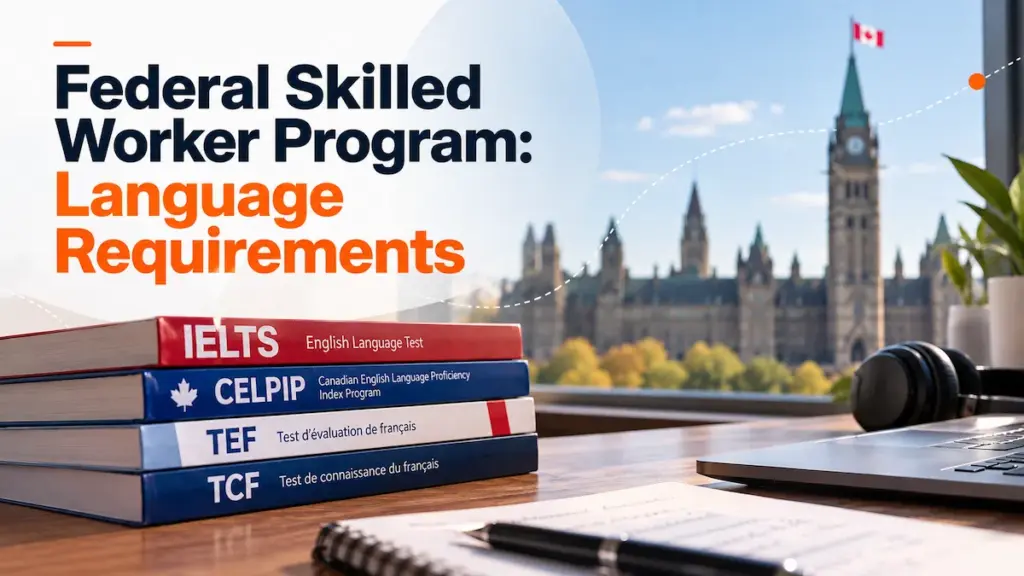
The minimum language level for FSWP is CLB 7 in English or NCLC 7 in French in all four abilities.
IRCC accepts CELPIP-General, IELTS General Training and PTE Core for English, and TEF Canada or TCF Canada for French.
For IELTS General Training, CLB 7 corresponds to:
| Ability | Minimum IELTS General |
|---|---|
| Speaking | 6.0 |
| Listening | 6.0 |
| Reading | 6.0 |
| Writing | 6.0 |
CLB 7 is only the program minimum. Higher language scores can have a substantial effect on both the FSWP 67-point grid and the applicant’s CRS.
For example, CLB 7 gives four FSW selection points per language ability. CLB 8 gives five, while CLB 9 or higher gives six per ability. The first official language can therefore contribute up to 24 points toward the 67-point threshold.
The Value of CLB 9
For many FSWP candidates, CLB 9 is more important than simply gaining a few extra language points.
Under CRS, CLB 9 can also increase skill-transferability points when combined with foreign work experience or post-secondary education.
A candidate who barely reaches CLB 7 may qualify for FSWP but remain relatively weak in the Express Entry pool. Improving the language score to CLB 9 can affect several parts of the CRS calculation at the same time.
This is one reason the language result should be viewed as more than a pass/fail requirement.
Education and ECA
FSWP requires at least a Canadian secondary-school credential or its foreign equivalent.
Applicants educated outside Canada generally need an Educational Credential Assessment for immigration purposes. The ECA verifies how the foreign qualification compares with a completed Canadian credential.
An ECA must be less than five years old both when the Express Entry profile is completed and when the permanent residence application is submitted. An expired assessment can result in refusal.
The ECA also determines the education points available under the FSWP selection grid.
| Canadian Equivalency | FSWP Points |
|---|---|
| Secondary school | 5 |
| One-year post-secondary credential | 15 |
| Two-year post-secondary credential | 19 |
| Bachelor’s degree / program of 3 years or more | 21 |
| Two or more credentials, with one at least 3 years | 22 |
| Master’s / qualifying professional degree | 23 |
| Doctoral degree | 25 |
IRCC’s current ECA tables assign 23 FSW selection points to a Canadian-equivalent master’s degree and 25 to a doctorate.
When points are being claimed for two or more credentials, each credential used for those points needs its own valid ECA, and at least one must represent a program of three years or longer.
Understanding the 67-Point Grid vs. CRS in Express Entry
The 67-point requirement exists only for Federal Skilled Worker eligibility.
It is not the CRS.
IRCC assesses six factors:
| FSWP Selection Factor | Maximum Points |
|---|---|
| Language | 28 |
| Education | 25 |
| Skilled work experience | 15 |
| Age | 12 |
| Arranged employment | 10 |
| Adaptability | 10 |
| Total | 100 |
A score of 67 or higher may allow the candidate to qualify for FSWP and enter the Express Entry pool. A score below 67 normally means that the person does not qualify under the program.
Once the candidate enters the pool, IRCC stops using this 100-point grid to rank the profile. Ranking is done through CRS.
This is one of the most frequent sources of confusion in Express Entry. A person can have 72 FSWP points and a CRS of 430, while another candidate might have 68 FSWP points and a CRS above 500.
Both have passed the FSWP eligibility threshold, but their positions in the Express Entry pool can be very different.
Work Experience Points
FSWP awards more selection points as skilled experience increases.
| Skilled Work Experience | FSWP Points |
|---|---|
| 1 year | 9 |
| 2–3 years | 11 |
| 4–5 years | 13 |
| 6 years or more | 15 |
For this selection factor, IRCC can count qualifying work performed in Canada or abroad, including qualifying work while studying and self-employed work.
This table should not be confused with the minimum requirement. One year is enough to satisfy the minimum work-duration rule, but six or more years can produce the maximum 15 points under this part of the FSWP grid.
Age Points
FSWP gives the full 12 points for age from 18 through 35.
After age 35, one point is lost for each additional year until age 47, when the age factor becomes zero.
| Age | Points |
|---|---|
| 18–35 | 12 |
| 36 | 11 |
| 37 | 10 |
| 38 | 9 |
| 39 | 8 |
| 40 | 7 |
| 41 | 6 |
| 42 | 5 |
| 43 | 4 |
| 44 | 3 |
| 45 | 2 |
| 46 | 1 |
| 47+ | 0 |
Having zero age points does not automatically make someone ineligible. It simply makes reaching the overall 67-point threshold harder and can also reduce CRS competitiveness.
Arranged Employment After the 2025 CRS Change
This is another area where two different point systems are easy to mix up.
Canada removed the additional 50 or 200 CRS points for job offers on March 25, 2025.
That change did not remove arranged employment from the Federal Skilled Worker selection grid.
A qualifying arranged employment offer can still contribute up to 10 points toward the FSWP 67-point threshold. IRCC requires the qualifying offer to be continuous, paid, full-time, non-seasonal, for at least one year and in TEER 0, 1, 2 or 3, together with the applicable LMIA or LMIA-exempt conditions.
The current position is therefore:
| Effect of a Qualifying Job Offer | Current Treatment |
|---|---|
| Required to qualify for FSWP | No |
| FSWP selection-grid points | Up to 10 |
| Additional CRS job-offer points | Removed since March 25, 2025 |
| Possible proof-of-funds exemption | Yes, when combined with authorization to work in Canada and other applicable conditions |
The removal of CRS job-offer points did not eliminate every immigration purpose served by a valid job offer.
Adaptability Points
The final 10 points on the FSWP grid come from adaptability.
Relevant factors include a spouse or partner’s language ability, previous Canadian study, previous authorized work in Canada, qualifying arranged employment and certain relatives living in Canada.
One year of the principal applicant’s qualifying full-time Canadian work can provide the full 10 adaptability points by itself. A spouse’s language score at CLB/NCLC 4 or higher in all four abilities can provide five points.
IRCC caps the entire adaptability section at 10 points even when several factors apply.

Proof of Funds
Most Federal Skilled Worker applicants need settlement funds.
The exemption applies when the applicant is authorized to work in Canada and also has a valid job offer.
As of October 1, 2026, IRCC’s current proof-of-funds page lists the following minimum amounts:
| Family Size | Required Funds |
|---|---|
| 1 | CAD 15,263 |
| 2 | CAD 19,001 |
| 3 | CAD 23,360 |
| 4 | CAD 28,362 |
| 5 | CAD 32,168 |
| 6 | CAD 36,280 |
| 7 | CAD 40,392 |
| Each additional family member | CAD 4,112 |
The current IRCC page identifies these amounts as having been updated on July 7, 2025, and they remain the amounts displayed by IRCC at the time of this article.
Family size includes the principal applicant, spouse or common-law partner and dependent children, even when some family members are not accompanying the applicant to Canada.
The funds must be legally available to the applicant. Borrowed money and equity in real property cannot be used as settlement funds. IRCC also requires bank documentation showing information such as current balances and average balances for the previous six months.
FSWP and Express Entry Category-Based Selection
An FSWP candidate is not limited to a hypothetical FSWP-only draw.
Candidates who qualify under FSWP can also receive invitations through category-based Express Entry rounds when they meet the requirements of the relevant category.
For example, IRCC’s 2026 Healthcare, Trades, French-language and Senior Manager ministerial instructions explicitly allow invitations to be issued to eligible candidates from the Federal Skilled Worker Program as well as CEC and, where applicable, FSTP.
This is particularly relevant for candidates living outside Canada.
A healthcare professional with foreign experience may qualify under FSWP and also meet the Healthcare category requirements. A French-speaking professional may qualify under FSWP while also being eligible for French-language rounds.
The underlying program determines whether the candidate can be in Express Entry. The category can create an additional way to be selected from the pool.
Read More: Express Entry Categories →
FSWP Draws in 2026
There has not been a dedicated Federal Skilled Worker Program-only round in 2026 through October 1.
That does not mean FSWP candidates cannot receive invitations. Category-based rounds can include qualifying FSWP candidates, and IRCC’s ministerial instructions for those rounds expressly provide for this.
For an FSWP candidate, a single historical “FSWP CRS cut-off” is therefore not particularly useful in the current selection environment.
The more relevant comparison depends on how the profile can actually be selected: through a category-based round, a provincial nomination or any broader round IRCC may conduct in the future.
Federal Skilled Worker Program (FSWP) and CRS
Passing the 67-point grid only determines program eligibility.
Once in the pool, the candidate receives a CRS score based on factors such as age, education, language proficiency, Canadian work experience, foreign work experience, spouse factors and additional points such as a provincial nomination.
Language can be particularly important for applicants relying heavily on foreign work experience. CRS provides skill-transferability points for combinations of foreign work experience with strong official-language scores, especially at CLB 9 or above.
This creates a practical difference between being eligible and being competitive.
An applicant may have enough experience and education to comfortably exceed the FSWP 67-point threshold while still needing a stronger language result, French proficiency, a provincial nomination or category eligibility to improve the likelihood of receiving an invitation.
Federal Skilled Worker Program (FSWP) and CEC
The two programs are often compared because both are managed through Express Entry, but they are designed for different work histories.
| Requirement | FSWP | CEC |
|---|---|---|
| Foreign work can establish eligibility | Yes | No |
| Canadian work required | No | Yes |
| Minimum experience | 1 year | 1 year |
| Experience window | 10 years | 3 years |
| Continuous minimum period | Yes | No |
| Primary occupation central to minimum year | Yes | No |
| Student work | Can count if conditions are met | Full-time student work excluded |
| Minimum language | CLB/NCLC 7 | CLB/NCLC 7 for TEER 0–1; 5 for TEER 2–3 |
| Minimum education | Secondary credential | None |
| 67-point grid | Yes | No |
| Proof of funds | Usually required | Not required |
| Job offer required | No | No |
Someone who has never worked in Canada can therefore qualify for FSWP. The same profile cannot qualify for CEC without eligible Canadian work experience.
Work Experience Evidence
NOC selection becomes especially important for applicants relying on foreign employment.
IRCC looks beyond the title printed on an employment letter. The applicant must demonstrate that the work corresponds to the NOC lead statement and most of its main duties.
A reference letter describing a candidate simply as a “Manager,” “Engineer” or “Developer” may therefore be insufficient if the duties do not allow an officer to understand the actual occupation.
The same concern applies where a company uses inflated titles. A person called a director internally may still perform duties that belong to a lower management or professional NOC.
The strongest work history is one where the NOC can be supported naturally by the duties, reporting structure, dates, hours and compensation rather than being forced to fit the immigration application.
Regulated Professions
An eligible NOC does not guarantee the right to practise a regulated profession in Canada.
The ECA is also not a professional licence. IRCC explicitly states that an ECA establishes Canadian educational equivalency for immigration purposes but does not guarantee licensing in a regulated occupation.
Doctors, pharmacists, engineers and other regulated professionals may therefore satisfy FSWP immigration requirements while still having a separate licensing process in the province where they intend to work.
These two assessments should be kept separate when planning immigration.
Quebec Work and Settlement
FSWP is intended for applicants planning to settle outside Quebec.
Experience gained while living or working in Quebec (PEQ – Québec Experience Program) can still be used, provided the applicant can demonstrate a genuine intention to settle elsewhere in Canada.
The location of past employment is therefore not the main issue. The relevant question for FSWP is the applicant’s intended province of settlement after becoming a permanent resident.
Quebec operates its own Skilled Worker Program (RSWP) selection system.
Processing Time
FSWP applications submitted through Express Entry have a federal service standard of six months, although the posted estimate can move above or below that benchmark.
IRCC reported in September 2026 that, between August 2025 and July 2026, about 78% of FSWP and CEC applications received decisions within the six-month service standard, while roughly half were finalized within five months.
The public processing-time data reported in early September 2026 placed new FSWP applications at approximately seven months. That figure is an estimate rather than a guaranteed completion date and can change as inventory changes.
Common Eligibility Problems
| Issue | Why It Matters |
|---|---|
| Treating 67 points as CRS | The 67-point grid only establishes FSWP eligibility |
| Using several disconnected periods to create the minimum year | The qualifying FSWP year must be continuous |
| Choosing a NOC from the job title alone | IRCC assesses duties and the NOC lead statement |
| Using CLB 7 as the final language target | CLB 7 may establish eligibility but may produce a weaker CRS |
| Assuming the newest job must be the primary occupation | The primary occupation can come from earlier qualifying experience |
| Believing student work never counts | Paid continuous student work can qualify under FSWP |
| Assuming a Canadian job offer is mandatory | FSWP does not require one |
| Assuming job offers still add 50 or 200 CRS points | Those CRS points were removed in March 2025 |
| Ignoring the remaining FSWP job-offer points | A qualifying offer can still add up to 10 points on the 67-point grid |
| Letting an ECA expire | The ECA must remain valid when the profile and PR application are submitted |
| Calculating funds only for accompanying relatives | IRCC uses the full family size in the settlement-fund calculation |
Future Changes to the Federal Skilled Worker Program
IRCC is considering a broader restructuring of the federal high-skilled programs.
In 2026, the department consulted on creating a single federal high-skilled program that could eventually replace the existing Federal Skilled Worker Program, Canadian Experience Class and Federal Skilled Trades Program. The consultation material discusses possible common requirements such as a Canadian high-school equivalent, a new language threshold and redesigned work-experience rules.
These proposals have not replaced FSWP as of October 1, 2026.
The current Federal Skilled Worker rules-including the one-year continuous work requirement, CLB/NCLC 7 minimum and 67-point grid-remain in effect.
For applicants preparing an Express Entry profile now, the existing rules remain the relevant standard unless IRCC formally introduces and implements a new program.
Final Takeaway
The Federal Skilled Worker Program remains the main Express Entry entry point for many professionals who have substantial skilled experience outside Canada.
Its structure is more demanding than simply having a degree, language test and a year of work. The qualifying experience must fit the correct NOC and include a continuous year in the primary occupation. Language must reach at least CLB or NCLC 7, foreign education normally requires a valid ECA, and the applicant must score at least 67 points on the FSWP selection grid.
The 67-point threshold is only the beginning. After entering the Express Entry pool, the profile is ranked through CRS, and the current draw structure makes factors such as stronger language scores, French proficiency, category eligibility and provincial nomination particularly relevant.
At the same time, FSWP offers flexibility that CEC does not. Canadian work experience is unnecessary, qualifying foreign experience can be used, and paid work completed while studying may count when it meets the program rules.
For most applicants, the quality of the NOC assessment, the language score and the distinction between FSWP eligibility and CRS competitiveness will have more practical impact than simply calculating whether the profile reaches 67 points.