Canada’s Express Entry system does not select candidates only through broad CRS-based draws. Immigration, Refugees and Citizenship Canada (IRCC) can also hold category-based rounds of invitations, targeting candidates with specific language skills or work experience in occupations Canada wants to prioritize.
For 2026, the list has changed significantly. Canada now has 10 Express Entry categories, including five categories announced as new for 2026. The work experience requirement for occupation-based categories has also increased, making it especially important to check the current rules rather than relying on older occupation lists.
This guide explains the current Express Entry categories, the work experience rules, eligible NOC codes and TEER levels, and which categories accept work experience gained outside Canada.
Information checked against the current Government of Canada category-based selection page, updated June 22, 2026.
What Is Express Entry Category-Based Selection?
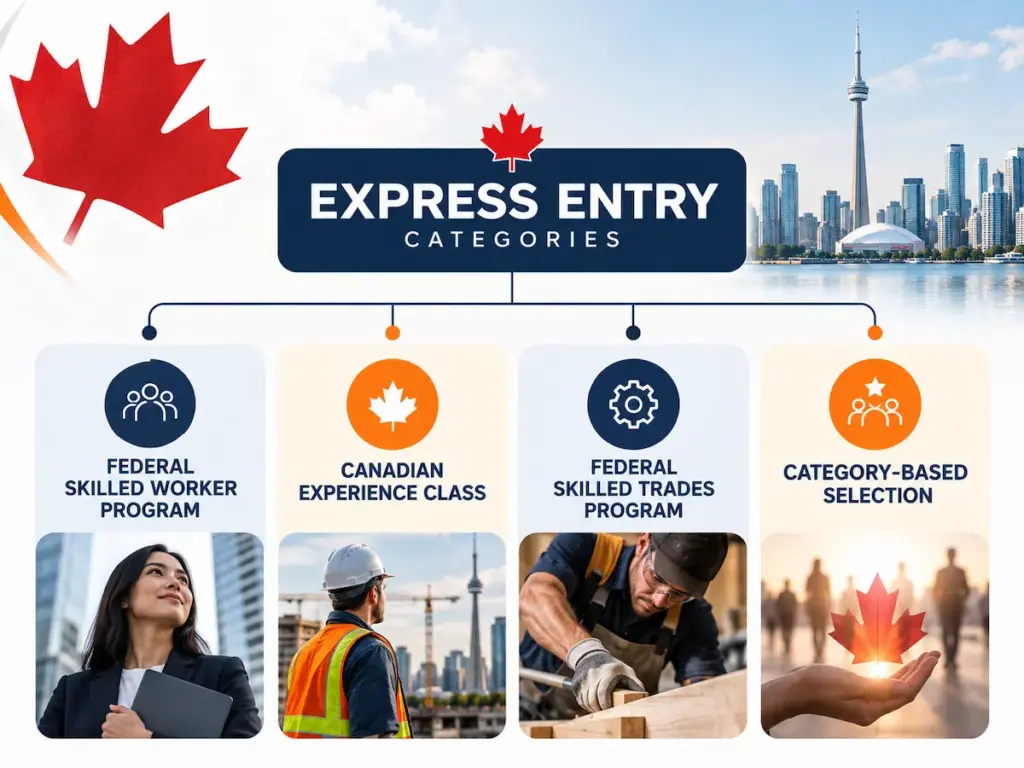
Express Entry manages applications for three federal economic immigration programs:
- Canadian Experience Class (CEC)
- Federal Skilled Worker Program (FSWP)
- Federal Skilled Trades Program (FSTP)
To participate in a category-based draw, you must first qualify for at least one of these programs and have an eligible Express Entry profile in the pool.
IRCC then identifies candidates who meet the requirements of a particular category. Those candidates are still ranked using their Comprehensive Ranking System (CRS) score, and the highest-ranking candidates in that category may receive an Invitation to Apply (ITA) for permanent residence.
Being eligible for a category does not guarantee an invitation.
Current Express Entry Categories for 2026
IRCC currently lists the following 10 categories.
| Express Entry Category | Main Requirement | Can Foreign Work Experience Qualify? |
|---|---|---|
| French-language proficiency | NCLC 7 in all four French abilities | Not an occupation-based category |
| Healthcare and social services | 12 months in an eligible occupation | Yes |
| STEM | 12 months in an eligible occupation | Yes |
| Trade occupations | 12 months in an eligible occupation | Yes |
| Education occupations | 12 months in an eligible occupation | Yes |
| Transport occupations | 12 months in an eligible occupation | Yes |
| Physicians with Canadian work experience | 12 months in an eligible physician occupation | No / Canadian experience required |
| Senior managers with Canadian work experience | 12 months in an eligible management occupation | No / Canadian experience required |
| Researchers with Canadian work experience | 12 months in an eligible research occupation | No / Canadian experience required |
| Skilled military recruits | Special military, employment and education requirements | Special rules apply |
This distinction is important for candidates applying from outside Canada. Five occupational categories currently accept qualifying experience gained either in Canada or abroad, while the physician, senior manager and researcher categories specifically require Canadian work experience.
What Changed in Express Entry Categories for 2026?
IRCC announced five categories as new for 2026:
- Physicians with Canadian work experience
- Researchers with Canadian work experience
- Senior managers with Canadian work experience
- Transport occupations
- Skilled military recruits
Canada also renewed:
- French-language proficiency
- Healthcare and social services
- Education
- STEM
- Trades
Agriculture and agri-food is not included in the current 2026 category list.
Another major change is the work experience requirement.
For the current occupation-based categories, candidates generally need at least 12 months of full-time work experience, or an equal amount of part-time experience, during the last three years. The qualifying experience does not need to be continuous.
For Healthcare, STEM, Trades, Education and Transport, this experience may be gained in Canada or abroad. For the separate physician, senior manager and researcher categories, the qualifying experience must have been gained in Canada.
Who Can Qualify for a Category-Based Express Entry Draw?
Meeting the requirements of a category is only one part of the process.
You must also be eligible for one of the three programs managed through Express Entry.
| Express Entry Program | General Profile |
|---|---|
| Canadian Experience Class | Skilled workers with eligible Canadian work experience |
| Federal Skilled Worker Program | Skilled workers with eligible Canadian or foreign work experience |
| Federal Skilled Trades Program | Workers qualified in eligible skilled trades |
For example, being a civil engineer listed under the STEM category does not automatically make you an Express Entry candidate. You must first qualify under CEC, FSWP or FSTP and enter the Express Entry pool.
Once you are in the pool, IRCC can identify your profile as eligible for a category-based round.
1. French-Language Proficiency Category
The French-language category works differently from the occupational categories because there is no special list of eligible professions.
To qualify for this category, your approved French-language test results must show a minimum NCLC level 7 in all four abilities:
- Speaking
- Listening
- Reading
- Writing
You must also meet the requirements of the particular invitation round and remain eligible under an Express Entry program.
This means your occupation does not need to appear in one of the occupational category tables simply because you want to qualify through the French-language category.
However, you still need to satisfy the requirements of CEC, FSWP or FSTP to enter the Express Entry pool.

2. Healthcare and Social Services Occupations
This is one of the largest Express Entry occupational categories.
You need at least 12 months of qualifying work experience within the last three years in one occupation on the current IRCC list. The experience can be full-time or an equivalent amount of part-time work, does not need to be continuous, and may have been gained in Canada or abroad.
Common examples include nurses, pharmacists, dentists, physiotherapists, psychologists, veterinarians and social workers.
Eligible Healthcare and Social Services NOC Codes
| Occupation | NOC 2021 | TEER |
|---|---|---|
| Specialists in clinical and laboratory medicine | 31100 | 1 |
| Specialists in surgery | 31101 | 1 |
| General practitioners and family physicians | 31102 | 1 |
| Veterinarians | 31103 | 1 |
| Dentists | 31110 | 1 |
| Optometrists | 31111 | 1 |
| Audiologists and speech-language pathologists | 31112 | 1 |
| Pharmacists | 31120 | 1 |
| Dietitians and nutritionists | 31121 | 1 |
| Psychologists | 31200 | 1 |
| Chiropractors | 31201 | 1 |
| Physiotherapists | 31202 | 1 |
| Occupational therapists | 31203 | 1 |
| Other professional occupations in health diagnosing and treating | 31209 | 1 |
| Nursing coordinators and supervisors | 31300 | 1 |
| Registered nurses and registered psychiatric nurses | 31301 | 1 |
| Nurse practitioners | 31302 | 1 |
| Physician assistants, midwives and allied health professionals | 31303 | 1 |
| Licensed practical nurses | 32101 | 2 |
| Paramedical occupations | 32102 | 2 |
| Respiratory therapists, clinical perfusionists and cardiopulmonary technologists | 32103 | 2 |
| Animal health technologists and veterinary technicians | 32104 | 2 |
| Other technical occupations in therapy and assessment | 32109 | 2 |
| Dental hygienists and dental therapists | 32111 | 2 |
| Medical laboratory technologists | 32120 | 2 |
| Medical radiation technologists | 32121 | 2 |
| Medical sonographers | 32122 | 2 |
| Cardiology technologists and electrophysiological diagnostic technologists | 32123 | 2 |
| Pharmacy technicians | 32124 | 2 |
| Other medical technologists and technicians | 32129 | 2 |
| Massage therapists | 32201 | 2 |
| Medical laboratory assistants and related technical occupations | 33101 | 3 |
| Nurse aides, orderlies and patient service associates | 33102 | 3 |
| Pharmacy technical assistants and pharmacy assistants | 33103 | 3 |
| Social workers | 41300 | 1 |
| Therapists in counselling and related specialized therapies | 41301 | 1 |
| Social and community service workers | 42201 | 2 |
Source: current IRCC category-based selection occupation table.
Example
Suppose you worked as a registered nurse outside Canada under NOC 31301 for two years.
Your foreign work experience can potentially satisfy the occupational requirement for the Healthcare and Social Services category because IRCC accepts qualifying experience from Canada or abroad.
You would still need to qualify for one of the Express Entry programs and meet the requirements of the specific invitation round.

3. STEM Occupations
STEM stands for Science, Technology, Engineering and Mathematics.
The current list is narrower than many older Express Entry STEM lists found online, so checking the latest government table is important.
To qualify, you need at least 12 months of eligible experience within the last three years in one occupation listed below. The experience does not need to be continuous and can be obtained in Canada or abroad.
Eligible STEM NOC Codes
| Occupation | NOC 2021 | TEER |
|---|---|---|
| Architecture and science managers | 20011 | 0 |
| Cybersecurity specialists | 21220 | 1 |
| Civil engineers | 21300 | 1 |
| Mechanical engineers | 21301 | 1 |
| Electrical and electronics engineers | 21310 | 1 |
| Industrial and manufacturing engineers | 21321 | 1 |
| Geological engineers | 21331 | 1 |
| Civil engineering technologists and technicians | 22300 | 2 |
| Mechanical engineering technologists and technicians | 22301 | 2 |
| Electrical and electronics engineering technologists and technicians | 22310 | 2 |
| Insurance agents and brokers | 63100 | 3 |
Source: current IRCC category-based selection occupation table.
Common Examples
A candidate may potentially fall under this category if their qualifying work experience matches occupations such as:
- Cybersecurity specialist
- Civil engineer
- Mechanical engineer
- Electrical engineer
- Industrial engineer
- Geological engineer
- Engineering technologist
Do not assume that every technology-related job is currently part of the STEM category. For example, the current 2026 list should be checked rather than relying on older lists that included a much wider range of software and IT occupations.

4. Trade Occupations
The Trades category covers a broad group of construction, industrial, mechanical and related skilled occupations.
To qualify, you need at least 12 months of work experience within the previous three years in one occupation listed by IRCC. The experience may be obtained in Canada or abroad and does not need to be continuous.
Eligible Trade Occupation NOC Codes
| Occupation | NOC 2021 | TEER |
|---|---|---|
| Construction estimators | 22303 | 2 |
| Construction managers | 70010 | 0 |
| Home building and renovation managers | 70011 | 0 |
| Machinists and machining and tooling inspectors | 72100 | 2 |
| Sheet metal workers | 72102 | 2 |
| Welders and related machine operators | 72106 | 2 |
| Electricians, except industrial and power system | 72200 | 2 |
| Industrial electricians | 72201 | 2 |
| Plumbers | 72300 | 2 |
| Gas fitters | 72302 | 2 |
| Carpenters | 72310 | 2 |
| Cabinetmakers | 72311 | 2 |
| Bricklayers | 72320 | 2 |
| Construction millwrights and industrial mechanics | 72400 | 2 |
| Heavy-duty equipment mechanics | 72401 | 2 |
| Heating, refrigeration and air conditioning mechanics | 72402 | 2 |
| Electrical mechanics | 72422 | 2 |
| Water well drillers | 72501 | 2 |
| Other technical trades and related occupations | 72999 | 2 |
| Concrete finishers | 73100 | 3 |
| Roofers and shinglers | 73110 | 3 |
| Painters and decorators, except interior decorators | 73112 | 3 |
| Floor covering installers | 73113 | 3 |
| Contractors and supervisors, oil and gas drilling and services | 82021 | 2 |
| Butchers – retail and wholesale | 63201 | 3 |
Source: current IRCC category-based selection occupation table.
Common Examples
This category can include workers such as:
- Electricians
- Plumbers
- Carpenters
- Welders
- Bricklayers
- HVAC mechanics
- Heavy-duty equipment mechanics
- Construction managers
- Construction estimators
Your exact job title is not enough to confirm your NOC. The duties you actually performed should match the main duties of the NOC you claim.

5. Education Occupations
The Education category covers several teaching, early childhood education and education-support occupations.
As with the other occupation-based categories, candidates need at least 12 months of eligible experience within the past three years. The experience can be gained inside or outside Canada and does not have to be continuous.
Eligible Education NOC Codes
| Occupation | NOC 2021 | TEER |
|---|---|---|
| Secondary school teachers | 41220 | 1 |
| Elementary school and kindergarten teachers | 41221 | 1 |
| Early childhood educators and assistants | 42202 | 2 |
| Instructors of persons with disabilities | 42203 | 2 |
| Elementary and secondary school teacher assistants | 43100 | 3 |
Source: current IRCC category-based selection occupation table.
Common Examples
Potentially eligible occupations include:
- High school teacher
- Elementary school teacher
- Kindergarten teacher
- Early childhood educator
- Early childhood assistant
- Teacher assistant
- Instructor of persons with disabilities
A teacher who has never worked in Canada may still potentially qualify under this category because foreign qualifying experience is accepted.

6. Transport Occupations
Transport is one of the categories announced for 2026.
An important point for candidates outside Canada is that this category does not require Canadian work experience. Qualifying experience may be obtained in Canada or abroad.
You need at least 12 months of experience during the previous three years in one eligible occupation, and the experience does not need to be continuous.
Eligible Transport NOC Codes
| Occupation | NOC 2021 | TEER |
|---|---|---|
| Aircraft mechanics and aircraft inspectors | 72404 | 2 |
| Air pilots, flight engineers and flying instructors | 72600 | 2 |
| Aircraft instrument, electrical and avionics mechanics, technicians and inspectors | 22313 | 2 |
| Automotive service technicians, truck and bus mechanics, and mechanical repairers | 72410 | 2 |
Source: current IRCC category-based selection occupation table.
Important: Transport Does Not Mean Every Transportation Job
The current Transport category is much narrower than its name may suggest.
For example, the current official list contains pilots, aircraft-related mechanics and inspectors, avionics occupations and automotive service technicians/mechanics.
You should not assume that working somewhere in the transportation or logistics industry automatically makes you eligible. Your actual occupation must match one of the current NOC codes.

7. Physicians With Canadian Work Experience
This is different from the broader Healthcare and Social Services category.
The separate Physicians with Canadian work experience category requires at least 12 months of qualifying work experience within the last three years in Canada.
The experience does not have to be continuous.
Eligible Physician NOC Codes
| Occupation | NOC 2021 | TEER |
|---|---|---|
| Specialists in clinical and laboratory medicine | 31100 | 1 |
| Specialists in surgery | 31101 | 1 |
| General practitioners and family physicians | 31102 | 1 |
Source: current IRCC category-based selection occupation table.
Healthcare Category vs Canadian Physician Category
A useful distinction is:
Broader Healthcare and Social Services category:
Eligible physician occupations can potentially use qualifying Canadian or foreign experience.
Physicians with Canadian work experience category:
Requires qualifying physician experience specifically gained in Canada.
A doctor may therefore need to consider which category requirements apply to a particular invitation round rather than treating the two categories as interchangeable.

8. Senior Managers With Canadian Work Experience
This new category focuses on senior managers who already have qualifying experience in Canada.
Candidates need at least 12 months of qualifying Canadian work experience during the previous three years in one occupation listed below. The experience does not have to be continuous.
Eligible Senior Manager NOC Codes
| Occupation | NOC 2021 | TEER |
|---|---|---|
| Senior managers – financial, communications and other business services | 00012 | 0 |
| Senior managers – health, education, social and community services and membership organizations | 00013 | 0 |
| Senior managers – trade, broadcasting and other services | 00014 | 0 |
| Senior managers – construction, transportation, production and utilities | 00015 | 0 |
Source: current IRCC category-based selection occupation table.
These NOCs can cover senior leadership positions across many industries.
However, having a title such as CEO, director, vice-president or general manager does not automatically place you in one of these NOCs. Your duties and level of responsibility need to match the relevant NOC classification.

9. Researchers With Canadian Work Experience
The Researchers category is also limited to qualifying work performed in Canada.
Candidates need at least 12 months of eligible Canadian experience within the last three years. The experience may be an equivalent combination of full-time or part-time work and does not need to be continuous.
Eligible Researcher NOC Codes
| Occupation | NOC 2021 | TEER |
|---|---|---|
| University professors and lecturers | 41200 | 1 |
| Post-secondary teaching and research assistants | 41201 | 1 |
Source: current IRCC category-based selection occupation table.
Examples may include qualifying work as:
- University professor
- University lecturer
- Post-secondary research assistant
- Teaching assistant
Again, the Canadian work experience requirement is central to this category.

10. Skilled Military Recruits
The Skilled Military Recruits category has a very different set of requirements from the other Express Entry categories.
A candidate must be a Foreign Skilled Military Applicant (FSMA) who is an eligible foreign national currently serving in a recognized foreign military.
IRCC also requires a minimum of 10 years of continuous military service and relevant work experience and training aligned with the duties of one or more specified Canadian Armed Forces NOCs.
Eligible Military NOC Codes
| Occupation | NOC 2021 | TEER |
|---|---|---|
| Commissioned officers of the Canadian Armed Forces | 40042 | 0 |
| Specialized members of the Canadian Armed Forces | 42102 | 2 |
| Operations members of the Canadian Armed Forces | 43204 | 3 |
Candidates must also have an arranged employment offer from the Canadian Armed Forces through the Canadian Forces Recruiting Group for continuous full-time work in Canada lasting at least three years in one of the eligible NOCs.
A minimum two-year post-secondary credential is also required. If the education was completed outside Canada, an educational credential assessment is required to show Canadian equivalency.

Can Foreign Work Experience Qualify for Express Entry Categories?
Yes, for several major categories.
This is one of the most useful distinctions for candidates who have never worked in Canada.
| Category | Foreign Experience | Canadian Experience |
|---|---|---|
| Healthcare and social services | Accepted | Accepted |
| STEM | Accepted | Accepted |
| Trades | Accepted | Accepted |
| Education | Accepted | Accepted |
| Transport | Accepted | Accepted |
| Physicians with Canadian work experience | Not enough for this category | Required |
| Senior managers with Canadian work experience | Not enough for this category | Required |
| Researchers with Canadian work experience | Not enough for this category | Required |
| French-language proficiency | Not an occupational experience category | Not specifically required by the category |
| Skilled military recruits | Special military requirements | Canadian Armed Forces job offer required |
For the first five occupational categories in this table, IRCC currently requires at least 12 months of qualifying work experience within the past three years in a single listed occupation.
How to Find the Correct NOC Code for Your Job
Finding an occupation with a similar job title is not enough.
Canada uses NOC 2021 to classify occupations based on training, education, experience and responsibilities.
IRCC specifically advises candidates to:
- Search for the occupation.
- Find the possible NOC code.
- Open that occupation in the official NOC system.
- Review its description and main duties.
- Make sure the main duties match what you actually did in your job.
If the duties do not match, IRCC advises finding a different NOC that better reflects your actual work.
Example
Someone whose company called them a “Software Project Manager” should not select a NOC simply because another occupation contains the word “software.”
The correct classification depends on what the person actually did: managing staff, developing software, analyzing systems, managing projects, or performing another set of duties.
The same rule applies to healthcare, engineering, trades, education and every other Express Entry category.
What Does TEER Mean?
TEER stands for: Training, Education, Experience and Responsibilities
Canada’s NOC 2021 system uses six TEER categories, from TEER 0 to TEER 5.
A simple way to understand the levels is:
| TEER | General Type of Occupation |
|---|---|
| 0 | Management occupations |
| 1 | Usually requires a university degree |
| 2 | Usually requires college education, longer apprenticeship training or supervisory experience |
| 3 | Usually requires college education, shorter apprenticeship training or significant on-the-job training |
| 4 | Usually requires secondary school or several weeks of on-the-job training |
| 5 | Usually requires short work demonstration and no formal education |
The TEER number itself does not determine whether you qualify for a category-based draw. What matters is whether your specific NOC appears in the current category list and whether you meet the other requirements.
Does a Category-Based Draw Replace the CRS Score?
No. CRS remains an important part of Express Entry.
IRCC first identifies candidates in the pool who meet the category requirements. It then ranks those candidates using their CRS scores and invites the highest-ranking candidates in that round.
So there are two separate questions:
1. Are you eligible for the category?
and
2. Is your CRS score competitive enough for the round?
A candidate may meet every occupational requirement but still not receive an ITA if their CRS score is below the cut-off for that particular round.
Are CRS Cut-Offs Lower in Category-Based Draws?
They can be, but there is no rule saying they must be.
The cut-off depends on factors such as:
- Which category IRCC targets
- How many invitations IRCC issues
- How many eligible candidates are in the pool
- The CRS scores of those candidates
This is why it is better to evaluate your actual profile rather than assume that qualifying for a category automatically makes a low CRS score competitive.
Do You Need a Job Offer for a Category-Based Express Entry Draw?
Not simply because you qualify for an occupational category.
Your underlying Express Entry program may have its own rules concerning job offers, and the Skilled Military Recruits category specifically requires arranged employment with the Canadian Armed Forces.
Another important change is that, since March 25, 2025, regular job offers no longer provide the previous 50 or 200 additional CRS points.
However, removing CRS points did not remove job-offer requirements where a valid offer is part of the eligibility rules of a particular immigration program.
Does My Occupation Need to Be My Primary Express Entry Occupation?
Not necessarily for category eligibility.
For the current occupation-based categories, IRCC states that the required experience can be in a single occupation listed in the relevant category table regardless of your primary occupation.
You still need to meet the separate requirements of the Express Entry program under which you qualify.
Example
Imagine a candidate has:
- Three years of work experience as a software professional, and
- More than 12 months of recent qualifying work as a cybersecurity specialist under NOC 21220.
Depending on the rest of the profile and the Express Entry program requirements, the candidate’s eligible cybersecurity experience may be relevant to the STEM category even if another occupation is used as the primary occupation in the Express Entry profile.
The exact profile should still be reviewed carefully because program eligibility and category eligibility are separate tests.
Which Categories Are Most Relevant if You Are Outside Canada?
For a person who has never worked in Canada, the occupational categories that currently allow foreign work experience are:
- Healthcare and social services
- STEM
- Trades
- Education
- Transport
The French-language proficiency category may also be available without Canadian work experience if the candidate meets the French threshold and qualifies for an Express Entry program.
By contrast, the separate categories for physicians, senior managers and researchers specifically require qualifying Canadian work experience.
This does not mean one category is automatically easier or better than another. Your CRS score, Express Entry program eligibility, NOC, language results, education and actual work history all affect the outcome.
Common Mistakes When Checking Express Entry Categories
Using an Old Occupation List
Express Entry categories can change.
A profession that appeared in an earlier year’s list may not appear in the current category. Always compare your NOC against the latest IRCC table.
Looking Only at Your Job Title
Two people with the same job title can perform very different duties.
The NOC should reflect your actual responsibilities, not simply the title printed on a business card or employment contract.
Assuming Category Eligibility Means Express Entry Eligibility
It does not.
You must first qualify for one of the three Express Entry programs.
Assuming Category Eligibility Guarantees an ITA
It does not.
Candidates who meet a category are still ranked by CRS.
Assuming All Categories Accept Foreign Experience
They do not.
The physician, senior manager and researcher categories specifically require qualifying Canadian work experience.
Using the Old Six-Month Work Experience Rule
Current occupational category rules generally require 12 months of qualifying experience during the previous three years.
Frequently Asked Questions About Express Entry Categories
IRCC currently lists 10 categories:
-French-language proficiency.
-Healthcare and social services.
-STEM.
-Trades.
-Education.
-Transport.
-Physicians with Canadian work experience.
-Senior managers with Canadian work experience.
-Researchers with Canadian work experience.
-Skilled military recruits.
IRCC announced five categories as new for 2026:
-Physicians with Canadian work experience.
-Researchers with Canadian work experience.
-Senior managers with Canadian work experience.
-Transport occupations.
-Skilled military recruits.
For the current Healthcare, STEM, Trades, Education and Transport categories, you generally need at least 12 months of full-time experience or an equal amount of part-time experience within the last three years in one eligible occupation.
The experience does not need to be continuous.
Yes, for Healthcare and Social Services, STEM, Trades, Education and Transport.
The physician, senior manager and researcher categories specifically require eligible experience obtained in Canada.
No.
The French-language category is based on French-language proficiency. The current category requirement is at least NCLC 7 in all four language abilities, together with the requirements of the applicable invitation round and underlying Express Entry program.
Do not assume so based on the word “STEM.”
The current 2026 IRCC STEM list must be checked by NOC. The present table is considerably narrower than some older STEM lists and does not list every technology occupation.
The current IRCC Transport table lists four NOCs: aircraft mechanics and inspectors, pilots/flight engineers/flying instructors, aircraft avionics-related mechanics and technicians, and automotive service technicians/truck and bus mechanics/mechanical repairers.
Transport truck drivers NOC 73300 are not on the current 2026 Transport category table.
Category eligibility itself is used to identify candidates for a targeted round. Candidates are then ranked by CRS.
It is not simply an automatic block of additional CRS points.
There is no fixed CRS score that guarantees an invitation.
A score of 450 may be sufficient in one round and insufficient in another. The answer depends on the category, the number of invitations and the CRS distribution of eligible candidates at the time.
Yes.
You must first qualify for one of the programs managed by Express Entry and be placed in the Express Entry pool. IRCC then identifies candidates in the pool who meet the category requirements.
Yes.
IRCC says categories are chosen using labour-market information, projections and input from provinces, territories and stakeholders. Categories are monitored and assessed regularly, and the government reports on category-based selection to Parliament.
Closing Note
The 2026 Express Entry categories create targeted opportunities for candidates whose French-language skills or work experience match Canada’s current immigration priorities.
But the first question should not simply be:
“Is my job on the list?”
A more useful sequence is:
1. Do I qualify for Express Entry?
2. What is my correct NOC based on my actual job duties?
3. Is that NOC included in a current category?
4. Do I have the required 12 months of recent qualifying experience?
5. Does the category accept foreign experience, or does it require Canadian experience?
6. What is my CRS score, and how competitive is it for the type of rounds IRCC is conducting?
For candidates outside Canada, Healthcare and Social Services, STEM, Trades, Education and Transport remain especially important because qualifying foreign work experience can be accepted. French-language proficiency also provides a separate category that is not tied to a specific occupation list.
For physicians, senior managers and researchers, however, the new 2026 categories place much greater importance on experience already gained in Canada.
Because occupation lists and category requirements can change, always verify your NOC and the latest IRCC category table before making an immigration plan.
Official Sources:
Government of Canada — Express Entry Category-Based Selection