Moving to Canada from India is possible through several immigration pathways, including Express Entry, Provincial Nominee Programs (PNPs), work permits, family sponsorship, study permits, and business immigration programs.
The right option depends on your age, education, work experience, language ability, family situation, occupation, and long-term plans.
Indian citizens should also understand an important distinction: being allowed to visit Canada is not the same as having permission to live, work, or study there. Indian passport holders are currently visa-required travellers to Canada. A Canadian work permit, study permit, or permanent resident status involves a separate immigration process.
This guide explains the main ways to move from India to Canada in 2026, the documents and funds you may need, and the practical steps involved.
Can Indian Citizens Move to Canada?
Yes. Indian citizens can apply for temporary or permanent immigration programs if they meet the requirements of the program they choose.
Your options generally fall into two groups:
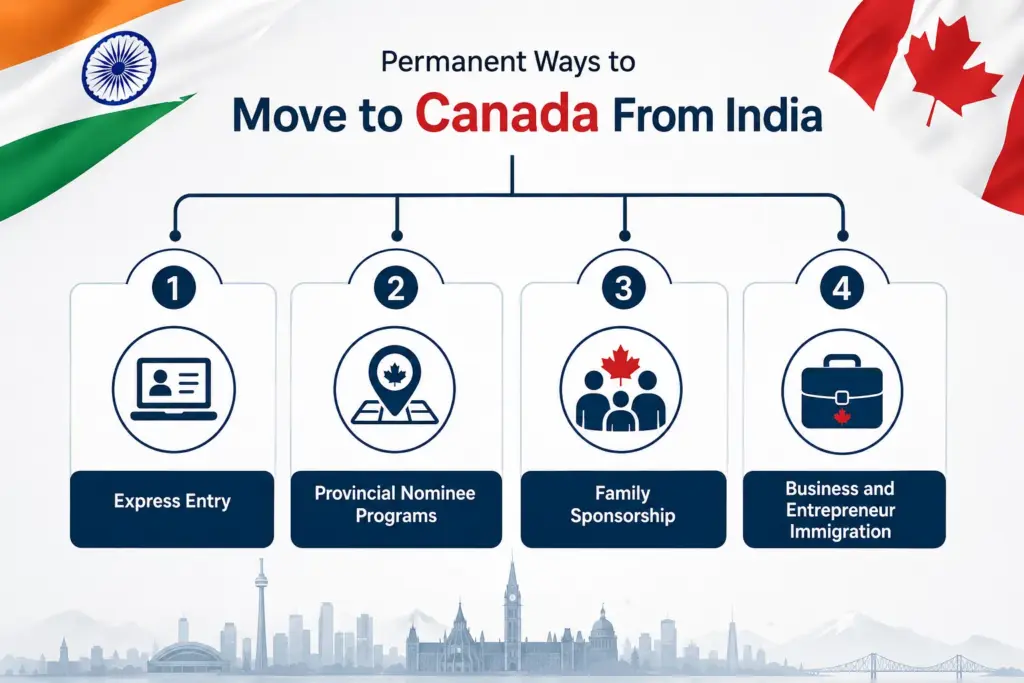
Permanent immigration pathways
- Express Entry
- Provincial Nominee Programs
- Family sponsorship
- Selected business and entrepreneur programs
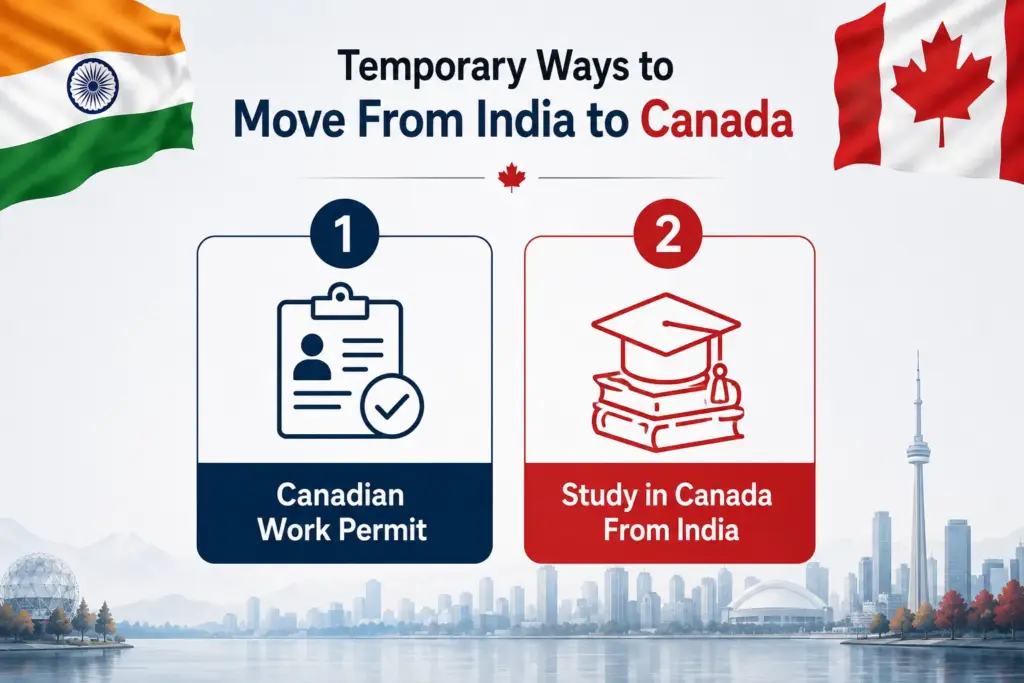
Temporary pathways
- Canadian work permits
- Study permits
- Temporary residence
Some people qualify directly for permanent residence. Others first move to Canada as a worker or student and may later become eligible for permanent residence.
A temporary permit does not guarantee permanent residence, so it is important to understand the long-term immigration potential of a pathway before applying.
Do Indian Citizens Need a Visa to Enter Canada?
Yes. India remains on Canada’s list of visa-required countries in 2026.
Indian passport holders normally need a valid Temporary Resident Visa (TRV) to visit or transit through Canada. This applies whether they arrive by air, land, or sea.
However, a visitor visa does not authorize you to work or study in Canada.
If you apply from India for your first Canadian work or study permit and your application is approved, IRCC normally issues the required travel visa as part of the process. You generally do not need to submit a separate visitor visa application.
Visitor Visa vs. Work Permit vs. Study Permit
| Document | What It Allows |
|---|---|
| Visitor Visa | Travel to Canada as a temporary visitor |
| Work Permit | Work in Canada under the conditions of your permit |
| Study Permit | Study at an eligible Canadian institution |
| Permanent Residence | Live and work in Canada permanently |
Having a visitor visa does not mean you can simply arrive in Canada and start working.
What Changed for Canada Immigration in 2026?
Canada continues to accept permanent residents in 2026, but immigration selection has become more targeted.
One of the most important changes is the way Canada uses category-based Express Entry draws.
For 2026, IRCC is prioritizing candidates in categories including:
- French-language proficiency
- Healthcare and social services
- STEM
- Trades
- Education
- Transport
- Physicians with Canadian work experience
- Researchers with Canadian work experience
- Senior managers with Canadian work experience
- Certain skilled military recruits
For several renewed occupation-based categories, applicants now need at least one year of eligible work experience within the previous three years.
Canada is also placing greater emphasis on candidates with Canadian work experience.
These changes can be particularly relevant to Indian professionals working in technology, engineering, healthcare, education, skilled trades, and transportation.
Which Immigration Path May Be Right for You?
| Your Situation | Pathway to Check First |
|---|---|
| Skilled professional living in India | Express Entry |
| Occupation targeted by a province | Provincial Nominee Program |
| Canadian employer wants to hire you | Work Permit |
| Spouse or partner is Canadian | Family Sponsorship |
| Want to study in Canada | Study Permit |
| Experienced entrepreneur or business owner | Provincial Business Programs |
| Already have Canadian work experience | Canadian Experience Class |
| Strong French ability | Express Entry French-language category |
There is no single immigration program that is best for every Indian applicant.
Your strongest option depends on your individual profile.
Permanent Ways to Move to Canada From India
1. Express Entry
Express Entry is one of Canada’s main systems for selecting skilled workers for permanent residence.
It manages three federal programs:
Federal Skilled Worker Program
The Federal Skilled Worker Program is usually the most relevant Express Entry program for skilled professionals applying directly from India.
Applicants are assessed based on factors such as:
- skilled work experience
- education
- English or French ability
- age
- adaptability
Applicants must first meet the Federal Skilled Worker eligibility requirements before entering the Express Entry pool.
Foreign education may also need an Educational Credential Assessment (ECA) to show how the qualification compares with a Canadian credential.
Canadian Experience Class
The Canadian Experience Class is mainly for people who have already gained qualifying skilled work experience in Canada.
This means it is usually more relevant to Indian nationals who first came to Canada as temporary workers or, in some cases, graduates who later obtained eligible Canadian work experience.
Federal Skilled Trades Program
This program is designed for people with qualifying experience in skilled trades.
Depending on your profile, Canadian trade certification or an eligible job offer may also be important.
How Express Entry Selection Works
Creating an Express Entry profile does not automatically result in permanent residence.
Eligible candidates enter a pool and receive a Comprehensive Ranking System (CRS) score.
The CRS considers factors such as:
- age
- education
- English or French ability
- Canadian and foreign work experience
- spouse factors
- provincial nomination
- certain additional qualifications
IRCC then holds invitation rounds and invites eligible candidates based on the type of draw and their ranking.
Why Occupation Matters More in 2026
Canada’s category-based selection system means some candidates may receive invitations through occupation-specific rounds.
For example, eligible experience in healthcare, STEM, trades, education, or transport may provide another opportunity beyond general Express Entry selection.
This does not remove the need to qualify for Express Entry. You must still be eligible for one of the Express Entry programs.
2. Provincial Nominee Programs
Canada’s provinces and territories operate their own immigration programs to select candidates who meet regional labour and economic needs.
A Provincial Nominee Program may be useful if:
- your occupation is in demand in a particular province
- you have a Canadian job offer
- you studied or worked in that province
- you have family or another connection to the province
- your CRS score is not strong enough for other Express Entry draws
- you qualify for a province-specific occupation stream
Some PNP streams are connected to Express Entry.
An Express Entry-aligned provincial nomination can add 600 CRS points, which can significantly improve your chances of receiving an invitation.
Other provincial streams operate outside Express Entry.
Requirements change frequently, so applicants from India should check the current provincial criteria before building an immigration strategy around a particular stream.
3. Family Sponsorship
If you have an eligible close family member in Canada, family sponsorship may provide a direct route to permanent residence.
Canadian citizens and permanent residents may be able to sponsor eligible:
- spouses
- common-law partners
- dependent children
Separate programs also exist for parents and grandparents, although intake rules for these programs are different and may not remain continuously open.
Family sponsorship is based on the relationship and the eligibility of both the sponsor and applicant. It is not a points-based program like Express Entry.
4. Business and Entrepreneur Immigration
Experienced Indian entrepreneurs and business owners may also have immigration options in Canada.
In 2026, it is particularly important to check whether a business immigration program is actually accepting new applications before making plans around it.
Provincial entrepreneur programs may consider factors such as:
- business ownership or senior management experience
- personal net worth
- proposed investment
- business plan
- job creation
- active management of the Canadian business
- intended province and community
Business immigration is not simply a matter of investing money in Canada. Most entrepreneur programs require the applicant to take an active role in operating the business.
Temporary Ways to Move From India to Canada
5. Canadian Work Permit
A Canadian work permit can allow an Indian citizen to work temporarily in Canada.
There are different types of work permits.
- Employer-Specific Work Permit
An employer-specific work permit allows you to work for a particular employer under specific conditions.
Depending on the immigration category, the employer may need a Labour Market Impact Assessment (LMIA) before the worker can apply.
However, not every Canadian work permit requires an LMIA.
The correct pathway depends on the employer, occupation, job, and the worker’s circumstances.
- Can You Move to Canada From India With a Job Offer?
Potentially, yes.
But a Canadian job offer is not automatically a work permit.
The employer and worker must determine which Canadian work authorization category applies.
Be especially careful with anyone selling a Canadian job offer or promising guaranteed immigration.
The Government of Canada specifically warns applicants in India about fake job offers, visa scams, and representatives who claim they can guarantee approval. No representative can guarantee a Canadian visa or permit.
- Can a Work Permit Lead to Permanent Residence?
Yes, in some situations.
Canadian work experience can later make you eligible or more competitive for programs such as:
- Canadian Experience Class
- Provincial Nominee Programs
- occupation-specific immigration streams
But a work permit itself does not guarantee permanent residence.
6. Study in Canada From India
Studying in Canada remains another pathway for Indian applicants, but Canada has significantly tightened the international student system.
For 2026, the federal target for new international student arrivals has been reduced to 155,000.
Students should therefore choose their school and program carefully.
Basic Study Permit Requirements
You will generally need:
- acceptance from a Designated Learning Institution
- a valid passport
- evidence of financial support
- supporting academic documents
- evidence that you meet temporary residence requirements
- other documents required for your application
Not every Canadian school or program provides the same post-graduation opportunities.
Before paying tuition, check:
- whether the institution is a DLI
- whether the particular program may qualify for a Post-Graduation Work Permit
- whether any field-of-study requirements apply
- whether the program makes sense for your academic and career history
How Much Money Does an Indian Student Need?
For study permit applications submitted on or after September 1, 2025, a single student studying outside Quebec must currently show at least CAD 22,895 for first-year living expenses, in addition to tuition and transportation costs.
The required amount increases when family members accompany you.
Canada updates these amounts periodically, so applicants should check the current requirement before submitting their application.
Can International Students Work in Canada?
Eligible international students can generally work up to 24 hours per week off campus during regular academic sessions, subject to the applicable study permit rules.
Working while studying can help with expenses, but students should not build their financial plan around part-time employment alone.
Can You Move to Canada From India Without a Job Offer?
Yes.
Several Canadian immigration pathways do not necessarily require a Canadian job offer.
The most important example is the Federal Skilled Worker Program under Express Entry.
You may also be eligible for:
- certain Provincial Nominee Programs
- family sponsorship
- study pathways
- selected entrepreneur programs
A job offer can still be useful in some immigration situations, but it is not a universal requirement for Canadian immigration.
Canada Immigration Statistics for Indian Applicants
India remains one of Canada’s most important source countries for immigration. In the latest IRCC annual reporting, 94,105 Indian citizens were admitted through economic immigration programs, while another 31,425 were admitted through family reunification.
Canada’s 2026 immigration plan also continues to place strong emphasis on economic immigration. The government has set a target of 380,000 permanent resident admissions in 2026, including 232,150 economic-class admissions.
| Canada Immigration Data | Latest Figure |
|---|---|
| 2026 permanent resident target | 380,000 |
| 2026 economic immigration target | 232,150 |
| Indian economic immigration admissions in latest IRCC annual report | 94,105 |
| Indian family reunification admissions in latest IRCC annual report | 31,425 |
| Canadian Experience Class target for 2026 | 109,000 |
| PR admissions recorded by Feb. 28, 2026 | 53,400 |
What this means for applicants from India: Canada is admitting fewer newcomers overall than during some earlier high-growth years, but economic immigration remains the largest part of the system. Skilled applicants should therefore focus less on simply “applying to Canada” and more on matching their occupation, language scores, Canadian experience, and provincial opportunities to current selection priorities.
How to Move From India to Canada: Step by Step
Step 1: Decide Whether You Want Temporary or Permanent Status
First determine your actual objective.
Do you want to:
- become a permanent resident directly?
- work temporarily in Canada?
- study first?
- reunite with family?
- operate a Canadian business?
The correct application depends on this decision.
Step 2: Compare Your Immigration Options
Review programs that match your:
- age
- education
- occupation
- work experience
- language ability
- available funds
- family situation
Do not choose a program simply because it is popular.
Step 3: Take an Approved Language Test if Required
Economic immigration programs commonly require approved English or French test results.
Your language results can have a major effect on your Express Entry CRS score.
Step 4: Get an Educational Credential Assessment if Required
If your education was completed in India, you may need an ECA for programs such as the Federal Skilled Worker Program or to receive CRS points for foreign education.
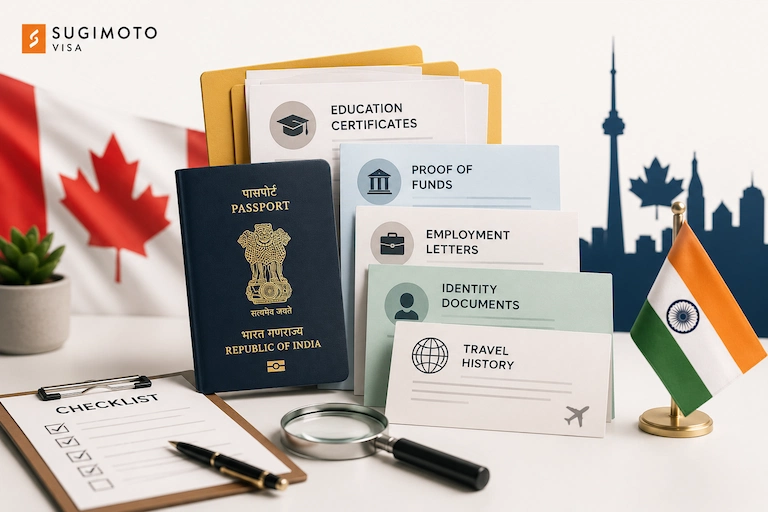
Step 5: Prepare Your Immigration Documents
Depending on the program, these may include:
- passport
- birth certificate
- marriage documents
- education records
- language test results
- ECA
- employment reference letters
- proof of funds
- police certificates
- medical examination
- provincial nomination
- Canadian job offer, where applicable
Step 6: Submit Your Profile or Application
Express Entry applicants first create a profile.
Other pathways may require a direct application to:
- IRCC
- a province
- or both
Step 7: Complete Biometrics
Most Indian applicants who need biometrics can provide fingerprints and a photo through Canadian Visa Application Centres.
As of August 2026, Canadian VAC locations in India include:
- Ahmedabad
- Bengaluru
- Chandigarh
- Chennai
- Hyderabad
- Jalandhar
- Kolkata
- Mumbai
- New Delhi
- Pune
Appointments are required for biometrics.
Step 8: Complete Medical and Police Requirements
IRCC may require a medical exam depending on your immigration program and circumstances.
Permanent residence applicants also generally need police certificates.
Step 9: Wait for the Immigration Decision
Processing times vary significantly by program, location, application volume, and complexity.
Use IRCC’s current processing-time tool rather than relying on old timelines found online.
Step 10: Prepare for Landing in Canada
After approval, start planning:
- housing
- travel
- banking
- employment
- health insurance
- schooling for children
- transportation
- required documents at the border
Important Documents for Indian Applicants
Indian Police Clearance Certificate
For Canadian permanent residence, Indian applicants may need an official Police Clearance Certificate (PCC).
IRCC states that an Indian PCC may be obtained through:
- a local district police station
- a passport office
- an Indian embassy or consulate
- a BLS International Centre
A Character Certificate is not accepted as a replacement for the required PCC. IRCC also warns that certificates covering only limited jurisdictions or periods may not be acceptable.
For Express Entry, adult applicants may need police certificates for countries where they lived for six consecutive months or more during the relevant period.
Employment Reference Letters
Indian applicants applying through skilled worker programs should make sure employment letters accurately describe:
- job title
- employment dates
- hours
- salary
- duties and responsibilities
For immigration purposes, your actual job duties can matter more than your internal company title.
Educational Documents
Degrees earned in India may require an ECA.
Your ECA does not simply confirm that you attended university. It determines the Canadian equivalency of your foreign educational credential for immigration purposes.
How Much Money Do You Need to Move to Canada From India?
The total depends heavily on the immigration pathway.
You should separate three different types of costs.
1. Immigration Costs
These can include:
- government processing fees
- biometrics
- language testing
- ECA
- police certificates
- medical exams
- provincial fees
- document translation where required
2. Proof of Funds
Federal Skilled Worker and Federal Skilled Trades applicants generally need settlement funds unless an exemption applies.
The current IRCC table lists:
| Family Members | Minimum Settlement Funds |
|---|---|
| 1 | CAD 15,263 |
| 2 | CAD 19,001 |
| 3 | CAD 23,360 |
| 4 | CAD 28,362 |
| 5 | CAD 32,168 |
| 6 | CAD 36,280 |
| 7 | CAD 40,392 |
Each additional family member requires an additional CAD 4,112 under the current table.
These funds must generally be available to you and cannot simply be borrowed for the purpose of satisfying the requirement.
3. Actual Moving and Settlement Costs
Proof of funds is not the same as your real relocation budget.
You may also need money for:
- airfare from India
- temporary accommodation
- rental deposit
- furniture
- winter clothing
- transportation
- phone and internet
- food
- childcare
- emergency expenses
Moving to Toronto or Vancouver can require a very different budget from settling in a smaller Canadian city.
Moving Money From India to Canada
Once you are preparing to relocate, you may need to transfer funds from Indian accounts to Canada.
Keep clear records showing:
- where the money came from
- account ownership
- transaction history
- transfer records
- supporting documents for significant deposits
This is particularly important if you are also using the money as immigration settlement funds.
When entering Canada, travellers carrying CAD 10,000 or more in currency or monetary instruments must declare it to the Canada Border Services Agency. Carrying more than CAD 10,000 is not prohibited, but failing to declare it can lead to penalties or seizure.
Healthcare After Moving to Canada
Canada has publicly funded provincial and territorial healthcare systems.
However, simply arriving from India does not mean you automatically receive public healthcare immediately.
Eligibility depends on:
- your immigration status
- the province or territory
- residency requirements
Some temporary residents may qualify while others may need private insurance.
Prescription drugs, dental treatment, and vision care are also not universally covered under basic provincial health plans.
Before travelling, check the health coverage rules for the province where you plan to live.
Working in Canada With Indian Qualifications
One important issue for newcomers is credential recognition.
An immigration approval does not automatically give you the right to practise every profession.
If you work in a regulated occupation, you may need provincial licensing or certification before you can work independently.
This can affect professions such as:
- medicine
- nursing
- engineering
- teaching
- accounting
- certain skilled trades
Research professional licensing separately from immigration eligibility.
You can qualify for Canadian immigration and still need additional steps before practising your profession.
Best Places in Canada for Indian Newcomers
There is no single best Canadian city for everyone. Choose based on employment, affordability, immigration opportunities, climate, and lifestyle.
Common destinations include:
Toronto and the Greater Toronto Area
Suitable for people looking for:
- large job markets
- finance
- technology
- professional services
- established Indian communities
The main disadvantage is the high cost of housing.
Vancouver and the Lower Mainland
Popular for:
- technology
- trade
- transportation
- milder weather
- access to the Pacific economy
Housing costs are among the highest in Canada.
Calgary
Can appeal to newcomers seeking:
- engineering
- energy
- technology
- skilled trades
- somewhat lower housing costs than Toronto or Vancouver
Edmonton
Offers employment across:
- healthcare
- construction
- education
- government
- industrial sectors
Ottawa
A strong option for:
- technology
- professional services
- government-related industries
- families
Smaller Canadian Cities
Smaller communities may offer:
- lower housing costs
- specific labour shortages
- regional immigration opportunities
But job markets are usually smaller, so research employment before choosing a destination.
What to Do After You Arrive in Canada
Your immigration process does not end at the airport.
During your first few weeks, you may need to:
- Apply for a Social Insurance Number: A SIN is generally required to work and access several government services.
- Open a Canadian Bank Account: Newcomer banking packages are available at several Canadian financial institutions.
- Apply for Provincial Health Coverage: Check eligibility immediately after arrival.
- Arrange Housing: Temporary accommodation can give you time to understand neighbourhoods before signing a long-term lease.
- Get a Canadian Phone Number: This is useful for employers, landlords, banks, and government services.
- Understand Your Driver’s Licence Options: Licence exchange and testing rules vary by province.
- Register Children for School: Public school administration is provincial, and registration procedures depend on where you live.
Avoid These Common Mistakes:
- Assuming a Visitor Visa Allows You to Work
A visitor visa does not normally give you permission to work in Canada. In most cases, you need separate authorization, such as a valid work permit. Before accepting any job or starting work, make sure your immigration status actually allows it. - Choosing a College Just Because Someone Says It Will Lead to PR
Be careful with promises such as “study here and you’ll get permanent residence.” No college or consultant can guarantee PR. Your study permit, eligibility for a Post-Graduation Work Permit (PGWP), Canadian work experience, and future PR eligibility are all separate matters and should be reviewed individually. - Paying for a Guaranteed Job Offer or Work Permit
A major warning sign is someone asking you to pay for a “guaranteed” Canadian job, LMIA, or work permit. Fake job offers and immigration scams can lead to financial loss and may also create serious problems for your immigration application. Always verify an offer before paying or submitting documents. - Focusing Only on Your Job Title Instead of Your NOC Duties
When determining your Canadian occupation classification, your actual job responsibilities matter more than the title printed on your business card or employment letter. Choosing the wrong NOC code can negatively affect an immigration application, so your duties should be compared carefully with the official classification. - Leaving Police Certificates Until the Last Minute
Police certificates from some countries can take several weeks or longer to obtain. If you are preparing for Express Entry or another permanent residence application, collecting required documents early can help you avoid unnecessary delays once you receive an invitation to apply. - Assuming Canadian Education Automatically Guarantees PR
Studying in Canada can create valuable opportunities, but it does not automatically lead to permanent residence. Immigration programs, eligibility requirements, CRS scores, provincial nomination criteria, and PGWP rules can change over time.
Before making an important decision, consider speaking with a licensed Canadian immigration professional who can review your education, work experience, NOC, study or work permit options, and potential PR pathways based on your individual situation. A personalized assessment is much safer than relying on promises from friends, agents, or social media.
Frequently Asked Questions
Yes, if you qualify for a Canadian permanent residence pathway such as Express Entry, a Provincial Nominee Program, family sponsorship, or another eligible immigration program.
There is no easiest pathway for everyone.
For a skilled professional with strong education, work experience, and language results, Express Entry may be a good starting point.
Someone with a Canadian spouse may have a stronger family sponsorship pathway, while a candidate with a Canadian employer may have work permit options.
Some Canadian immigration programs do not use IELTS specifically, but many economic immigration pathways require an approved English or French language test.
The accepted test depends on the program.
Yes.
A Canadian job offer is not required for every immigration program. Federal Skilled Worker applicants, for example, can potentially qualify without one.
Yes.
Express Entry does not exclude applicants based on Indian citizenship. Candidates must meet program requirements and compete within the applicable invitation system.
Canada’s 2026 Express Entry system continues to use general, program-specific, and category-based invitation rounds.
Canada’s 2026 Express Entry priorities include several categories connected to labour shortages, including healthcare and social services, STEM, trades, education, and transport.
However, being in an in-demand occupation does not automatically make you eligible for permanent residence.
For applicants who must provide settlement funds, the current minimum for one family member is CAD 15,263. The required amount increases with family size.
Actual relocation costs may be considerably higher.
Potentially.
Canadian study can sometimes be followed by a PGWP, Canadian work experience, and eligibility for programs such as the Canadian Experience Class or a PNP.
But studying in Canada does not guarantee permanent residence.
For applications submitted on or after September 1, 2025, a single applicant outside Quebec currently needs CAD 22,895 for living expenses, excluding tuition and transportation.
Canada currently lists VACs in Ahmedabad, Bengaluru, Chandigarh, Chennai, Hyderabad, Jalandhar, Kolkata, Mumbai, New Delhi, and Pune.
Yes. India is currently a visa-required country for Canada.
Often, yes, but their status and eligibility depend on the immigration program you use.
Permanent residence applications may include eligible accompanying family members. Temporary workers and students should separately check the current rules for spouses and dependent children because family work permit eligibility has changed in recent years.
Potentially.
Permanent residents who later meet Canada’s citizenship requirements may apply for Canadian citizenship.
Becoming a permanent resident is therefore often the main long-term goal for applicants who want to make Canada their permanent home.
Final Thoughts
Moving to Canada from India in 2026 remains possible, but the strongest pathway depends on your individual profile rather than your nationality alone.
For many skilled Indian professionals, Express Entry and Provincial Nominee Programs are the first permanent residence options worth checking. Others may have stronger opportunities through a Canadian employer, family sponsorship, study, or business immigration.
Before applying, confirm the latest requirements directly with IRCC because immigration programs, financial thresholds, occupation lists, provincial streams, and temporary residence rules can change during the year.