
A university in Toronto may have a stronger international reputation than an institution in a smaller Canadian city. But does that automatically make it the better choice for every international student?
Consider two applicants interested in studying computer science.
One wants a bachelor’s degree with structured opportunities to gain industry experience. The other already has a master’s degree and is looking for a university with researchers working on a particular area of artificial intelligence.
Both may initially consider the same highly ranked universities, but their priorities are different.
The undergraduate applicant may place greater importance on co-op education, curriculum, and tuition. The prospective doctoral student may care more about research supervision, laboratory resources, and funding.
Canada offers a diverse university system, with institutions varying in size, academic specialization, language of instruction, and research activity.
Studying in Canada should begin with choosing the right academic program and defining your educational goals, rather than focusing solely on a university’s position in international rankings.
For international students, there are additional considerations. Admission requirements vary according to previous education, while tuition fees, scholarships, campus locations, and immigration conditions can significantly affect the overall experience.
This guide explains how Canadian universities operate, how to verify their recognition, which institutions appear in current international rankings, and how to compare universities before applying.
How Many Universities Are There in Canada?
Note: University counts vary depending on institutional classification and the inclusion of private and specialized degree-granting institutions.
Degree-granting institutions can include universities, university colleges, certain colleges, polytechnics, specialized institutes, and other authorized educational institutions.
The distinction matters because not every institution authorized to award a bachelor’s degree is legally designated as a university.
Who Regulates Canadian Universities?
Education in Canada falls primarily under provincial and territorial jurisdiction.
There is no single federal ministry that establishes academic admission standards for every Canadian university.
Instead, provincial and territorial governments determine the legal frameworks under which institutions operate.
A university’s authority to award degrees generally comes from legislation or another recognized form of provincial authorization.
Universities typically retain significant autonomy over academic matters.
For example, a university may establish its own admission requirements, degree programs, academic calendars, and internal quality assurance procedures.
These arrangements operate within the relevant provincial regulatory system.
Are Canadian Universities Public or Private?
Canada has both public and private universities.
Public universities are generally established through provincial legislation and operate as publicly supported institutions.
Private universities operate under different legal and financial structures.
Some private universities offer specialized programs in fields such as business, liberal arts, or theology.
Others provide a wider range of academic qualifications.
However, public and private status should not be treated as a simple measure of academic quality.
The important considerations are whether the institution has the authority to award the proposed qualification, whether the program meets applicable academic or professional standards, and whether the education is appropriate for the student’s objectives.
For international applicants, immigration eligibility must also be evaluated separately.
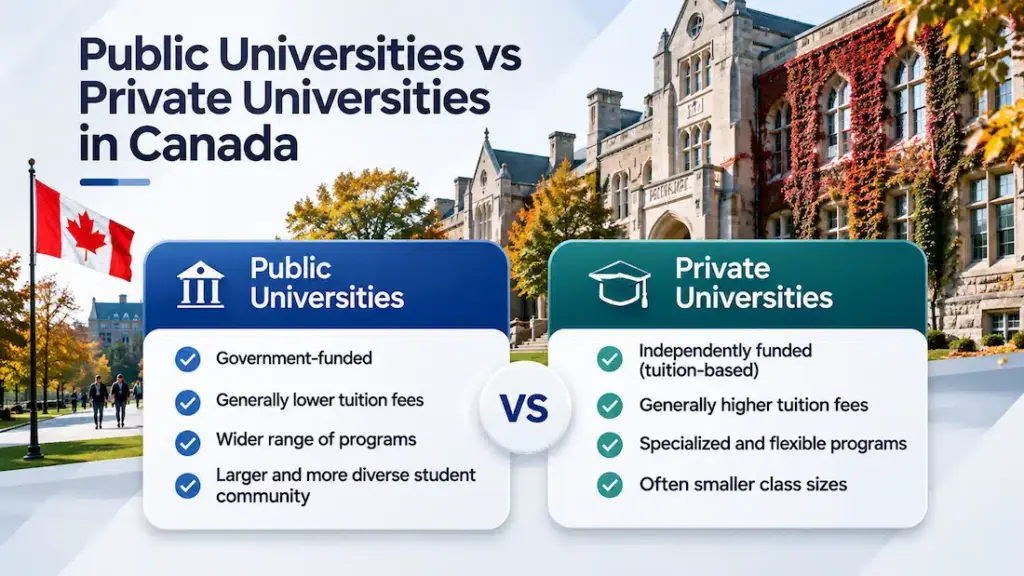
Public Universities vs Private Universities in Canada
Public universities account for much of Canada’s university education and research activity.
Many offer undergraduate, master’s, and doctoral programs across multiple academic disciplines.
Private universities may operate on a smaller scale or concentrate on particular areas of education.
However, institutional structures vary.
Comparing Public and Private Universities
| Feature | Public Universities | Private Universities |
|---|---|---|
| Legal status | Generally established through provincial legislation | Operate under applicable provincial authorization |
| Funding | Public support, tuition and other revenue | Tuition and other private or institutional funding sources |
| Degree programs | Often offer multiple undergraduate and graduate qualifications | Varies by institution and authorization |
| Research activity | Can include extensive research infrastructure | Depends on institution and academic specialization |
| Tuition | Varies by institution and program | Varies by institution and program |
| Academic recognition | Subject to applicable provincial frameworks | Subject to applicable provincial frameworks |
| PGWP eligibility | Must be verified | Must be verified; eligibility can be more restricted |
The table describes general differences rather than rules that apply identically to every institution.
A publicly funded university does not necessarily offer every academic discipline.
Likewise, a private institution should not automatically be described as unrecognized.
The actual legal authorization and academic programs must be examined.
Are Private University Degrees Recognized in Canada?
A degree issued by an appropriately authorized private institution can be a recognized Canadian academic qualification.
However, recognition depends on the institution’s legal status and the qualification awarded.
Prospective students should verify whether the institution has authority to grant the specific degree.
This is particularly important for specialized professional qualifications.
For example, an institution may be authorized to award a bachelor’s degree without necessarily offering an accredited professional engineering program.
Academic recognition and professional licensing requirements are separate matters.
How to Verify a University’s Recognition
The Canadian Information Centre for International Credentials provides information about recognized educational institutions and Canada’s academic credential system.
Provincial government directories are another important source.
For example, Ontario publishes an official list of its public universities.
Applicants can use these resources to verify whether an institution has the appropriate legal recognition.
However, institutional recognition should not be confused with Designated Learning Institution status.
A university’s authority to grant degrees and its authorization to host international students are related but separate questions.
Are Canadian Universities Accredited?
Canada’s university quality assurance system differs from the system used in some other countries.
There is no single national university accreditation agency responsible for accrediting every Canadian institution.
Instead, quality assurance operates through provincial and territorial legislation, institutional academic review processes, and external oversight mechanisms.
Universities Canada, an organization representing Canadian universities, explicitly states that it is not a national accreditation body.
Its membership should therefore not be confused with a government-issued accreditation certificate.
Institutional Recognition vs Program Accreditation
Two separate issues should be considered.
The first is whether the institution is legally recognized and authorized to award degrees.
The second is whether a particular academic program satisfies professional accreditation or licensing requirements.
For example, Engineers Canada accredits undergraduate engineering programs through the Canadian Engineering Accreditation Board.
The accreditation applies to individual engineering programs rather than to the university as a whole.
A university may therefore offer several accredited engineering programs alongside degrees that are not subject to the same professional accreditation process.
This does not make the other degrees academically invalid.
It means professional accreditation serves a different purpose.
Professional Programs Require Additional Verification
Students interested in regulated occupations should investigate the applicable professional requirements before selecting a university.
For example, engineering, nursing, medicine, architecture, and certain other professions have specific educational or licensing pathways.
The precise requirements depend on the occupation and jurisdiction.
A student intending to become a licensed professional engineer should investigate whether the intended engineering degree is accredited under the appropriate Canadian framework.
A student interested in nursing should examine the requirements established by the relevant provincial nursing regulator.
A university’s overall reputation does not replace verification of the specific professional program.

Best Universities in Canada: 2027 Rankings
International university rankings can provide a useful starting point when researching Canadian institutions.
However, rankings should be interpreted carefully.
Different ranking organizations use different methodologies.
Some place substantial weight on academic reputation and research output.
Others include employment-related indicators, international collaboration, or teaching resources.
For that reason, a university’s position can vary between ranking systems.
Top Universities in Canada According to THE 2027
The following table presents the highest-ranked Canadian universities in the Times Higher Education World University Rankings 2027, published in September 2026.
| Canada Rank | University | World Rank 2027 |
|---|---|---|
| 1 | University of Toronto | 22 |
| 2 | McGill University | 43 |
| 3 | University of British Columbia | 44 |
| 4 | McMaster University | =116 |
| 5 | University of Alberta | =118 |
| 6 | Université de Montréal | 132 |
| 7 | University of Waterloo | 178 |
| =8 | University of Calgary | =185 |
| =8 | University of Ottawa | =185 |
| 10 | Western University | =212 |
Source: Times Higher Education World University Rankings 2027, published September 2026. Rankings describe performance under THE’s methodology and should not be interpreted as a universal measure of program suitability.
These universities appear near the top of the Canadian rankings, but they do not represent every strong academic option in the country.
Institutions with lower overall rankings may offer excellent programs in particular disciplines.
Similarly, smaller universities may provide educational environments that suit students who prefer smaller academic communities.
What Do University Rankings Actually Measure?
The 2027 Times Higher Education methodology uses 17 performance indicators organized into five main categories:
- Teaching environment.
- Research environment.
- Research quality.
- International outlook.
- Industry engagement.
Research activity and reputation account for a substantial share of the overall score.
This is important because rankings are particularly useful for understanding a university’s research profile and institutional visibility.
However, they do not necessarily measure every factor that matters to an undergraduate student.
For example, a university’s overall research performance may provide limited information about the practical content of a specific undergraduate software development program.
Likewise, an institution’s global ranking does not directly establish whether an individual master’s student will receive research funding.
University Rankings vs Program Quality
Consider two hypothetical universities.
University A is ranked significantly higher internationally and has a large research output.
University B has a lower overall ranking but offers a specialized program with excellent facilities, relevant coursework, and strong connections to the student’s intended field.
For a prospective PhD student interested in a particular research laboratory, University A may be preferable if it has the appropriate supervisor and funding.
For an undergraduate applicant seeking a highly practical degree, University B might offer a better academic fit.
The ranking itself does not resolve the decision.
Students should investigate the specific department, curriculum, academic resources, and opportunities associated with their intended qualification.
Should You Only Apply to the Top 10 Universities?
Not necessarily.
Restricting applications to highly ranked universities can eliminate suitable programs from consideration.
For example, an international student may find a program at a university outside the top ten that offers a better combination of academic specialization, affordability, and location.
Another applicant may prefer a smaller campus or a university with a particular research group.
Highly ranked universities can be excellent options, but their international reputation should be one factor among several.
The appropriate shortlist depends on the student’s academic qualifications and priorities.
Universities in Canada by Province
Canadian universities are distributed across ten provinces, with post-secondary education also available in the territories.
The province and city can influence a student’s academic experience, living expenses, language environment, and access to particular industries.
However, universities within the same province can differ substantially.
The following overview introduces examples of universities across Canada.
Universities in Ontario
Ontario has a large university system offering programs across many academic disciplines.
Examples include:
- University of Toronto
- University of Waterloo
- McMaster University
- University of Ottawa
- Western University
- Queen’s University
- York University
- Toronto Metropolitan University
These institutions have different academic strengths, locations, and program structures.
For example, the University of Toronto operates three campuses in the Greater Toronto Area: St. George, Mississauga, and Scarborough.
Students can encounter different academic environments and program options depending on the campus.
The University of Waterloo is particularly well known for its co-operative education system.
However, applicants should examine the specific degree program rather than assuming every program at either institution has identical opportunities.
Universities in British Columbia
British Columbia offers several recognized universities.
Examples include:
- University of British Columbia
- Simon Fraser University
- University of Victoria
- University of Northern British Columbia
- Thompson Rivers University
These institutions operate in different geographic environments.
For example, UBC has major campuses in Vancouver and Kelowna.
Its Vancouver and Okanagan campuses offer different combinations of programs and student experiences.
Students applying to UBC must select the appropriate campus and degree options through the university’s application process.
The choice of campus can affect housing, transportation, and the academic programs available.
Universities in Alberta
Alberta’s university system includes institutions offering undergraduate, graduate, professional, and research education.
Examples include:
- University of Alberta
- University of Calgary
- University of Lethbridge
- MacEwan University
- Mount Royal University
- Athabasca University
The universities vary in institutional focus.
Some offer extensive doctoral research programs.
Others emphasize undergraduate education or provide distinctive delivery arrangements.
For example, Athabasca University specializes in open and online education.
However, international students interested in obtaining a Canadian study permit or PGWP should not assume that an online degree provides the same immigration opportunities as an eligible program completed in person in Canada.
The delivery model matters.
Universities in Quebec
Quebec has a distinct education system, and language is an especially important consideration.
Examples of universities include:
- McGill University
- Concordia University
- Université de Montréal
- Université Laval
- Université de Sherbrooke
- Université du Québec à Montréal (UQAM)
Quebec offers both English-language and French-language university education.
For example, McGill and Concordia are major English-language institutions in Montreal.
Université de Montréal and Université Laval primarily operate in French.
However, the language of an individual program should always be checked.
Some universities offer programs, courses, or research activities in more than one language.
International students should also consider Quebec’s separate immigration authorization requirements.
Universities in Atlantic Canada
Atlantic Canada includes Nova Scotia, New Brunswick, Prince Edward Island, and Newfoundland and Labrador.
Examples of universities include:
| Province | University Examples |
|---|---|
| Nova Scotia | Dalhousie University, Saint Mary’s University, Acadia University |
| New Brunswick | University of New Brunswick, Université de Moncton, Mount Allison University |
| Prince Edward Island | University of Prince Edward Island |
| Newfoundland and Labrador | Memorial University of Newfoundland |
These universities vary in size, academic programs, research activity, and language of instruction.
Atlantic Canada may appeal to students interested in studying outside Canada’s largest metropolitan areas.
However, living costs, transportation, tuition, and program availability must still be compared individually.
A university in Atlantic Canada should not automatically be assumed to be inexpensive.
Universities in Saskatchewan and Manitoba
The Prairie provinces also provide university options.
Examples include:
- University of Saskatchewan
- University of Regina
- University of Manitoba
- University of Winnipeg
- Brandon University
These universities offer different undergraduate and graduate programs.
Some have substantial research activities, while others may appeal to students seeking particular academic programs or campus environments.
Prospective students should compare institutional tuition schedules and local housing costs rather than relying only on provincial averages.

English-Language and French-Language Universities
Canada has two official languages: English and French.
However, the language of university instruction depends on the institution and academic program.
Many universities primarily teach in English.
Others primarily teach in French.
Some offer programs in both languages.
French-Language Universities
French-language universities offer undergraduate and graduate education in French.
Applicants may need to demonstrate proficiency in French according to the university’s requirements.
For example, an applicant interested in a French-taught master’s program should check the program’s specific language requirements.
Having previous education in English does not automatically establish eligibility for a French-language program.
English-Language Universities
English-language universities are available across Canada.
Applicants typically need to demonstrate English proficiency unless they qualify for an institutional exemption.
Universities may accept IELTS Academic, TOEFL, or other recognized evidence of proficiency.
The accepted tests and minimum scores vary.
There is no single English-language requirement covering all Canadian universities.
Bilingual Universities
The University of Ottawa provides an important example of bilingual university education.
It offers programs and academic opportunities in English and French.
However, bilingual institutional status does not mean every individual program can be completed in either language.
Students must verify the language of instruction of their intended degree.
A particular program may be available entirely in English, entirely in French, or through a defined bilingual structure.
University Admission Requirements for International Students
Canadian universities establish their own admission criteria.
Requirements vary by academic level, program, and the applicant’s previous education.
A high school graduate applying for a bachelor’s degree is assessed differently from a university graduate seeking admission to a research-based master’s or doctoral program.
Undergraduate Admissions
Most bachelor’s degree applicants need an appropriate secondary school qualification.
Universities may assess applicants according to country-specific requirements.
For example, universities can apply different academic standards to International Baccalaureate, A-Level, American high school, and national secondary school qualifications.
Some programs also require specific subjects.
Engineering applicants may need advanced mathematics and physics.
Certain science programs may require chemistry or biology.
Creative programs may request portfolios.
The academic prerequisites are established by the individual university and program.
Master’s Degree Admissions
Master’s programs normally require an appropriate bachelor’s degree or recognized equivalent.
However, admission requirements can vary considerably.
Some professional master’s programs emphasize previous employment or relevant professional experience.
Research-based master’s programs may place greater importance on academic preparation, research interests, and potential supervision.
The university may also establish minimum GPA and language requirements.
There is no national minimum GPA that guarantees admission to a Canadian master’s program.
PhD Admissions
Doctoral admissions usually place substantial emphasis on research preparation.
Applicants may need to demonstrate research experience, academic ability, and compatibility with the department’s research activities.
Some programs require a confirmed research supervisor before admission.
Others assess applicants through a centralized departmental process.
A master’s degree is commonly expected, but some universities offer direct-entry doctoral programs for exceptional bachelor’s graduates.
The rules depend on the program.
Can You Study at a Canadian University Without IELTS?
Potentially, yes.
IELTS Academic is widely accepted by Canadian universities, but it is not the only method of demonstrating English-language proficiency.
Some universities recognize alternative tests.
Others provide exemptions for applicants whose previous education satisfies particular requirements.
For example, UBC provides several ways for undergraduate applicants to satisfy its English-language admission standard.
These include specified educational backgrounds and approved language assessments.
However, an IELTS exemption should not be interpreted as automatic admission without any language requirement.
Language Requirements Are Program-Specific
Consider two universities offering master’s degrees in computer science.
One may accept a particular English-language test.
The other may require a different minimum score or apply different exemption criteria.
Even within one university, graduate departments may establish requirements above the institution’s general minimum.
Applicants should therefore check the actual program rather than relying on an article listing a universal IELTS score for Canada.
Admission Language Tests vs Immigration Language Tests
University language requirements and immigration language requirements are separate.
For example, IELTS Academic may be accepted for university admission.
However, graduates using IELTS to satisfy the language requirements for a Post-Graduation Work Permit generally need IELTS General Training.
The test accepted for admission does not necessarily satisfy the requirements of a later immigration application.

How to Apply to Universities in Canada
Canada does not have a single national application portal for every university.
Application systems vary by province, institution, and academic level.
Some universities participate in provincial application platforms.
Others receive applications through their own systems.
Applying to Universities in Ontario
The Ontario Universities’ Application Centre (OUAC) manages undergraduate applications for participating Ontario universities.
However, the universities make their own admission decisions.
For the 2027 application cycle, OUAC distinguishes between Group A and Group B applicants.
Most international students applying from outside Ontario fall within Group B.
For these applicants, there is no single general application deadline covering every university and program.
Students must check the deadlines published by their intended institutions.
Applying to Universities in British Columbia
Many British Columbia institutions use EducationPlannerBC for undergraduate applications.
For example, UBC uses this platform for most new undergraduate applicants.
The university’s 2027–2028 application cycle opened in October 2026.
Applicants must select their intended degree and campus and submit the required supporting information.
Some programs have supplemental requirements.
Graduate applications may use separate institutional systems.
Applying for Graduate Studies
Master’s and PhD applications often involve additional academic requirements.
These may include statements of purpose, academic references, CVs, research proposals, or evidence of previous research experience.
Some applicants may also need to contact prospective supervisors.
However, this is not mandatory for every graduate program.
Students should follow the specific department’s application procedure.
Admission and Scholarship Deadlines
Scholarship deadlines can differ from ordinary admission deadlines.
For example, a university may require undergraduate scholarship applicants to submit documents before the general admission deadline.
Research-based graduate programs may also have departmental funding deadlines.
Applicants should therefore distinguish between admission, scholarship, and supporting-document deadlines.
Receiving an admission offer does not automatically establish eligibility for a competitive scholarship.
University Tuition Fees in Canada
University tuition varies significantly according to academic level, institution, province, and discipline.
Statistics Canada’s 2026–2027 tuition survey provides national averages for full-time international degree students at publicly funded institutions.
| Academic Level | Average Annual International Tuition |
|---|---|
| Undergraduate | CAD 42,062 |
| Graduate | CAD 24,693 |
Source: Statistics Canada, Tuition and Living Accommodation Costs Survey, academic year 2026–2027.
These figures are weighted averages.
They do not represent the tuition charged by every Canadian university.
They also exclude accommodation, food, transportation, health insurance, and other living expenses.
Why Tuition Differs Between Universities
Universities establish different tuition schedules.
The amount may depend on the academic discipline, credential, number of courses, or student’s year of admission.
For example, an engineering degree may have a different tuition structure from an arts degree at the same institution.
Professional master’s programs may also charge different fees from research-based master’s programs.
Students should examine the published tuition for the actual academic program and intake.
Choosing a University in a Lower-Cost Province
Some provinces have substantially lower average university tuition than others.
According to Statistics Canada’s 2026–2027 provincial data, Ontario has the highest average international undergraduate tuition among the provinces covered.
Newfoundland and Labrador has the lowest provincial undergraduate average.
However, provincial averages are not sufficient to identify the least expensive institution.
A specialized program at one university may cost more than a comparable program in a province with a higher overall average.
Living expenses must also be considered.
Total Cost of Attendance
Consider two hypothetical universities.
University A
- Annual tuition: CAD 32,000
- Annual living expenses: CAD 24,000
- Estimated annual cost: CAD 56,000
University B
- Annual tuition: CAD 39,000
- Annual living expenses: CAD 16,000
- Estimated annual cost: CAD 55,000
Although University B charges higher tuition, the total annual estimate is slightly lower.
These calculations are illustrative, but they demonstrate why students should not compare tuition alone.
Program duration, scholarships, housing arrangements, and additional academic costs can all affect the final budget.
Scholarships and Financial Support at Canadian Universities
Canadian universities offer various forms of financial assistance.
However, availability depends on the student’s academic level and the institution.
Undergraduate scholarships often recognize academic achievement, leadership, or demonstrated financial need.
Graduate funding may involve scholarships, fellowships, research assistantships, and teaching assistantships.
Undergraduate Scholarships
Some universities offer entrance scholarships to exceptional international students.
For example, the University of Toronto’s Lester B. Pearson International Scholarship provides substantial support to selected undergraduate students.
UBC offers International Major Entrance Scholarships and other programs for eligible international applicants.
The University of Alberta also offers competitive international entrance awards.
However, application requirements differ.
Some awards are assessed automatically.
Others require a separate application or school nomination.
Students should not assume that every admission offer includes a scholarship.
Research-Based Master’s Funding
Research-based master’s programs may offer financial support through departments, supervisors, or institutional awards.
However, funding is not guaranteed for every program.
A course-based professional master’s may be self-funded even when a related research-based program at the same university provides financial assistance.
Students should verify the actual funding policy of their intended program.
PhD Funding
Some Canadian universities provide minimum funding commitments to eligible doctoral students.
For example, from September 2026, UBC Vancouver’s minimum funding package for eligible full-time PhD students is CAD 40,000 annually during the first four years.
The package can include scholarships and academic employment.
This should not be interpreted as a separate CAD 40,000 scholarship paid in addition to all other funding.
Other universities have different funding policies.
Applicants should examine the written funding terms before accepting admission.
Research Universities vs Teaching-Focused Universities
Canadian universities differ in the balance between research activity and undergraduate education.
Some institutions have extensive research laboratories, doctoral programs, and externally funded research projects.
Others place greater emphasis on undergraduate teaching or particular professional fields.
However, these categories are not absolute.
A research-intensive university may provide excellent undergraduate teaching.
A smaller university may also support meaningful research.
Research Opportunities for Graduate Students
For master’s and PhD applicants, the availability of appropriate research supervision can be more important than overall university rankings.
Consider a student interested in a highly specialized area of environmental science.
A department with relevant faculty members and funded projects may offer a stronger academic fit than a more highly ranked university without researchers working in that particular area.
Applicants should examine faculty profiles, recent publications, laboratories, and current research opportunities.
A university’s general research reputation does not guarantee that every professor has space or funding for new graduate students.
Research Opportunities for Undergraduates
Some universities offer undergraduate research programs, summer research positions, or opportunities to assist faculty members.
These experiences can be valuable for students considering graduate education.
However, undergraduate research opportunities are not guaranteed.
Availability depends on the department, funding, and eligibility criteria.
Students interested in research should investigate the actual opportunities available within their intended academic program.
Co-op Education and Career Opportunities
Some Canadian universities provide co-operative education programs that combine academic coursework with periods of professional employment.
These programs can help students develop practical experience.
However, they vary in structure.
Example: University of Waterloo
The University of Waterloo is well known for its co-op education system.
In several undergraduate programs, co-op education extends the typical degree duration.
For example, an undergraduate program that ordinarily takes four years may require approximately five years in its co-op format.
Students alternate between academic terms and work terms.
However, they generally need to apply and compete for individual employment opportunities.
A co-op program should not be treated as a guarantee of employment with a particular company.
Does a University Guarantee Employment After Graduation?
No.
University admission, graduation, and participation in co-op education do not guarantee a job.
Employers assess applicants according to their qualifications, skills, experience, language ability, and other relevant factors.
Some occupations also require professional registration.
Students should investigate the actual employment opportunities associated with their intended field.
University rankings alone cannot establish the employment outcome of an individual graduate.
Student Life and Campus Location
University selection also involves practical considerations.
A student’s experience may differ significantly between a large metropolitan campus and a smaller university community.
Housing, transportation, climate, access to services, and campus facilities can influence everyday life.
Universities in Major Cities
Universities in cities such as Toronto, Vancouver, Montreal, Calgary, and Ottawa offer access to large urban environments.
Students may find extensive public transportation networks, cultural activities, and employers operating across different industries.
However, housing costs and competition for accommodation can be significant.
The benefits of a large city should therefore be considered alongside the financial implications.
Universities in Smaller Cities
Universities in smaller Canadian communities may offer different living environments.
Some students prefer smaller campuses or shorter commuting distances.
However, the availability of housing, public transportation, and specialized employment opportunities varies.
A smaller city does not automatically mean low living costs or easier access to employment.
Students should research the actual community before making a decision.
Multi-Campus Universities
Some universities operate multiple campuses.
The academic programs and student services available can differ between campuses.
For example, the University of Toronto has campuses in downtown Toronto, Mississauga, and Scarborough.
UBC has major campuses in Vancouver and Kelowna.
Applicants should confirm which campus offers the intended degree.
Campus location can affect program options, tuition arrangements, housing, and transportation.
Study Permit Requirements for Canadian Universities
International students generally need a Canadian study permit to pursue longer university programs unless they qualify for a specific exemption.
Most applicants need a letter of acceptance from a Designated Learning Institution.
They must also satisfy the applicable financial, immigration, and admissibility requirements.
A university admission offer does not automatically guarantee study permit approval.
Designated Learning Institution Status
Students should verify that their intended university appears in IRCC’s official DLI directory.
The directory identifies institutions authorized to host international students.
However, DLI status does not automatically establish that every program qualifies for a Post-Graduation Work Permit.
The specific program must be checked separately.
PAL/TAL Requirements in 2026
Most new international students entering undergraduate university programs require a Provincial Attestation Letter or Territorial Attestation Letter unless they qualify for an exemption.
However, the rules are different for certain graduate students.
Since January 1, 2026, applicants entering eligible degree-granting master’s and doctoral programs at public DLIs are exempt from the PAL/TAL requirement.
This exemption does not automatically apply to graduate certificates or graduate diplomas.
Universities in Quebec and the CAQ
Quebec has a separate authorization process for international students.
Most students undertaking longer academic programs in Quebec need a Quebec Acceptance Certificate (CAQ), unless a specific exemption applies.
The federal PAL/TAL exemption for eligible graduate programs does not automatically remove Quebec’s CAQ requirement.
Students should assess both sets of requirements before applying.
Proof of Financial Support
Study permit applicants must demonstrate sufficient resources for tuition, living expenses, and transportation.
For regular applications submitted on or after September 1, 2026, IRCC’s annual living-expense requirement for one student outside Quebec is CAD 23,448.
This amount excludes tuition and transportation.
The financial threshold is not the same as the student’s actual cost of living.
Applicants should prepare a budget based on the university’s fees and their expected expenses.
Can University Students Work While Studying?
Eligible international students may work during their studies.
Under the current rules, qualifying study permit holders can generally work up to 24 hours per week off campus during regular academic sessions.
Different rules apply to eligible on-campus employment and scheduled academic breaks.
However, students must satisfy the relevant employment conditions.
For example, they generally need to be enrolled full-time in an eligible academic program and hold appropriate study authorization.
Students cannot begin working under the ordinary student employment provisions before their program starts.
Part-time work should not be treated as guaranteed financial support.
IRCC requires study permit applicants to demonstrate sufficient financial resources without relying on future employment in Canada.
PGWP Eligibility After Graduating From a Canadian University
Eligible graduates of Canadian universities may qualify for a Post-Graduation Work Permit.
However, the institution, academic program, and applicant must meet the applicable requirements.
Bachelor’s, Master’s and Doctoral Degrees
Graduates of eligible bachelor’s, master’s, and doctoral degree programs are exempt from the PGWP field-of-study requirement.
For example, an eligible Bachelor of Arts graduate does not need to demonstrate that the academic major appears on IRCC’s list of qualifying CIP codes.
However, the graduate must still satisfy the remaining PGWP conditions.
These can include language proficiency, full-time enrolment, and application deadlines.
Other University Credentials
Universities may also offer graduate certificates, graduate diplomas, and other non-degree programs.
These credentials are not automatically treated as bachelor’s or master’s degrees.
For some non-degree programs, the PGWP field-of-study requirement applies depending on the date of the student’s original study permit application.
Students should verify the credential’s official designation before assuming that a university program provides the same immigration opportunities as a degree program.
PGWP Is Not Permanent Residence
A PGWP provides temporary work authorization to eligible graduates.
It does not guarantee permanent residence.
Some graduates may use qualifying Canadian work experience to support an application under an economic immigration program.
However, eligibility depends on the requirements of the relevant program.
Completing a degree at a highly ranked Canadian university does not automatically provide an advantage that guarantees permanent residence.
How to Compare Universities Before Accepting an Offer
A useful university comparison should begin with the student’s intended academic outcome.
- For an undergraduate applicant, curriculum, admission requirements, costs, and co-op opportunities may be central considerations.
- For a research-based master’s applicant, supervision, department expertise, and funding may be more important.
- For a doctoral applicant, research compatibility and financial support can be decisive.
Comparing Three Hypothetical Universities
Consider an international student interested in graduate education in computer science.
The student receives offers from three institutions.
| Factor | University A | University B | University C |
|---|---|---|---|
| Overall ranking | Very high | High | Moderate |
| Program type | Course-based master’s | Thesis-based master’s | Thesis-based master’s |
| Research supervisor | Not required | Confirmed | To be assigned |
| Guaranteed funding | None | Available | Limited |
| Tuition | High | Moderate | Lower |
| Main advantage | Professional coursework | Research and funding | Lower tuition |
The table is hypothetical, but it illustrates an important principle.
University A may be the most appropriate choice for a professional seeking advanced coursework.
University B may be preferable for someone considering doctoral research.
University C could be suitable for an applicant whose academic interests and financial circumstances align with the program.
There is no universally correct choice.
The best option depends on what the student intends to accomplish.
Questions About Universities in Canada
Canada has over 300 public and private post-secondary institutions authorized to grant degrees, according to the Canadian Information Centre for International Credentials (CICIC). The Council of Ministers of Education, Canada (CMEC) specifically identifies 223 public and private universities across the country, alongside recognized degree-granting polytechnics and colleges.
According to major global academic evaluations such as the Times Higher Education World University Rankings, the University of Toronto is consistently ranked as the #1 university in Canada. Other top Canadian institutions include the University of British Columbia (UBC) and McGill University.
Yes. Degrees awarded by authorized public and accredited private Canadian universities are recognized globally for further academic study, employment, and professional credential evaluation. Quality assurance is maintained through strict provincial and territorial degree authorization frameworks.
No. While the vast majority of major research universities in Canada are public, Canada also has recognized private degree-granting institutions. Both public and private institutions must obtain legal authorization from their respective province to grant degrees.
Generally, yes—provinces like Newfoundland and Labrador, Manitoba, and Saskatchewan often feature lower average tuition and living costs than Ontario or British Columbia. However, tuition rates vary significantly by specific university, academic program, and degree level.
Not necessarily. Most Canadian universities accept alternative English language tests, including TOEFL iBT, PTE Academic, or the Duolingo English Test (DET). Additionally, applicants who completed 3 to 4 consecutive years of full-time education in an English-medium curriculum can often request a language waiver.
Most public universities offer merit-based entrance scholarships or academic excellence awards for international students. However, funding availability varies widely by institution, and admission does not automatically guarantee a scholarship.
No. While co-op work terms are widely popular in Canada, availability depends on the specific university and program of study. STEM and business faculties frequently feature co-op streams, whereas other disciplines may offer internships or traditional coursework models.
Graduating from an eligible degree program at a public university makes you eligible to apply for a PGWP of up to 3 years. University degree graduates (Bachelor’s, Master’s, PhD) remain exempt from field-of-study restrictions, though applicants must satisfy all general PGWP criteria including minimum language requirements (CLB 7).
No. A university degree does not automatically grant Permanent Residence. However, a Canadian degree awards maximum educational points in Express Entry and opens direct immigration pathways, including the Canadian Experience Class (CEC) and Provincial Nominee Programs (PNPs).
Choosing the Right University in Canada
Canada offers university education across a wide range of academic disciplines and institutional environments.
Some universities are internationally recognized for extensive research activity.
Others provide specialized professional programs, distinctive undergraduate experiences, or opportunities to study in smaller academic communities.
For international students, the right choice depends on more than institutional reputation.
A program’s curriculum, admission requirements, tuition, available funding, location, and academic recognition all deserve consideration.
The immigration implications should also be assessed before enrolment.
A university’s DLI designation does not automatically make every program PGWP-eligible, and graduation does not guarantee employment or permanent residence.
Sugimoto Visa assists prospective international students in understanding Canadian study permit requirements and evaluating the immigration implications of their educational plans.
If you are comparing Canadian universities, reviewing your academic qualifications, intended degree, budget, and immigration circumstances can help you make a more informed decision before accepting an admission offer.
Official Sources: