
The Canadian Experience Class, usually called CEC, is an Express Entry program for skilled workers who have already gained qualifying work experience in Canada.
The basic requirement sounds simple: one year of skilled Canadian work experience within the last three years.
But not every year spent working in Canada counts.
The job must be in NOC TEER 0, 1, 2 or 3, the work must have been paid and authorized, and you must have been physically working in Canada. Work completed while studying full-time normally does not count, and neither does regular self-employment.
CEC also has one important advantage over the Federal Skilled Worker Program: your qualifying Canadian experience can come from more than one job and more than one NOC.
As of October 1, 2026, CEC remains an active Express Entry program, and IRCC has already conducted 17 CEC-specific draws in 2026. The latest was held on September 29, when 2,000 candidates were invited at a CRS cut-off of 518.
Canadian Experience Class (CEC)
| Requirement | 2026 Rule |
|---|---|
| Canadian work experience | At least 1 year |
| Required hours | 1,560 hours |
| Experience period | Within the last 3 years |
| Eligible NOC levels | TEER 0, 1, 2 or 3 |
| Multiple jobs allowed | Yes |
| Multiple NOCs allowed | Yes |
| Experience must be paid | Yes |
| Work must be authorized | Yes |
| Must be physically in Canada | Yes |
| Student work | Generally does not count |
| Self-employment | Generally does not count |
| Job offer | Not required |
| Education | No minimum requirement |
| Settlement funds | Not required |
| Must plan to live outside Quebec | Yes |
| Language | CLB/NCLC 7 for TEER 0–1; CLB/NCLC 5 for TEER 2–3 |
IRCC confirms that CEC experience can come from one or more TEER 0–3 occupations, provided the other requirements are met.
One Year of Canadian Work
CEC requires at least one year of full-time skilled Canadian work or the equivalent in part-time work during the three years before the permanent residence application.
IRCC defines this as 1,560 hours.
A standard full-time calculation is: 30 hours per week × 52 weeks = 1,560 hours
You can also accumulate the requirement through part-time work or through more than one job.
The experience does not need to be continuous.
That makes CEC different from the Federal Skilled Worker Program, where the minimum qualifying year must be continuous.
Can You Work More Than 30 Hours a Week?
Working 40, 50 or 60 hours per week does not allow you to complete the CEC requirement in six or eight months.
IRCC counts up to 30 hours per week toward the full-time calculation.
Someone working 40 hours per week for nine months may have worked more than 1,560 actual hours, but that does not automatically create one year of qualifying CEC experience.
You still need the required period of qualifying work.
Can You Combine Different Jobs?
Yes. CEC does not require all 1,560 hours to come from one employer.
For example, you could potentially combine:
| Canadian Experience | NOC | Time |
|---|---|---|
| Marketing coordinator | Eligible TEER 0–3 NOC | 7 months |
| Administrative professional | Eligible TEER 0–3 NOC | 5 months |
If both jobs independently meet the CEC requirements, the experience can potentially be combined.
You can also combine qualifying part-time jobs. IRCC expressly allows experience from more than one job or NOC.
This is an important difference from Federal Skilled Worker Program (FSWP), where the minimum qualifying work experience is tied to one primary occupation.
Can You Combine Different NOCs?
Yes. Your CEC experience can come from more than one NOC, as long as each occupation being counted falls under TEER 0, 1, 2 or 3 and the work itself qualifies.
For example, someone could work several months in one skilled occupation and later change careers into another eligible skilled occupation.
This is particularly useful for international graduates whose first Canadian job may not remain their long-term career.
The NOC still needs to match the work actually performed. IRCC requires the candidate to have performed the actions in the NOC lead statement and most of the main duties.
Which NOCs Are Eligible?
CEC accepts Canadian work experience in:
| TEER | General Type |
|---|---|
| 0 | Management occupations |
| 1 | Professional occupations |
| 2 | Technical occupations and skilled trades |
| 3 | Technical, skilled and intermediate occupations |
Jobs classified as TEER 4 or TEER 5 do not satisfy the CEC skilled-work requirement.
The job title alone is not enough.
For every job being claimed, the duties should correspond to the chosen NOC, including the lead statement and most of the main duties.
Student Work Does Not Count
This is one of the most important CEC rules for international students.
Canadian work experience gained while you were studying full-time does not count toward the CEC minimum work-experience requirement. That includes co-op work terms.
For example, imagine a student who worked:
- 20 hours per week for two years while studying full-time
and then:
- 8 months full-time after graduation on a PGWP.
The student cannot simply combine the student work with the eight post-graduation months to claim the required CEC year.
The qualifying period generally starts with eligible work gained after the full-time studies have ended.
IRCC specifically tells recent international graduates that their CEC experience must be gained legally in Canada after graduation and that work performed while they were students cannot be included.
Returning to School After Gaining Canadian Work Experience
Re-enrolling in a post-secondary program does not erase or invalidate the Canadian work experience you have already completed.
For instance, if an applicant graduates, completes one year of eligible work experience, and subsequently returns to university, that initial year of work remains valid. As long as this experience was gained within the three-year window prior to submitting your Application for Permanent Residence, it continues to qualify under the Canadian Experience Class (CEC). This specific scenario is explicitly confirmed by Immigration, Refugees and Citizenship Canada (IRCC).
Please keep in mind that any work experience gained while registered as a full-time student cannot be counted toward the minimum requirement for the CEC stream.
Self-Employment
Regular self-employment does not count toward the minimum Canadian work-experience requirement for CEC.
That can affect people working as:
independent contractors, consultants, freelancers or business owners.
Simply receiving Canadian income or issuing invoices to a Canadian company does not automatically turn self-employed activity into qualifying CEC employment.
The actual employment relationship matters.
This becomes especially important where a worker is called an “independent contractor” but works almost entirely for one company. The immigration analysis should be based on the real employment arrangement, not only the wording used on an invoice or contract.
Exception for Physicians:
Some physicians are treated differently.
IRCC has a temporary public policy allowing certain foreign national physicians providing publicly funded medical services in Canada, including some fee-for-service physicians, to count qualifying self-employed medical work as Canadian experience.
This is a specific physician exception.
It should not be interpreted as a general self-employment exemption for consultants, IT contractors, business owners or other professionals.
Read More: Physicians with Canadian Work Experience Express Entry →
Does Remote Work Qualify as Canadian Work Experience?
Remote work can be counted as Canadian experience under certain conditions. To qualify, you must have been physically present in Canada while performing the work and directly employed by a Canadian employer.
Work performed remotely while residing outside of Canada, or for an entity based outside the country without a Canadian payroll presence, will generally not qualify under the Canadian Experience Class (CEC).
For example:
| Situation | CEC Canadian Experience? |
|---|---|
| Living in Toronto, working remotely for Canadian employer | Potentially yes |
| Living in Vancouver, working remotely for Canadian employer | Potentially yes |
| Living in Iran, remotely working for Toronto employer | No |
| Living in Europe, paid in CAD by Canadian employer | No |
A Canadian employer, Canadian payroll or Canadian salary is not enough if you performed the work while physically outside Canada.
Authorized Work
The Canadian experience must have been gained while you were authorized to work in Canada under temporary resident status.
Unauthorized employment cannot be used to meet the CEC requirement.
The work should also have been paid through wages or commission. Volunteer work and unpaid internships do not count.
This makes work authorization an important part of the evidence review-not simply the employer letter.
Language Requirements
CEC has two minimum language thresholds.
| NOC TEER | English | French |
|---|---|---|
| TEER 0 or 1 | CLB 7 | NCLC 7 |
| TEER 2 or 3 | CLB 5 | NCLC 5 |
The minimum must be met in all four abilities: speaking, listening, reading and writing.
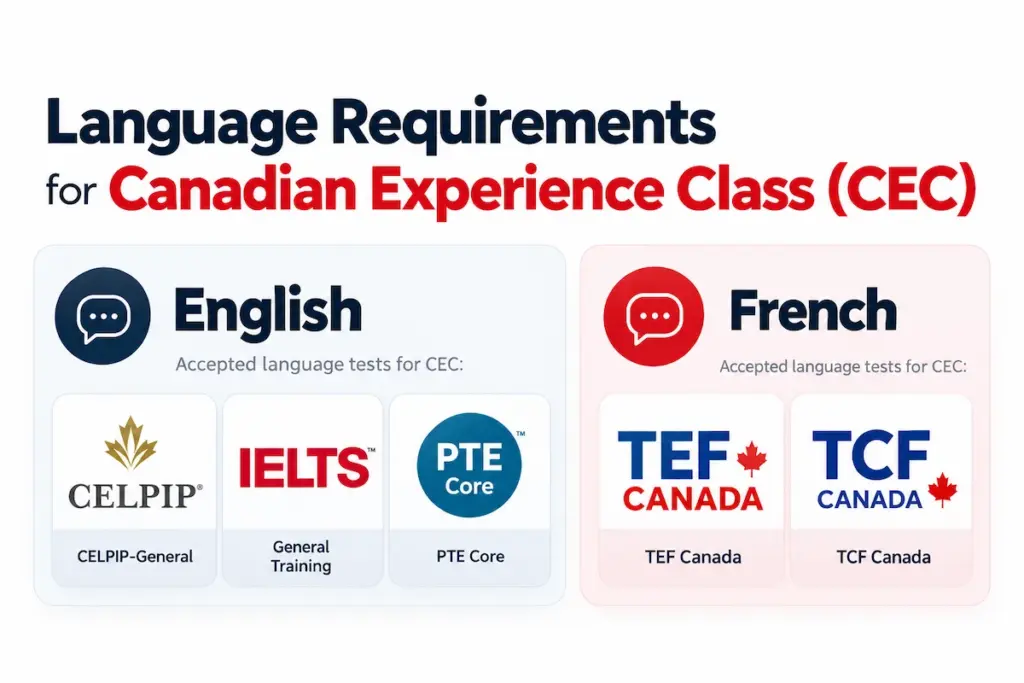
IRCC currently accepts:
- English: CELPIP-General, IELTS General Training and PTE Core.
- French: TEF Canada and TCF Canada.
IELTS Academic is not the Express Entry test option, and IRCC currently does not accept IELTS One Skill Retake for Express Entry.
IELTS Scores for CEC
For TEER 0 and TEER 1, the CEC minimum is CLB 7:
| IELTS General | Minimum |
|---|---|
| Speaking | 6.0 |
| Listening | 6.0 |
| Reading | 6.0 |
| Writing | 6.0 |
For TEER 2 and TEER 3, the minimum is CLB 5:
| IELTS General | Minimum |
|---|---|
| Speaking | 5.0 |
| Listening | 5.0 |
| Reading | 4.0 |
| Writing | 5.0 |
These are minimum eligibility scores, not necessarily competitive CRS scores.
A candidate can meet CEC eligibility at the minimum language level and still have a CRS score too low to receive an invitation.
PTE Core Scores
For a TEER 0 or 1 occupation, CLB 7 corresponds to:
| Ability | PTE Core |
|---|---|
| Speaking | 68–75 |
| Listening | 60–70 |
| Reading | 60–68 |
| Writing | 69–78 |
For a TEER 2 or 3 occupation, CLB 5 corresponds to:
| Ability | PTE Core |
|---|---|
| Speaking | 51–58 |
| Listening | 39–49 |
| Reading | 42–50 |
| Writing | 51–59 |
Language Tests Expire
Express Entry language results must be less than 2 years old both when you complete the profile and when you submit the permanent residence application.
If your test expires after you receive an ITA but before you submit the PR application, that can create a serious problem.
IRCC warns that an application submitted with expired language results can be refused.
Education Requirements for CEC
The Canadian Experience Class (CEC) does not mandate a minimum level of education, meaning an applicant can satisfy the program’s basic eligibility criteria without holding a post-secondary degree.
However, education remains a critical factor under the Comprehensive Ranking System (CRS). Completing a Canadian credential provides valuable points, and foreign qualifications can also enhance your score if supported by an Educational Credential Assessment (ECA).
In short, while education is not a strict prerequisite to qualify for the CEC, it often plays a decisive role in achieving a competitive CRS score and securing an Invitation to Apply (ITA).
Do You Need a Job Offer?
No. A Canadian job offer is not required to qualify for the Canadian Experience Class.
You also do not have to remain with the employer whose work experience made you eligible.
IRCC confirms that recent graduates do not even need to be working at the time they apply, provided the qualifying experience is still within the three-year window.
Also remember that Canada removed the previous additional CRS points for arranged employment in March 2025.
A job offer may still matter for work authorization or another immigration pathway, but it is not a CEC minimum requirement.
Do You Need Settlement Funds?
No.
Applicants invited under the Canadian Experience Class are exempt from the Express Entry proof-of-funds requirement.
The Express Entry system may still ask for a proof-of-funds document during the application process.
IRCC instructs CEC applicants who do not need settlement funds to upload a letter explaining that they were invited under the Canadian Experience Class.
This is different from the Federal Skilled Worker Program, where settlement funds may be required unless an exemption applies.
What About Quebec?
Work experience gained in Quebec can count toward CEC.
However, CEC applicants must intend to live outside Quebec because Quebec selects its own skilled workers (RSWP).
For example, someone who worked in Montreal for two years can potentially use that experience for CEC and later plan to settle in Ontario, Alberta or another province.
IRCC states that applicants using Quebec work experience (PEQ) must provide evidence that they do not plan to settle in Quebec.
The problem is therefore not where the Canadian work was performed.
The issue is the applicant’s intended destination after permanent residence.

CEC vs. FSWP
The two programs overlap, but their work-experience rules are quite different.
| Requirement | CEC | FSWP |
|---|---|---|
| Canadian experience required | Yes | No |
| Minimum experience | 1 year | 1 year |
| Experience window | Last 3 years | Last 10 years |
| Must be continuous | No | Yes, for minimum qualifying year |
| Multiple NOCs for minimum experience | Yes | Minimum year tied to primary occupation |
| Student work | Does not count | Can count if requirements are met |
| Minimum language | CLB 7 or 5 depending on TEER | CLB 7 |
| Education required | No | Secondary education |
| Job offer required | No | No |
| Proof of funds | No | Usually yes unless exempt |
This distinction matters especially for international students and workers with both foreign and Canadian experience.
A person may qualify for both programs at the same time.
CEC and Category-Based Draws
CEC eligibility can also combine with one of the current Express Entry categories.
For example, a CEC candidate may independently qualify for:
French-language proficiency, Healthcare and Social Services, STEM, Trades, Education or Transport.
Some candidates with specific Canadian experience can also qualify for the newer categories for:
Physicians, Senior Managers or Researchers with Canadian Work Experience.
Category-based selection does not replace CEC.
A candidate first qualifies for an Express Entry program such as CEC and may then also be identified as eligible for one or more categories.
This can create more than one possible route to an ITA.
Read More: Express Entry Categories →
Canadian Experience Class Draw
CEC has been one of the most frequently used Express Entry round types in 2026.
As of September 29, 2026, IRCC had conducted 17 CEC-specific rounds and issued 55,250 invitations. CRS cut-offs ranged from 507 to 523.
| Date | ITAs | CRS |
|---|---|---|
| January 7 | 8,000 | 511 |
| January 21 | 6,000 | 509 |
| February 17 | 6,000 | 508 |
| March 3 | 4,000 | 508 |
| March 17 | 4,000 | 507 |
| March 31 | 2,250 | 509 |
| April 14 | 2,000 | 515 |
| April 28 | 2,000 | 514 |
| May 27 | 3,000 | 518 |
| June 23 | 4,000 | 516 |
| July 7 | 2,000 | 517 |
| July 21 | 2,000 | 516 |
| August 5 | 3,000 | 516 |
| August 18 | 1,000 | 523 |
| September 1 | 2,000 | 521 |
| September 15 | 2,000 | 519 |
| September 29 | 2,000 | 518 |
The September 29 round was Express Entry round #446. Candidates needed CRS 518, with a tie-breaking timestamp of February 13, 2026 at 20:48:08 UTC.
Understanding Competitive CRS Scores for CEC
There is no fixed Comprehensive Ranking System (CRS) score needed to apply for the Canadian Experience Class (CEC). Meeting the basic eligibility requirements allows an applicant to enter the Express Entry pool, but the CRS score determines whether a profile is strong enough to receive an Invitation to Apply (ITA) during a selection round.
Throughout 2026, CRS cutoff scores for CEC-specific draws have fluctuated between 507 and 523. The lowest cutoff recorded this year was 507 on March 17, while the highest reached 523 on August 18.
Recent trends show a gradual decline across the latest draws, moving from 521 on September 1, to 519 on September 15, and reaching 518 on September 29. While this downward trend provides helpful insight into current pool dynamics, past draw results do not guarantee that future cutoffs will continue to drop.
Understanding the Distinction Between CEC Eligibility and Receiving an ITA
It is crucial to distinguish between being eligible for the Canadian Experience Class (CEC) and actually receiving an Invitation to Apply (ITA).
Consider a candidate who meets all fundamental criteria: one year of qualifying Canadian work experience, the required language test results, and an eligible NOC code. While this candidate is fully eligible to enter the Express Entry pool under the CEC stream, eligibility alone does not guarantee selection.
For instance, if a candidate has a Comprehensive Ranking System (CRS) score of 470, but the latest CEC draw cutoff stands at 518, they will not receive an invitation in that round.
Simply put, CEC eligibility determines whether a candidate can enter the pool, whereas the CRS score determines whether their profile ranks high enough relative to other applicants to secure an ITA. Meeting the basic program criteria is merely the first step in the process.
Foreign Experience Still Matters
CEC requires Canadian experience for eligibility, but foreign skilled experience can still strengthen an Express Entry profile.
Someone with one year of Canadian skilled work plus qualifying foreign skilled experience may gain additional CRS skill-transferability points, depending on language, education and the rest of the profile.
This is one reason candidates should not remove legitimate foreign employment simply because they are applying through CEC.
The Canadian year establishes CEC eligibility.
The rest of the career can still affect CRS.
Is CEC Being Replaced?
There is an important future policy development to watch.
IRCC’s 2026–2028 Forward Regulatory Plan says the government intends to propose amendments that would create a new streamlined federal high-skilled immigration class and repeal the existing:
Federal Skilled Worker Class, Canadian Experience Class and Federal Skilled Trades Class.
As of October 1, 2026, this is a proposed regulatory initiative, not the current law.
CEC is still active, IRCC continues to publish CEC eligibility rules, and CEC draws were still being conducted at the end of September 2026.
Candidates should therefore apply the current CEC rules unless and until IRCC formally implements a replacement framework.
Proving Your Work Experience
The employer reference or experience letter is one of the central pieces of evidence for Canadian work experience. IRCC lists proof of work experience, such as employer reference or experience letters, among the Express Entry documents candidates may need.
The evidence should make it possible to verify the period of employment, hours, position and actual duties.
Documents such as pay records and Canadian tax records may also help support the work history where appropriate.
The biggest mistake is treating the job title as sufficient evidence.
A title such as “software engineer,” “manager,” “technician” or “analyst” does not establish the NOC by itself.
The duties need to support the NOC being claimed.
Parallel Express Entry Routes for CEC Candidates
A CEC candidate should not focus solely on CEC-specific draws. Beyond general rounds, IRCC actively conducts Category-Based Selection tailored to specific occupations and skills. This means a single Express Entry profile can frequently qualify for multiple invitation rounds simultaneously.
Healthcare & Social Services
Candidates with eligible experience in healthcare or social assistance can qualify for targeted, lower-CRS rounds in these critical sectors.
STEM Occupations
Cybersecurity specialists, software developers, and engineers may tap into dedicated selection draws for tech and science professionals.
Skilled Trades
Qualified tradespeople with practical expertise gain access to dedicated trade-focused invitation rounds across Canada.
French-Language Proficiency
Demonstrating NCLC 7 across all four skills opens up one of the most consistent and prioritized streams in Express Entry.
In-Canada Physicians
Medical practitioners with Canadian clinical experience gain access to specialized pathway incentives and tailored draws.
Senior Managers
Executive and senior management professionals leverage Canadian corporate experience for targeted selection pools.
Researchers & Academics
In-Canada research, post-doctoral, and academic work history opens specialized avenues for scientific contributors.
Frequently Asked Questions
At least one year or 1,560 hours of qualifying Canadian work experience within the three years before you apply.
No. Unlike the FSWP minimum qualifying year, CEC experience does not need to be continuous.
Yes. Qualifying experience can come from more than one job.
Yes. CEC permits eligible experience across more than one TEER 0–3 NOC.
Not if you were studying full-time. Co-op work also does not count toward the CEC minimum.
Qualifying work gained legally in Canada after graduation can count if it meets the CEC requirements, including the NOC, duties and paid-work rules.
Only if you were physically in Canada and working for a Canadian employer.
Self-employed work generally does not count toward the CEC minimum. A specific exception exists for some physicians providing publicly funded medical services.
No.
No. CEC has no minimum education requirement.
Not if you are applying under CEC.
Yes. You must still demonstrate that you intend to settle outside Quebec.
For TEER 0 and 1, the minimum is IELTS General 6.0 in each skill. For TEER 2 and 3, the CLB 5 minimum corresponds to Speaking 5.0, Listening 5.0, Reading 4.0 and Writing 5.0.
On September 29, 2026, IRCC issued 2,000 invitations at a CRS cut-off of 518.
So far, 507, recorded on March 17, 2026.
Not currently. IRCC has proposed future regulatory reforms that could replace CEC, FSWP and FSTP with a new federal high-skilled class, but those proposed reforms have not replaced the current CEC rules as of October 1, 2026.
Final Takeaway
The Canadian Experience Class (CEC) remains a premier Express Entry pathway for temporary workers and international graduates with skilled Canadian work experience.
While the core requirement is one year of qualifying Canadian work in the past three years, the regulatory details matter: the experience must be paid, authorized, physically performed in Canada, and classified under TEER 0, 1, 2, or 3 (with full-time student work and ordinary self-employment excluded). Fortunately, this year does not need to be continuous and can span different employers or NOCs.
However, eligibility is only half the battle. With 2026 CEC cut-offs consistently above 500 (ranging from 507 to 523), candidates must evaluate both the validity of their work experience and the competitiveness of their CRS score. For those in targeted categories or with strong French skills, CEC eligibility provides a strong foundation to leverage multiple pathways to permanent residency.