A Canadian master’s degree can serve very different purposes depending on the program you choose.
For a software developer, a professional master’s program may provide advanced technical training and opportunities to develop specialized industry skills.
For a biology graduate interested in academic research, a thesis-based Master of Science may offer the opportunity to work with a university research group and prepare for doctoral studies.
Both students could graduate with a master’s degree, but their academic experiences, financial arrangements, and admission procedures may be substantially different.
The distinction also matters for international students planning to remain in Canada after graduation.
A qualifying master’s degree may provide access to a three-year Post-Graduation Work Permit (PGWP), even when the program lasts less than two years. However, the rules governing work permits for accompanying spouses are different and generally require the master’s program to last at least 16 months.
Choosing a master’s degree in Canada therefore involves more than comparing universities, tuition fees, and admission requirements.
The academic structure of the program, availability of research supervision, funding opportunities, and immigration conditions can all influence whether it is suitable for your circumstances.
This guide explains the main types of Canadian master’s degrees, how graduate admissions work, what financial assistance may be available, and which immigration requirements international students should consider.
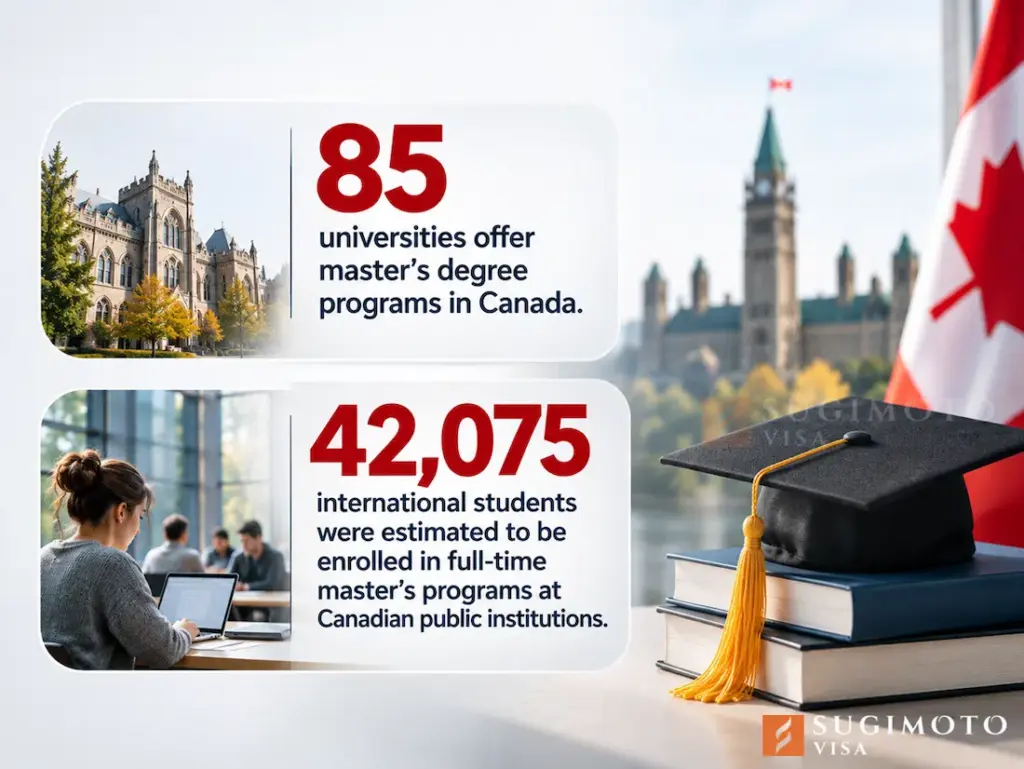
What Is a Master’s Degree in Canada?
A master’s degree is a graduate-level university qualification normally completed after a bachelor’s degree or an equivalent academic credential.
Canadian universities offer master’s programs across fields such as engineering, computer science, business, public health, education, natural sciences, humanities, and social sciences.
Some programs focus on advanced professional education.
Others concentrate on academic research and the development of specialized knowledge.
The degree may be designated as a Master of Arts (MA), Master of Science (MSc), Master of Engineering (MEng), Master of Applied Science (MASc), Master of Business Administration (MBA), or another recognized master’s qualification.
However, the degree title alone does not always establish whether a program is research-based or course-based.
For example, some engineering schools offer a coursework-based MEng alongside a thesis-based MASc.
The distinction must be verified through the individual program’s academic requirements.
How Long Does a Master’s Degree Take in Canada?
Many Canadian master’s programs take between one and two years of full-time study.
Some professional programs can be completed in approximately 12 months.
Research-based programs commonly require 18 to 24 months, although the actual duration depends on the academic discipline and research progress.
Longer programs also exist.
For example, the University of British Columbia’s School of Biomedical Engineering distinguishes between a professional MEng lasting approximately 12–18 months and a research-based MASc expected to take approximately 24 months.
The difference reflects the academic structure of each qualification rather than a universal rule governing all engineering master’s programs.
International students should check the official program duration rather than relying only on descriptions such as one-year master’s or two-year master’s.
The advertised duration can affect tuition budgeting, study permit planning, and the immigration options available to accompanying family members.
Types of Master’s Programs in Canada
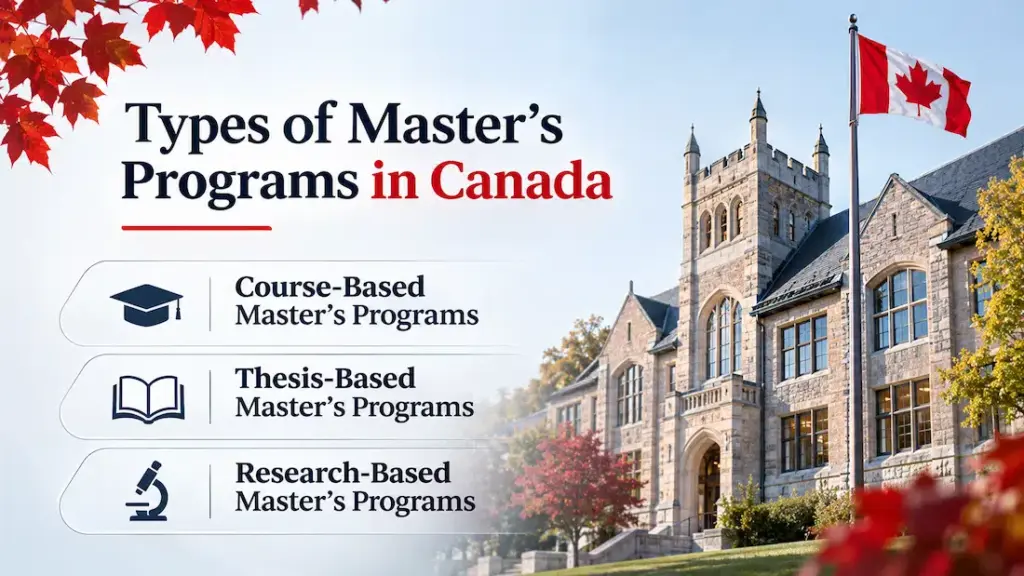
Canadian universities commonly distinguish between course-based, thesis-based, and other research-oriented master’s programs.
These categories describe how students complete their academic requirements.
They do not necessarily indicate that one qualification is more academically valuable than another.
The appropriate choice depends on whether the student intends to develop professional expertise, conduct research, or prepare for further academic study.
01Course-Based Master’s Programs
Course-based master’s programs emphasize advanced academic coursework.
Students normally complete a defined number of graduate courses and may undertake a final project, capstone assignment, internship, or other practical component.
However, they are not generally required to complete a traditional research thesis.
These programs can be suitable for professionals who want to acquire specialized knowledge or advance their careers.
For example, an experienced engineer may pursue an MEng to develop expertise in artificial intelligence, project management, or another technical field.
A professional with previous experience in finance may consider a coursework-based master’s degree in business analytics.
The academic experience is generally more structured around taught courses.
A research supervisor may not be required.
However, some course-based programs include industry projects or other supervised academic work.
02Thesis-Based Master’s Programs
Thesis-based programs require students to complete a substantial research project under academic supervision.
The research normally addresses a defined question and applies appropriate scholarly methods.
Students may conduct laboratory experiments, analyse datasets, undertake fieldwork, or examine academic literature.
For example, a Master of Applied Science student in mechanical engineering might investigate the performance of an advanced manufacturing process.
A Master of Science student in psychology may examine a research question using experimental or statistical methods.
In these programs, the relationship between the student’s research interests and the department’s expertise can be particularly important.
The student usually works with a research supervisor and completes a thesis that is assessed according to university requirements.
Thesis-based programs can be appropriate for students considering doctoral studies, although completing a thesis is not the only possible route into a PhD.
03Research-Based Master’s Programs
The term research-based is sometimes used more broadly than thesis-based.
A research-based master’s program may involve a traditional thesis or a substantial research paper.
For example, the University of Waterloo includes master’s programs with either a thesis or a master’s research paper within its description of research-based graduate education.
These programs may involve faculty supervision and access to research funding.
However, not every program containing a research project is classified as research-based.
A professional master’s degree may include a capstone project without having the same funding model or research requirements as a thesis-based program.
Students should therefore examine the university’s official program classification.
Comparing Master’s Program Types
| Feature | Course-Based Master’s | Thesis-Based Master’s |
|---|---|---|
| Main focus | Advanced coursework and professional specialization | Independent academic research |
| Thesis | Usually not required | Required |
| Research supervisor | Not always required | Generally required |
| Typical duration | Often 12–18 months | Often 18–24 months |
| Funding | Commonly self-funded | More likely to offer research funding |
| Academic structure | Courses, projects and sometimes internships | Courses, research and thesis |
| Preparation for PhD | Possible, depending on program and background | Often particularly suitable |
| Professional orientation | Often strong | Depends on research field |
These are general patterns.
A particular university may offer course-based programs with funding or research-based programs with different duration requirements.
The individual program’s official description should determine the comparison.
Course-Based vs Thesis-Based Master’s: Which Should You Choose?
The decision depends on the applicant’s academic history and intended career.
Consider two bachelor’s graduates in computer science.
The first has four years of professional experience as a software developer.
Their objective is to specialize in advanced computing systems and return to industry.
A course-based master’s program may provide the structured technical training they need.
The second graduate has participated in university research projects and wants to investigate a particular area of machine learning.
A thesis-based master’s may offer a stronger connection to their research objectives.
Neither applicant necessarily needs the same type of master’s degree.
If Your Goal Is Professional Development
A professional master’s program may be appropriate when the curriculum provides advanced knowledge relevant to your intended occupation.
For example, UBC offers a professional Master of Engineering alongside research-based engineering degrees.
The university describes its MEng as suitable for engineers seeking advanced professional training.
The MASc, by comparison, is a thesis-based degree intended for students pursuing research.
Professional master’s programs may also include industry-focused projects or internships.
However, applicants should verify whether those opportunities are guaranteed or competitive.
If Your Goal Is a PhD
A thesis-based master’s degree can provide valuable preparation for doctoral research.
It may allow students to develop a research question, work with a supervisor, and demonstrate their ability to undertake independent academic work.
For example, UBC’s School of Biomedical Engineering advises applicants considering a future PhD to choose the MASc rather than its professional MEng.
This is a program-specific recommendation, not a rule that every Canadian PhD program requires a thesis-based master’s degree.
Some doctoral programs admit exceptional applicants directly from bachelor’s degrees.
Others consider candidates with substantial research experience gained outside a traditional thesis program.
Students who intend to continue into doctoral research should examine the admission requirements of their intended PhD field before choosing a master’s degree.
Master’s Degree Admission Requirements in Canada
Canadian universities establish their own admission criteria.
There is no single national GPA threshold, English-language score, or set of prerequisites applicable to all master’s programs.
Requirements depend on the institution, academic discipline, and type of degree.
Most programs expect applicants to hold a recognized bachelor’s degree or an equivalent qualification.
However, the acceptable academic background varies.
For example, a master’s degree in mechanical engineering may require previous engineering education, while an interdisciplinary graduate program may accept applicants from several academic fields.
Minimum GPA Requirements
Canadian universities commonly assess academic achievement using grades from the applicant’s previous degree.
For example, the University of Waterloo’s general minimum for master’s and graduate diploma admissions is normally a 75% average in an appropriate four-year Honours Bachelor’s degree or equivalent.
The precise method of assessment differs for Canadian and international credentials.
Waterloo also explains that academic departments may establish higher or additional admission requirements.
This means an applicant meeting the university-wide minimum is not necessarily competitive for every program.
A department may require stronger grades, specific prerequisite courses, or relevant professional experience.
International applicants should also avoid applying unofficial GPA conversions without considering the receiving university’s credential-equivalency rules.
Are Three-Year Bachelor’s Degrees Accepted?
Sometimes.
The answer depends on the institution, the country where the qualification was awarded, and the academic structure of the degree.
For example, UBC states that most three-year Bologna-compliant degrees from research-intensive European universities can satisfy its academic basis for master’s admission.
However, this does not mean every three-year bachelor’s degree from every country is automatically accepted.
UBC assesses international academic qualifications according to its country-specific requirements.
Applicants with a three-year degree should therefore check the university’s international credential requirements before assuming they need to complete additional undergraduate education.
Can You Apply From an Unrelated Academic Field?
Some master’s programs accept applicants whose bachelor’s degree is in a different discipline.
For example, an interdisciplinary program may admit graduates from engineering, mathematics, computer science, economics, or other related fields.
However, specific prerequisite knowledge may still be required.
A student applying for a master’s program involving advanced statistics may need previous coursework in calculus, probability, or linear algebra.
An applicant to a regulated professional program may face more restrictive educational requirements.
Relevant work experience can strengthen an application, but it does not automatically replace mandatory academic prerequisites.
Does Professional Experience Matter?
Professional experience is especially relevant to certain course-based and professional master’s degrees.
Some programs are designed for applicants who have already worked in their field.
For example, UBC’s Master of Engineering Leadership targets engineers and technical leaders with at least three years of industry experience.
Other master’s programs admit students directly after completing their bachelor’s degrees.
Therefore, it would be inaccurate to say that all Canadian master’s programs either require or disregard professional experience.
The individual program determines how employment history is considered.

English and French Language Requirements
International applicants may need to demonstrate proficiency in the language of instruction.
English-language universities commonly accept standardized tests such as IELTS Academic or TOEFL.
Some institutions also recognize other language tests or provide exemptions for applicants who meet specified educational criteria.
French-language programs have separate requirements.
The accepted tests and minimum scores vary by institution and academic program.
Can You Study a Master’s Degree in Canada Without IELTS?
Possibly. Some Canadian universities accept alternative English-language evidence.
Others exempt applicants who completed previous education under specified conditions.
For example, an institution may recognize a degree completed entirely in English if the applicant satisfies its exemption criteria.
However, an English-medium bachelor’s degree does not automatically provide an IELTS exemption at every Canadian university.
Likewise, admission without IELTS does not necessarily mean admission without any assessment of English proficiency.
Applicants should verify the language policy of their intended academic program.
Are Master’s Language Requirements Different From PGWP Requirements?
Yes. A university may accept IELTS Academic for master’s admission.
However, IRCC uses a separate list of approved tests when assessing the language requirement for the Post-Graduation Work Permit.
Graduates using IELTS for PGWP must generally submit IELTS General Training results.
A test accepted for admission should not automatically be assumed to satisfy future immigration requirements.
Documents Required for a Master’s Application
Most Canadian master’s applications require academic records and supporting information.
However, there is no universal document package.
A research-based master’s may request evidence of research interests, while a professional program may place greater emphasis on work experience.
Academic Transcripts and Degree Documents
Universities generally request academic transcripts from previous post-secondary studies.
Some require degree certificates or confirmation of graduation.
International applicants may need to provide official translations or satisfy country-specific document verification requirements.
Institutions may accept uploaded copies during the initial application process and require official records after admission.
Applicants should follow the exact procedure established by the university.
Statement of Purpose
A Statement of Purpose (SOP) explains why the applicant wishes to pursue the selected graduate program.
For a course-based master’s, the statement may focus on previous academic preparation, professional experience, and the relevance of the program to the applicant’s goals.
For a research-based master’s, it may also address specific research interests and the department’s expertise.
For example, an applicant to a master’s in data science may explain how previous experience in software development led to an interest in statistical modelling.
The statement should provide a credible connection between the applicant’s background and the proposed studies.
Generic descriptions of the university’s reputation are usually less informative than a specific explanation of academic fit.
Academic CV or Résumé
Some universities request a curriculum vitae or résumé.
Research-based applicants may emphasize academic projects, research experience, publications, and technical skills.
Professional master’s applicants may place more emphasis on relevant employment, leadership, and professional accomplishments.
The document should reflect the program’s purpose.
An applicant seeking research supervision may need to demonstrate different strengths from someone applying to an executive or professional graduate program.
Recommendation Letters
Graduate applications commonly require references.
Some programs prefer academic referees who can assess the applicant’s ability to undertake advanced study.
Professional programs may accept or request employment-related references.
A supervisor who has worked closely with the applicant on a research project may be particularly valuable for a thesis-based program.
However, the number and type of references depend on the institution.
Applicants should not assume that every master’s program requires exactly two or three letters.
GRE, GMAT and Portfolios
Some master’s programs require additional assessments.
Business schools may request GMAT or GRE results.
Certain engineering and science programs may request GRE scores, while others do not require them.
Creative programs may require portfolios.
The presence or absence of these requirements can change between admission cycles.
Applicants should verify the current instructions for the intended intake.
Do You Need a Supervisor for a Master’s in Canada?
Not always.
The need for a supervisor depends mainly on the program’s academic structure and the department’s admission procedures.
Course-based professional master’s programs generally do not require students to secure a research supervisor before applying.
Research-based programs may require an appropriate supervisor, but the timing varies.
Research-Based Master’s Programs
Some departments expect applicants to contact potential supervisors before submitting an application.
Others evaluate applications centrally and assign supervisors after admission.
The University of Waterloo explicitly distinguishes these situations.
Its guidance states that some research-based master’s programs require a supervisor before applying, while others arrange supervision after the student has entered the program.
Therefore, contacting professors should not be treated as a mandatory first stage for every Canadian master’s application.
How to Find a Suitable Research Supervisor
A prospective research student should begin by identifying the academic subject they want to investigate.
For example, a computer science graduate interested in medical imaging may look for faculty members whose recent research involves computer vision and healthcare applications.
The applicant should examine current projects, publications, laboratory activities, and research opportunities.
A strong connection involves more than matching broad keywords.
A professor working in artificial intelligence may not supervise research in the applicant’s particular area of interest.
Funding availability and supervision capacity also matter.
Contacting Professors
When a department encourages prospective applicants to contact faculty, a concise and specific inquiry may be appropriate.
The message should explain the applicant’s academic background, research interests, and connection to the professor’s work.
An academic CV can help provide supporting context.
However, an encouraging response from a professor does not automatically establish admission or guaranteed funding.
Applicants must still complete the university’s formal admission requirements.
For course-based programs that do not involve research supervision, contacting professors individually may provide little benefit.
Examples of Canadian Master’s Programs
The following examples demonstrate how master’s programs can differ even within the same university or academic field.
They are intended to illustrate academic structures rather than rank universities.
UBC: Master of Engineering vs Master of Applied Science
The University of British Columbia offers both professional and research-based master’s degrees in engineering.
Its School of Biomedical Engineering provides a useful comparison.
| Feature | Master of Engineering | Master of Applied Science |
|---|---|---|
| Program type | Professional | Research |
| Expected duration | 12–18 months | Approximately 24 months |
| Main components | Coursework, seminars and optional internship | Coursework, seminars and thesis |
| Research thesis | Not required | Required |
| Research supervisor | Not part of the standard MEng structure | Required |
| Financial assistance | May include teaching assistant opportunities | May include supervisor funding, teaching assistantships and awards |
| Typical objective | Advanced professional development | Research training and possible PhD preparation |
The structure is specific to UBC’s School of Biomedical Engineering. Other universities may use different terminology and requirements.
Waterloo: A 16-Month Professional Master’s
The University of Waterloo offers a Master of Management Science in Systems Design Engineering.
Its published program information identifies a 16-month full-time coursework-based master’s.
The university also offers thesis-based research programs in related areas.
This example is particularly relevant to international students comparing academic duration and immigration requirements.
A 16-month qualifying master’s degree may meet the program-duration threshold relevant to the standard spousal open work permit category.
However, eligibility still depends on the student’s and spouse’s circumstances.
The duration alone does not guarantee that a spouse will receive a work permit.
Waterloo: A 24-Month Research Master’s
Waterloo’s Master of Applied Science in Management Science and Engineering is a research-oriented program.
The university lists it as a 24-month full-time master’s with a thesis component.
The program requires applicants to submit a statement addressing their academic background and research interests.
This illustrates how research-based master’s admissions may involve a stronger emphasis on academic preparation and proposed research than some professional programs.
Master’s Degree Tuition Fees in Canada
Graduate tuition varies substantially across Canadian universities.
The cost depends on the institution, province, academic discipline, and type of master’s degree.
Professional programs may have a different fee structure from research-based graduate degrees.
According to Statistics Canada’s data for the 2026–2027 academic year, the average annual tuition for international graduate students in degree programs is approximately CAD 24,693.
This is a national weighted average for publicly funded degree-granting institutions.
It is not the advertised tuition of a typical individual master’s program.
The figure also includes graduate programs with different tuition structures and should not be interpreted as an identical average for every master’s category.
Course-Based Master’s Tuition
Professional master’s programs are frequently self-funded.
For example, the University of Waterloo explains that students in course-based graduate programs are normally expected to cover their tuition and incidental fees.
Some programs may offer entrance awards or paid work opportunities, but these are not guaranteed across all coursework-based degrees.
A student considering a professional master’s should calculate the entire program cost.
A 12-month degree with higher tuition may have a different overall cost from a 24-month program with lower annual tuition.
The longer program also involves additional living expenses.
Research-Based Master’s Tuition
Research-based master’s students may receive funding that offsets tuition and living expenses.
However, the amount offered differs by university and department.
A student with a research funding package should confirm whether tuition is covered separately or must be paid from the funding amount.
The distinction can substantially change the financial value of an offer.
Additional Living Expenses
Tuition is not the only expense.
Students must also account for accommodation, food, transportation, health insurance, academic materials, and personal expenses.
Living costs differ between Canadian cities.
A student attending university in Vancouver may have different housing expenses from someone studying in a smaller Ontario or Prairie community.
Students should use the university’s current cost-of-living estimates and their actual housing plans when preparing a budget.
Master’s Scholarships and Funding in Canada
Financial assistance is available to some international master’s students.
However, funding arrangements differ considerably between academic programs.
A research-based master’s degree is generally more likely to provide institutional research funding than a course-based professional master’s.
This does not mean every research student receives a full scholarship or that professional students can never receive assistance.
The funding policy of the specific program is what matters.
Graduate Funding at the University of Waterloo
Waterloo provides a useful example of research-based master’s funding.
The university identifies a recommended minimum of CAD 12,000 for the first year for eligible full-time research-based master’s students in good academic standing.
Some departments offer more substantial support.
The university reports that average funding across its research-based master’s programs was CAD 20,206 in the 2024–2025 academic year.
These amounts should not be treated as a guaranteed scholarship for every incoming international student.
Funding practices vary by academic unit, and eligibility depends on the program’s conditions.
Research Assistantships
Research assistantships may provide financial support through participation in research projects.
For example, a Master of Applied Science student may work on a project funded through a professor’s research grant.
The funding can be connected to experimental research, technical development, data analysis, or other research activities.
However, the availability of an assistantship depends on the supervisor’s funding and the institution’s arrangements.
Admission to a research program does not automatically guarantee employment as a research assistant.
Teaching Assistantships
Graduate students may also receive financial support through teaching assistantships.
These positions can involve grading assignments, supporting laboratory sessions, leading tutorials, or assisting with course administration.
Teaching assistantship income may form part of a graduate funding package.
Students should verify whether these positions are guaranteed, assigned by the department, or obtained through a separate recruitment process.
The employment obligations and payment arrangements can differ between institutions.
International Master’s Award of Excellence
The University of Waterloo also offers an International Master’s Award of Excellence (IMAE) for eligible international students in research-based master’s programs.
The award may be offered by the relevant faculty in addition to other qualifying funding.
It is not automatically available to every admitted international student.
Applicants should verify whether their department participates and how recipients are selected.
Can International Students Apply for Federal Master’s Scholarships?
Some federal research awards are restricted by citizenship or immigration status.
An important example is the Canada Graduate Research Scholarship—Master’s (CGRS M).
The award provides CAD 27,000 for 12 months.
However, applicants must be Canadian citizens, permanent residents, or qualifying protected persons by the relevant deadline.
An international student whose only Canadian immigration status is a study permit does not qualify under this program’s standard eligibility requirements.
This is an important distinction when researching government scholarships.
Not every Canadian scholarship appearing in search results is available to students applying from abroad.
International applicants may instead consider university funding packages, eligible institutional awards, or external scholarships that accept applicants with their nationality and immigration status.
Fully Funded Master’s Programs: What Does Funding Cover?
The term fully funded master’s can be misleading when used without an explanation.
Some universities provide a guaranteed financial package intended to support tuition and living expenses.
Others provide a smaller amount that must be combined with personal savings.
For example, consider two hypothetical funding offers.
Program A
If tuition must be paid from the funding package, only CAD 7,000 would remain before other expenses.
Program B
Program B would provide a different level of financial support despite the smaller cash stipend.
These examples are illustrative.
Actual graduate funding offers may include conditions related to academic progress, teaching duties, research assignments, or the duration of financial support.
Applicants should examine the written funding terms rather than relying on the description fully funded.
Is Funding Guaranteed for the Entire Degree?
Not necessarily.
A two-year research master’s program may guarantee funding for one year.
Some departments provide support for the second year, subject to continued eligibility and academic progress.
Other programs offer funding for the expected program duration.
Students should confirm whether their offer specifies guaranteed funding, expected funding, or merely potential scholarship opportunities.
These distinctions are particularly important for international students who must demonstrate sufficient financial resources for their study permit applications.
Application Deadlines and Master’s Intakes
Canadian master’s programs do not share a single national application deadline.
Many accept students for September.
Some also admit students in January or May.
The available intakes depend on the university and academic department.
For example, Waterloo’s Systems Design Engineering MEng lists fall, winter, and spring admission intakes.
Other master’s programs admit students only once per academic year.
Research-based programs may also have deadlines connected to available supervision or funding.
Applicants should therefore check the current academic intake and application requirements before preparing their documents.
When Should You Apply?
The appropriate preparation timeline depends on the program.
For a research-based master’s, identifying relevant faculty members and research opportunities can take additional time.
Professional programs may require applicants to prepare academic records, employment documentation, and language test results.
Some universities establish separate deadlines for scholarship consideration.
An admission deadline should not automatically be treated as the last date for every available funding opportunity.
Study Permit Requirements for Master’s Students
International students generally need a Canadian study permit to pursue a full-time master’s degree unless a specific exemption applies.
Applicants normally need a letter of acceptance from a Designated Learning Institution.
They must also meet the relevant financial, immigration, and admissibility requirements.
Admission to a Canadian master’s program does not guarantee approval of a study permit.
However, important changes introduced in 2026 have affected the documentation required from certain graduate students.
PAL/TAL Exemption for Master’s Degrees in 2026
Since January 1, 2026, applicants entering eligible degree-granting master’s programs at public Designated Learning Institutions have been exempt from the Provincial or Territorial Attestation Letter requirement.
For example, an applicant admitted to an eligible Master of Science program at a public Canadian university may qualify for the exemption.
However, the exemption is not a general rule for every program described as postgraduate education.
A graduate certificate or graduate diploma may still require a PAL/TAL unless another exemption applies.
Likewise, applicants should verify the classification of the institution and the specific program.
Master’s Students in Quebec
Quebec has separate provincial requirements for international students.
Most students pursuing longer academic programs in the province must obtain a Quebec Acceptance Certificate (CAQ), unless a specific exemption applies.
The federal PAL/TAL exemption does not automatically remove the requirement to obtain a CAQ.
For example, a student admitted to a qualifying master’s degree at a public university in Montreal may be exempt from providing a separate PAL/TAL while still needing provincial study authorization through Quebec’s process.
The applicable rules should be checked before submitting the federal study permit application.
Proof of Financial Support
A master’s applicant must demonstrate sufficient financial resources to cover tuition, living expenses, and transportation.
For regular study permit applications submitted on or after September 1, 2026, IRCC requires a single applicant studying outside Quebec to demonstrate at least:
CAD 23,448 for annual living expenses.
This amount is separate from tuition and transportation costs.
Applicants accompanied by family members must meet higher financial requirements.
Quebec establishes separate financial thresholds.
A university funding package can form part of the financial evidence.
However, the applicant must still demonstrate that sufficient resources are available for expenses not covered by the funding.
A scholarship award does not independently guarantee study permit approval.
Can Your Spouse Work While You Study for a Master’s?
This is one of the most important immigration considerations for married international students.
Under the rules introduced on January 21, 2025, spouses and common-law partners of eligible students enrolled in master’s degree programs lasting 16 months or longer may qualify for an open work permit.
The spouse must still meet the applicable requirements.
Marriage to a master’s student does not independently guarantee a work permit.
Comparing a 12-Month and 16-Month Master’s
Consider two international students.
Both receive admission to PGWP-eligible master’s degree programs at public universities.
Student A
Student A enters a 12-month master’s degree.
12-month master’s degree
Student A’s spouse would not qualify under that category solely on the basis of the 12-month master’s program.
Student B
Student B enters a 16-month master’s degree.
16-month master’s degree
Under the standard student-spouse category, Student B’s spouse may qualify for an open work permit because the master’s degree lasts at least 16 months.
Both may qualify for a three-year PGWP after graduation, provided they satisfy the relevant PGWP requirements.
This comparison demonstrates why program duration matters beyond the length of the degree itself.
The spouse may still have other immigration options depending on individual circumstances, but those must be assessed separately.
Does a 16-Month Master’s Guarantee a Spousal Work Permit?
No. The applicant must demonstrate the qualifying relationship and satisfy the applicable immigration requirements.
IRCC assesses the spouse’s application independently.
The master’s student must also meet the conditions associated with the eligible educational program and study permit.
Applicants should verify the university’s officially published program duration rather than relying on assumptions about how long they personally expect to take to graduate.
Can You Work During a Master’s Degree?
Eligible international master’s students may work while studying in Canada.
Under the current rules, qualifying study permit holders can generally work up to 24 hours per week off campus during regular academic sessions.
Different rules apply to eligible on-campus employment and officially scheduled academic breaks.
However, employment rights depend on the student’s enrolment and study permit conditions.
Students cannot begin working under the normal student employment provisions before their academic program starts.
Research and Teaching Assistantships
Master’s students may receive funding through research or teaching assistantships.
Depending on the employment arrangement, these positions may qualify as on-campus work.
Eligible on-campus employment is not subject to the standard 24-hour weekly off-campus limit.
However, the relevant conditions must still be satisfied.
Students should also distinguish between scholarship payments and employment income.
A graduate funding package may combine several sources of support that are treated differently for employment and taxation purposes.
Internships and Co-op Programs
Some professional master’s programs include internships or work placements.
As of April 1, 2026, eligible post-secondary international students no longer need a separate co-op work permit for qualifying placements required by their academic programs.
The placement must meet IRCC’s requirements, including approval by the DLI and confirmation that it is necessary to complete the academic program.
An optional internship or employment opportunity should not automatically be treated as a mandatory academic placement.
Students should verify the structure of the program and the immigration conditions associated with the work.
PGWP After a Master’s Degree in Canada
The Post-Graduation Work Permit is an important consideration for international students who intend to work in Canada after graduation.
Eligible master’s degree graduates may qualify for a PGWP valid for up to three years.
Since February 15, 2024, the special master’s rule has allowed qualifying graduates to receive a three-year PGWP even when their master’s program lasts less than two years.
The program must generally last at least eight months, or meet the applicable 900-hour requirement for certain Quebec programs.
The applicant must also satisfy the remaining PGWP requirements.
One-Year vs Two-Year Master’s: PGWP Duration
Consider two eligible master’s degrees.
The first lasts 12 months.
The second lasts 24 months.
Under the special master’s degree provisions, both graduates may qualify for PGWPs valid for up to three years.
This differs from the general rule applicable to many shorter diploma and certificate programs.
For example, an eligible one-year graduate certificate does not automatically qualify for a three-year PGWP simply because it is offered at the postgraduate level.
The credential must be an eligible master’s degree to benefit from the special master’s provision.
PGWP Language Requirements for Master’s Graduates
Master’s graduates submitting PGWP applications under the current rules generally need to demonstrate at least CLB 7 in English or NCLC 7 in French in all four language abilities.
IRCC recognizes specific tests for this purpose.
For example, IELTS General Training, CELPIP-General, PTE Core, TEF Canada, and TCF Canada are among the accepted options.
The university’s admission language requirements are separate.
A student admitted using IELTS Academic may still need to obtain an accepted immigration language test before applying for PGWP.
Eligible master’s degree graduates are exempt from the PGWP field-of-study requirement.
When Should You Apply for PGWP?
Eligible graduates generally have up to 180 days after receiving confirmation of program completion to apply for a PGWP.
However, the 180-day application period is different from the validity of their study permits.
A study permit generally becomes invalid on the earlier of its printed expiry date or 90 days after completion of studies.
The applicant must also satisfy the relevant study permit history and immigration status requirements.
Waiting until the end of the 180-day period can create complications if the study permit has already expired.
Graduates should therefore evaluate their immigration status before submitting the application.
Can a Canadian Master’s Degree Lead to Permanent Residence?
A Canadian master’s degree may contribute to an applicant’s eligibility or ranking under certain economic immigration programs.
For example, eligible Canadian educational credentials can provide points under Express Entry.
Graduates may also gain qualifying Canadian work experience after receiving appropriate work authorization.
However, permanent residence is not automatically granted to students who complete a Canadian master’s degree.
Applicants must qualify under an appropriate immigration program.
Canadian Experience Class
Some master’s graduates use the Post-Graduation Work Permit to gain qualifying Canadian skilled work experience.
That experience may support eligibility for the Canadian Experience Class.
However, the work must satisfy the program’s requirements.
Employment obtained while studying full-time generally does not count toward the minimum Canadian work experience requirement for CEC.
A graduate must also meet the language and other eligibility criteria.
Federal Skilled Worker Program
Applicants with previous skilled work experience outside Canada may have different options.
For example, a professional who worked for several years before entering a Canadian master’s program may already satisfy the minimum work experience requirement for the Federal Skilled Worker Program.
They may not need to wait until accumulating a full year of Canadian employment to establish eligibility for that program.
However, qualification for an Express Entry program does not guarantee an invitation to apply for permanent residence.
Provincial Immigration Programs
Provincial Nominee Programs may also provide opportunities for eligible graduates.
Requirements differ by province and can change.
Some pathways consider employment, occupational qualifications, language proficiency, or connections to the province.
Students should not assume that graduating from a university in a particular province automatically guarantees access to a provincial immigration stream.
Immigration options should be assessed using the requirements in effect when the applicant becomes eligible.
Permanent Residence After Studying in Canada ↗
Is a Master’s Degree in Canada Worth It?
A Canadian master’s degree can provide advanced education, professional specialization, and opportunities to participate in research.
For some applicants, a course-based professional master’s can help develop skills relevant to a particular industry.
For others, a thesis-based degree may offer stronger preparation for doctoral research.
However, the value of the qualification depends on the applicant’s goals.
A shorter professional master’s may allow a student to return to the workforce sooner.
A research-based master’s may offer financial support and opportunities to work closely with academic researchers.
A longer program may also have different implications for accompanying family members.
For example, a 16-month master’s can meet the duration threshold relevant to certain spousal open work permit applications, while a shorter master’s may not.
Students should also consider the full cost of completing the program.
A university with lower tuition is not necessarily more affordable if funding is unavailable or living expenses are substantially higher.
Likewise, a funded research program may be financially attractive without being the strongest choice for someone whose primary objective is professional coursework.
The most suitable program is the one whose academic structure, admission requirements, cost, and immigration implications align with the student’s circumstances.
Questions About Master’s Degrees in Canada
Possibly. While traditional Canadian Master’s programs require a 4-year honours Bachelor’s degree, many major universities accept 3-year Bachelor’s degrees if they are recognized as equivalent (such as Bologna-compliant European degrees from research-intensive institutions, or first-class 3-year degrees from accredited international universities). Requirements vary by country, university, and specific academic department.
Yes. Eligibility for a PGWP is based on the academic credential (degree status), institutional designation (DLI), and overall program rules rather than whether the Master’s is course-based or research-based. Graduates of eligible course-based Master’s degree programs offered by public universities or colleges qualify for a PGWP.
No. Research-based Master’s programs (MSc/MA with thesis) typically provide full or partial institutional funding packages through Teaching Assistantships (TA), Research Assistantships (RA), and stipends. Conversely, course-based and professional Master’s programs (e.g., MBA, MEng) are predominantly self-funded by the student.
Yes. Under IRCC’s Master’s degree PGWP rules, eligible graduates of Master’s degree programs lasting at least 8 months to 1 year can qualify for a 3-year PGWP, even if the program duration is shorter than two years.
Generally no under the main international student family stream. Under IRCC rules, international student spouses are eligible for a Spousal Open Work Permit only if the principal student is enrolled in a Master’s degree program with an official duration of 16 months or longer (or a doctoral degree/eligible professional degree).
It depends on the program type. Research-based Master’s programs often require applicants to identify and obtain approval from a faculty supervisor prior to applying. Course-based or professional Master’s programs do not require a supervisor.
No. Starting January 1, 2026, applicants entering degree-granting graduate programs at the Master’s or Doctoral level at public Designated Learning Institutions (DLIs) are exempt from the PAL/TAL requirement. Non-degree graduate certificates or diplomas are not included in this exemption.
Choosing the Right Master’s Program in Canada
A master’s degree is a significant academic and financial investment.
For international applicants, the most important decision is often not which university has the highest ranking, but which program best matches their educational background and objectives.
A research-based master’s may provide opportunities for academic supervision, research experience, and financial support.
A course-based master’s may be more appropriate for someone seeking advanced professional training.
The differences also extend to immigration planning.
Program duration can affect a spouse’s potential work permit eligibility. The type of credential matters for PGWP requirements, and the institution’s status can affect the documents needed for a study permit.
Before committing to a program, applicants should evaluate these factors together rather than treating admission, funding, and immigration as unrelated decisions.
Sugimoto Visa assists prospective international students with understanding Canadian study permit requirements and evaluating the immigration implications of their educational plans.
If you are considering a master’s degree in Canada, reviewing your academic background, intended program, available funding, and family circumstances can help clarify which educational and immigration options may be suitable.
Official Sources: