Moving to Canada from Germany can be relatively straightforward compared with moving from many other countries, especially for short visits and certain temporary work opportunities.
German citizens can travel to Canada without a traditional visitor visa, and younger Germans may have access to International Experience Canada (IEC). Professionals and employees of European companies may also have work permit opportunities under the Canada-European Union Comprehensive Economic and Trade Agreement (CETA).
For permanent immigration, however, Germans must qualify under the same Canadian immigration programs as other foreign nationals. Common options include Express Entry, Provincial Nominee Programs, family sponsorship, and selected business immigration pathways.
This guide explains the main ways to move from Germany to Canada in 2026 and the country-specific rules German applicants should know.
Can German Citizens Move to Canada?
Yes. German citizens can move to Canada temporarily or permanently if they qualify for the appropriate immigration status.
The main options include:
Permanent pathways
- Express Entry
- Provincial Nominee Programs
- Family sponsorship
- Selected entrepreneur and business programs
Temporary pathways
- International Experience Canada
- CETA work permits
- Employer-specific work permits
- Intra-company transfers
- Study permits
The important point is that visa-free travel does not give a German citizen the automatic right to live or work in Canada.
You still need the correct immigration status for your purpose.
Do German Citizens Need a Visa for Canada?
German citizens are visa-exempt travellers.
If you fly to Canada, you normally need:
- a valid German passport
- an Electronic Travel Authorization (eTA)
An eTA currently costs CAD 7 and is electronically linked to your passport.
If you enter Canada by land or sea, German citizens normally do not need an eTA, although they still need an acceptable travel document such as a valid passport.
An eTA is only a travel authorization.
It does not give you permission to:
- move permanently to Canada
- take a Canadian job
- study long-term
- remain in Canada indefinitely
eTA vs. Canadian Immigration Status
| Status | What It Allows |
|---|---|
| eTA | Travel to Canada by air as a visa-exempt visitor |
| Visitor status | Stay temporarily without working unless separately authorized |
| Work permit | Work in Canada according to permit conditions |
| Study permit | Study at an eligible Canadian institution |
| Permanent residence | Live and work permanently in Canada |
Canada Immigration in 2026: Key Numbers
Canada has reduced the pace of temporary immigration while continuing to prioritize economic immigration and people who can fill specific labour shortages.
| 2026 Canada Immigration Indicator | Current Figure |
|---|---|
| Permanent resident target | 380,000 |
| Economic immigration target | 239,800 |
| Federal High Skilled target | 109,000 |
| PNP admissions target | 91,500 |
| New temporary resident arrivals target | 385,000 |
| Temporary worker target | 230,000 |
| International student target | 155,000 |
| German IEC Working Holiday quota | 3,030 |
Canada is targeting 380,000 new permanent residents in 2026, with economic immigration representing the largest share. The government is also giving greater priority to people who already have Canadian work experience and candidates whose occupations match labour-market needs.
For German citizens specifically, IEC remains a notable advantage. The 2026 German Working Holiday quota is 3,030 places. As of July 17, 2026, IRCC listed 239 places still available and rated the chance of receiving an invitation in the next round as excellent.
Which Canadian Immigration Path May Fit You?
| Your Situation | Option to Check First |
|---|---|
| Skilled professional living in Germany | Express Entry |
| Occupation targeted by a province | Provincial Nominee Program |
| Age 18–35 and want temporary Canadian work experience | IEC |
| German employee transferring to a Canadian office | CETA / Intra-company transfer |
| Professional with a qualifying Canadian contract | CETA or another LMIA-exempt option |
| Have a Canadian employer | Work Permit |
| Canadian spouse or partner | Family Sponsorship |
| Want a Canadian degree | Study Permit |
| Experienced entrepreneur | Provincial Entrepreneur Programs |
| Already have Canadian skilled work experience | Canadian Experience Class |
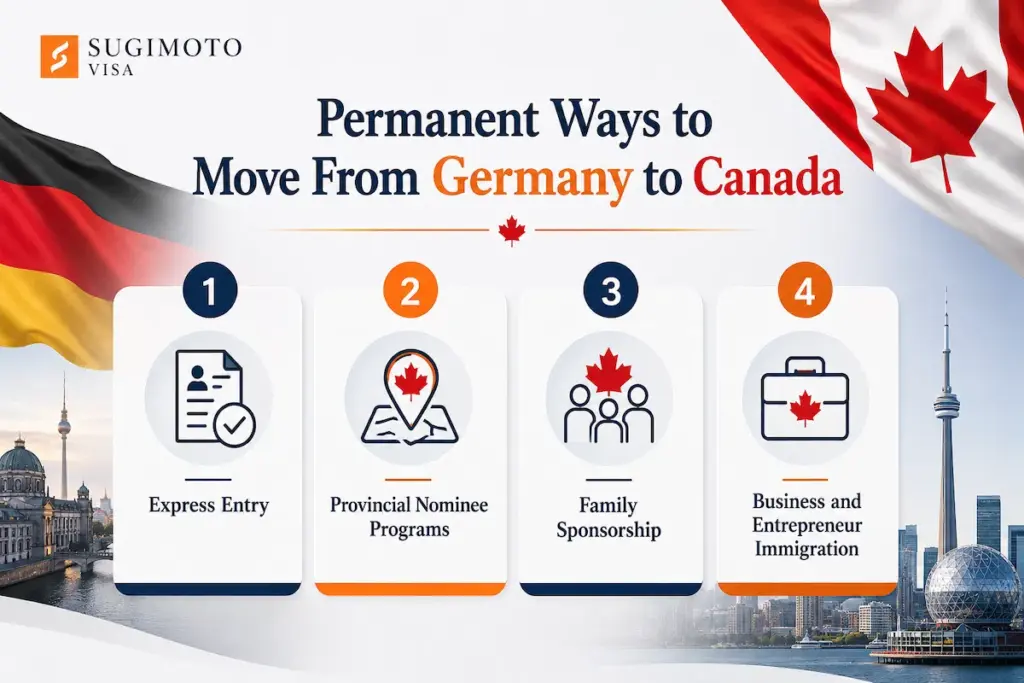
Permanent Ways to Move From Germany to Canada
1. Express Entry
Express Entry is one of Canada’s main immigration systems for skilled workers seeking permanent residence.
It manages three programs:
For German professionals applying directly from Germany, the Federal Skilled Worker Program is often the most relevant starting point.
Federal Skilled Worker Program
Applicants generally need qualifying skilled work experience and must meet requirements related to:
- language ability
- education
- skilled employment
- admissibility
- settlement funds, where required
Qualifying work experience generally falls within NOC TEER categories 0, 1, 2, or 3.
Your German qualifications may also need an Educational Credential Assessment (ECA) if you want to claim Express Entry points for education completed outside Canada.
Do Germans Still Need an English Test?
Yes, if you apply through an Express Entry program requiring language results.
Being a German citizen or speaking fluent English does not remove the language testing requirement.
Applicants normally need an approved test such as:
- IELTS General Training
- CELPIP-General
- PTE Core
French tests may also be used.
Strong German academic credentials and professional experience can help your profile, but immigration points are based on Canadian rules rather than how strong your résumé appears in Germany.
Related Article: Canadian Language Benchmark (CLB)
How CRS Selection Works
Eligible applicants enter the Express Entry pool and receive a Comprehensive Ranking System score.
CRS points are based on factors such as:
- age
- education
- English and French
- Canadian and foreign work experience
- spouse factors
- Canadian education
- provincial nomination
- certain additional factors
A provincial nomination can provide an additional 600 CRS points.
Express Entry Categories in 2026
Canada is using category-based selection more aggressively in 2026.
Current categories include:
- French-language proficiency
- Healthcare and social services
- STEM
- Trades
- Education
- Transport
- Physicians with Canadian work experience
- Senior managers with Canadian work experience
- Researchers with Canadian work experience
- Skilled military recruits
For occupation-based categories, eligible candidates generally need at least 12 months of qualifying experience in a single eligible occupation during the previous three years.
Why This Matters for German Applicants
Applicants working in areas such as:
- engineering
- cybersecurity
- healthcare
- skilled trades
- transportation
- research
may have an additional selection opportunity if their occupation appears in a current Express Entry category.
German applicants with French ability should also pay attention to the French-language category.
You do not need to be from a French-speaking country to qualify.
2. Provincial Nominee Programs
Canada’s provinces and territories operate immigration programs designed around local economic needs.
PNPs may target applicants with:
- specific occupations
- Canadian job offers
- Canadian work experience
- previous study in a province
- regional connections
- business experience
Some PNPs are linked to Express Entry.
An enhanced nomination can add 600 CRS points to your Express Entry profile.
Other PNPs operate outside Express Entry.
The 2026 admissions target for the Provincial Nominee Program is 91,500, making provincial immigration an important part of Canada’s economic immigration system.
For a German applicant, PNPs may be particularly useful when there is a clear link between your occupation and the needs of a specific province.
3. Family Sponsorship
German citizens with qualifying close family relationships in Canada may be able to obtain permanent residence through family sponsorship.
Canadian citizens and permanent residents may sponsor eligible:
- spouses
- common-law partners
- dependent children
Separate programs exist for parents and grandparents.
Unlike Express Entry, spousal sponsorship does not use a CRS score.
The key factors are the eligibility of the sponsor, the applicant, and the qualifying relationship.
4. Business and Entrepreneur Immigration
German entrepreneurs, company owners, and experienced senior managers may have several options depending on whether they want to:
- operate a new Canadian company
- acquire an eligible business
- expand a German company into Canada
- settle permanently through a provincial entrepreneur program
In 2026, applicants should be cautious with outdated articles discussing federal business programs that are paused, restricted, or no longer accepting new applications.
Provincial entrepreneur programs may require:
- minimum net worth
- minimum investment
- business or management experience
- active management
- job creation
- a business plan
- residence in the nominating province
Business immigration should therefore be planned around a currently operating program rather than simply around the idea of buying a company in Canada.
Temporary Ways to Move From Germany to Canada
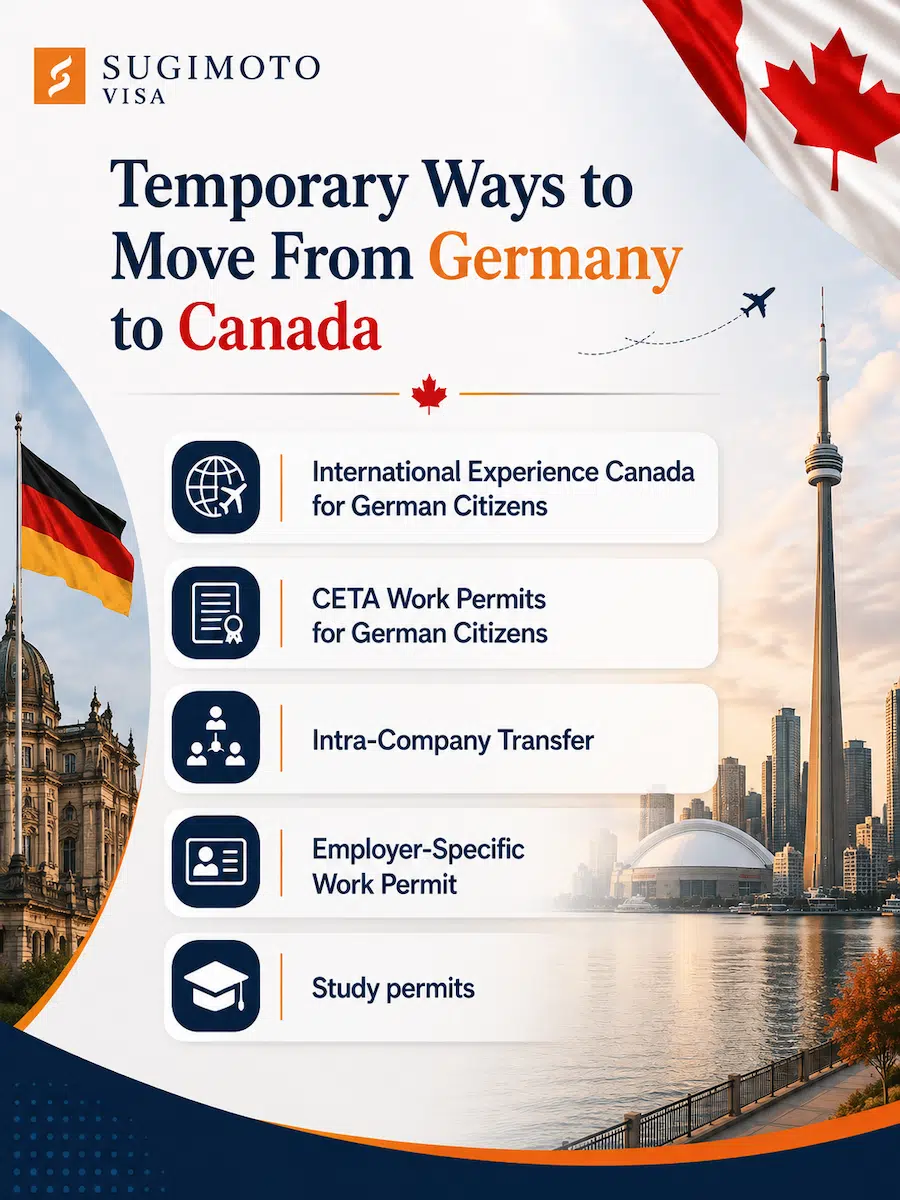
1. International Experience Canada for German Citizens
IEC is one of the biggest advantages available specifically to younger German citizens.
Germany has a youth mobility agreement with Canada, and German citizens may have access to:
- Working Holiday
- Young Professionals
- International Co-op (Internship)
IRCC currently lists all three categories for Germany.
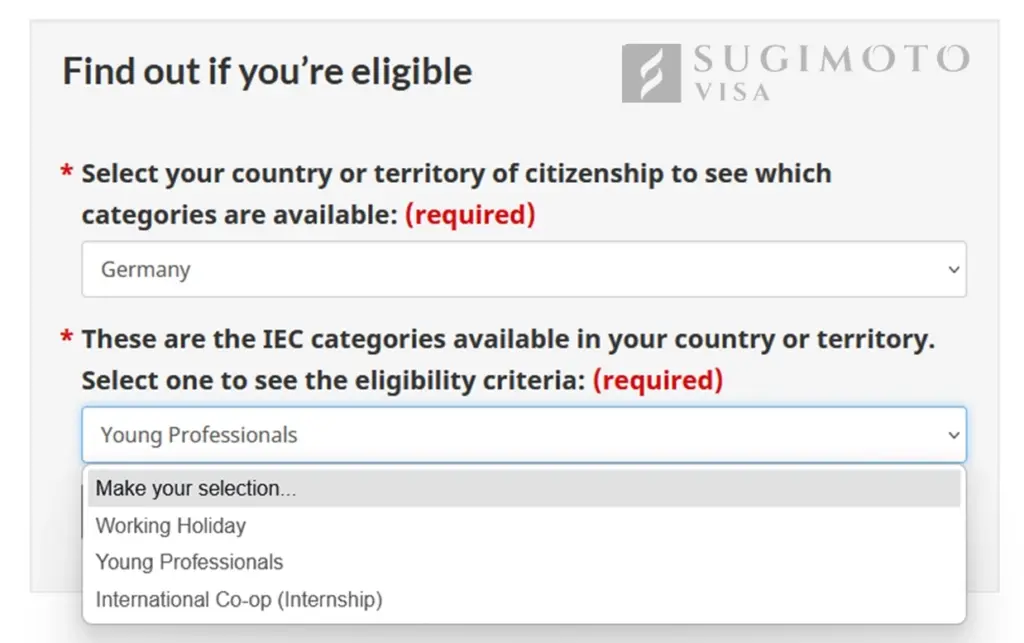
The Canada-Germany youth mobility arrangement generally covers people aged 18 to 35, and German participants can generally receive permits for up to 12 months depending on the category and eligibility.
Working Holiday
Working Holiday is particularly flexible because it normally provides an open work permit.
That means you generally do not need to secure a Canadian employer before entering the pool.
This can be useful if you want to:
- experience living in Canada
- travel while working
- explore Canadian career opportunities
- gain Canadian work experience before deciding whether to immigrate permanently
The 2026 Germany Working Holiday quota is 3,030.
Young Professionals
Young Professionals is designed around professional development.
Unlike Working Holiday, this category generally involves an employer-specific work permit and requires a qualifying Canadian job offer.
The job normally needs to contribute to your professional development. IRCC generally expects qualifying Young Professionals employment to fall within TEER 0, 1, 2, or 3, although certain TEER 4 positions may qualify when connected to the applicant’s field of study.
For Germany, IRCC’s 2026 Young Professionals quota is 350.
International Co-op
This category is designed for eligible students who need a Canadian work placement or internship as part of their studies.
It normally produces an employer-specific work permit.
Can IEC Lead to Permanent Residence?
IEC itself is temporary.
However, qualifying Canadian work experience obtained through IEC can potentially improve your future immigration options.
Depending on the job and duration of your Canadian experience, you may later become eligible for:
- Canadian Experience Class
- a Provincial Nominee Program
- another economic immigration program
IEC should therefore be viewed as a temporary work pathway that can sometimes support a later PR strategy, not as guaranteed permanent residence.
2. CETA Work Permits for German Citizens
Germany is a member of the European Union, so some German business people and professionals may benefit from provisions of the Canada-European Union Comprehensive Economic and Trade Agreement (CETA).
CETA can facilitate temporary entry for certain EU citizens without requiring an LMIA.
Possible categories can include qualifying:
- intra-corporate transferees
- investors
- contractual service suppliers
- independent professionals
- certain business visitors
Canada’s immigration framework includes specific LMIA exemptions for CETA-related intra-corporate transfers and other international-agreement work permits.
However, simply being German does not automatically qualify you for a CETA work permit.
Your:
- occupation
- employer
- contract
- professional qualifications
- role in the company
- length and purpose of the Canadian assignment
must fit the relevant CETA category.
CETA vs. IEC
These pathways serve very different applicants.
| Pathway | Best suited for | Main use |
|---|---|---|
| IEC | Younger Germans looking for temporary Canadian work experience | Short-term work and international experience in Canada |
| CETA | Established professionals, specialists, managers, investors, or people providing qualifying services between European and Canadian businesses | Facilitating professional mobility and qualifying business services between the EU and Canada |
3. Intra-Company Transfer
If you work for a German company that has:
- a Canadian parent company
- subsidiary
- branch
- affiliate
you may be able to transfer to Canada under an intra-company work permit category.
This can be particularly relevant to German employees working for multinational companies in industries such as:
- automotive
- engineering
- manufacturing
- pharmaceuticals
- software
- finance
- industrial technology
The applicant generally needs to hold a qualifying role, such as an executive, manager, or specialized-knowledge employee, depending on the immigration category used.
CETA also contains provisions relevant to certain intra-corporate transferees from EU countries.
4. Employer-Specific Work Permit
A German citizen who receives a Canadian job offer may qualify for an employer-specific work permit.
Depending on the situation, the Canadian employer may need an LMIA.
In other cases, the worker may qualify for an LMIA exemption through:
- CETA
- intra-company transfer provisions
- International Experience Canada
- another International Mobility Program category
A Canadian job offer is therefore not enough on its own.
The employer and worker must determine which work permit category applies.
Related Article: Temporary Foreign Worker Program (TFWP)
5. Study in Canada From Germany
German citizens can study in Canada if they meet Canadian study permit requirements.
For programs longer than six months, a study permit is generally required.
You will normally need:
- a letter of acceptance from an eligible Designated Learning Institution
- sufficient financial resources
- a valid passport
- evidence supporting the purpose of study
- any additional documents required for your application
Canada Has Reduced International Student Admissions
Canada’s 2026–2028 Immigration Levels Plan targets 155,000 new student arrivals in 2026, compared with much higher levels in previous years.
This makes program selection more important.
Before enrolling, check:
- whether the institution is a Designated Learning Institution
- whether the particular program is PGWP-eligible
- whether any field-of-study rules apply
- whether studying in Canada makes sense financially
- whether you actually have a realistic post-graduation immigration strategy
German University vs. Canadian University
Because public higher education in Germany is often significantly less expensive than international tuition in Canada, moving to Canada purely to obtain another degree may not always be the strongest financial decision for a German citizen.
For someone who already holds a recognized German degree, has relevant work experience, and can demonstrate strong English or French skills, direct skilled immigration or a temporary work pathway may be more practical than returning to university in Canada.
| Factor | Studying in Germany | Studying in Canada |
|---|---|---|
| Tuition cost | Often relatively low at public universities | International tuition can be substantial |
| Living costs | Generally more predictable for German residents | Can be high, especially in major Canadian cities |
| Need for another degree | Often unnecessary if the applicant already has strong qualifications | May only make sense if the Canadian credential clearly improves career prospects |
| Access to Canadian employers | More limited while living in Germany | Stronger local networking, internships, and recruitment opportunities |
| Immigration value | A German degree can still support skilled immigration applications | Canadian education may provide additional immigration or employment advantages in some pathways |
| Career transition | Better for applicants continuing in their existing profession | Can be useful for people changing fields or entering regulated professions |
| Time investment | No additional study period if already qualified | Usually requires one or more years of study before entering the workforce full-time |
| Financial risk | Lower if the applicant remains in Germany while preparing an immigration or work application | Higher because tuition, housing, insurance, and living expenses must usually be paid before long-term status is secured |
Can You Move From Germany to Canada Without a Job Offer?
Yes. A Canadian job offer is not required for every pathway.
Depending on eligibility, Germans may move toward Canada through:
- Federal Skilled Worker Program
- certain Provincial Nominee Programs
- Working Holiday
- family sponsorship
- study
- some entrepreneur programs
For German citizens aged 18–35, Working Holiday is particularly noteworthy because it can provide an open work permit without requiring a pre-arranged Canadian job.
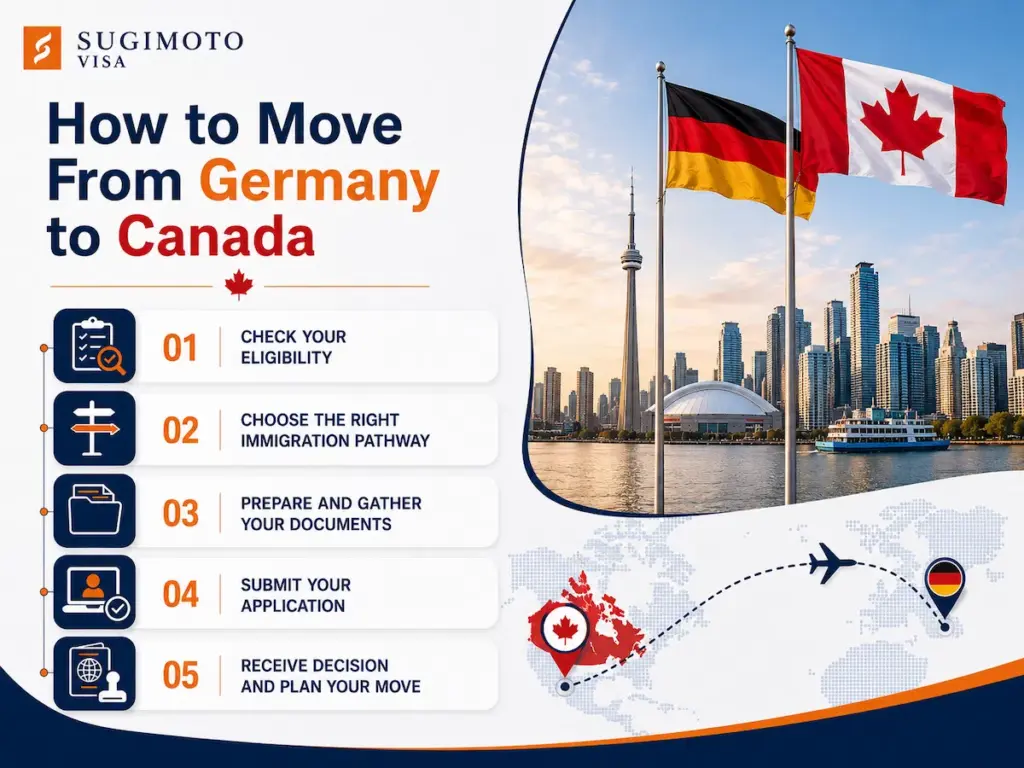
How to Move From Germany to Canada: Step by Step

Step 1: Decide Whether Your Goal Is Temporary or Permanent
Ask whether your main objective is:
- permanent residence
- temporary Canadian work experience
- company transfer
- study
- family reunification
- business expansion
This determines which pathway should be examined first.

Step 2: Compare Your Best Immigration Options
For example:
- Skilled professional in Germany:
Start with Express Entry and PNP eligibility. - Age 18–35:
Check IEC before assuming you need an LMIA-backed work permit. - Employee of a German multinational:
Check CETA and intra-company transfer options. - German entrepreneur:
Compare temporary business mobility options with provincial entrepreneur immigration.

Step 3: Prepare Language Results if Required
Economic permanent residence programs may require an approved English or French test.
Do not assume your English proficiency will be accepted without a formal test.

Step 4: Get an ECA if Necessary
Foreign education may need an Educational Credential Assessment for Express Entry purposes.
This can apply even to degrees from well-known German universities.

Step 5: Prepare Supporting Documents
Depending on the pathway, documents may include:
- German passport
- birth certificate
- marriage documents
- language test
- education records
- ECA
- employment reference letters
- Canadian job offer
- proof of funds
- police certificate
- medical exam
- provincial nomination

Step 6: Submit the Correct Application
Different pathways have different application systems.
For example:
- Express Entry starts with an online profile
- IEC starts with an IEC profile and pool
- PNPs may involve a provincial application
- work permits require the appropriate work authorization category

Step 7: Complete Biometrics if Required
Whether biometrics are required depends on the application and whether previously submitted biometrics remain valid for the particular process.
Follow the instructions issued by IRCC rather than booking biometrics before being instructed where applicable.

Step 8: Prepare for Your Move
Once approved, plan:
- housing
- health insurance
- banking
- employment
- transportation
- tax matters
- shipment of personal belongings
- Canadian documents needed after arrival
German Police Certificate for Canada Immigration
German applicants for Canadian permanent residence may need a German police certificate.
IRCC identifies the required German document as:
- Certificate of Good Conduct (Führungszeugnis), or
- European Certificate of Good Conduct (Europäisches Führungszeugnis) for citizens of another EU member state where applicable
The certificate can be obtained through Germany’s Federal Office of Justice (Bundesamt für Justiz).
IRCC states that newer German police certificates are issued in German, English, and French and therefore generally do not need translation.
This is an important practical advantage compared with documents from countries where certified translation is routinely required.
How Much Money Do You Need to Move From Germany to Canada?
There is no single required amount for every immigration pathway.
Separate the costs into three categories.
1. Immigration Costs
These may include:
- permanent residence fees
- work permit fees
- study permit fees
- IEC fees
- language testing
- ECA
- medical exams
- police certificate costs
- provincial fees
2. Settlement Funds
Certain Express Entry applicants must demonstrate settlement funds.
The amount depends on family size and is updated by IRCC.
Applicants should check the current official table immediately before submitting their application rather than using an older amount from a blog or immigration forum.
3. Actual Relocation Costs
You may also need money for:
- flights from Germany
- temporary accommodation
- rental deposits
- furniture
- transportation
- winter clothing
- phone and internet
- food
- vehicle costs
- emergency savings
Your actual budget will vary significantly depending on whether you move to Toronto, Vancouver, Calgary, Montreal, Ottawa, or a smaller community.
Related Article: Canada Immigration Fees
Moving Money From Germany to Canada
German residents have relatively easy access to international banking, but moving large balances still requires planning.
Keep records of:
- the source of funds
- account ownership
- bank transfers
- investment sales
- major deposits
These records may also be important when the same money is being used as settlement funds for immigration.
If you physically enter Canada carrying CAD 10,000 or more in cash or monetary instruments, you must declare it to Canadian border authorities.
There is no general prohibition on bringing more than CAD 10,000, but the declaration requirement applies.
Taxes When Moving From Germany to Canada
Moving to Canada can change your tax residency.
Canada generally taxes residents based on residency rather than citizenship.
Germany also has its own tax residency and departure rules.
Depending on your situation, cross-border issues may involve:
- the date German tax residency ends
- the date Canadian tax residency begins
- worldwide income
- investments
- pensions
- rental property in Germany
- business ownership
- capital gains
- German pension and retirement arrangements
Canada and Germany have a tax treaty designed to address situations where both countries could otherwise tax the same income.
However, tax treaty rules can be complicated.
Someone maintaining significant:
- German property
- business interests
- investments
- pensions
should consider obtaining professional Canada-Germany tax advice before rather than after relocating.
German Qualifications and Working in Canada
A Canadian immigration approval does not automatically recognize a German professional licence.
Some occupations are regulated provincially.
Examples include:
- physicians
- nurses
- engineers
- teachers
- electricians
- other skilled trades
- certain healthcare professionals
You may therefore face two separate processes:
Immigration recognition
Determines whether your education and experience count for immigration.
Professional recognition
Determines whether you are legally allowed to practise the occupation in a Canadian province.
Canada continues to identify foreign credential recognition as an important barrier for internationally trained professionals.
German applicants should investigate licensing requirements before choosing a province.
Best Places in Canada for German Newcomers
The best city depends more on your occupation and lifestyle than your nationality.
| City | Best suited for | Main advantages | Main disadvantages / considerations |
|---|---|---|---|
| Toronto | Finance, technology, consulting, professional services, corporate management | Strong job market and broad professional opportunities | High housing costs |
| Vancouver | Technology, international trade, engineering, outdoor-oriented careers/lifestyles | Relatively mild winters and strong outdoor lifestyle | Expensive housing |
| Calgary | Engineering, energy, construction, technology, skilled trades | More housing space for the money compared with Toronto or Vancouver | Job opportunities can depend more on specific industries |
| Ottawa | Technology, engineering, professional services, government-related industries | Strong public-sector and technology employment | Smaller job market than Toronto |
| Montreal | Aerospace, engineering, AI and technology, creative industries, research | Strong research, technology, and creative sectors | French is considerably more important for employment and daily integration; Quebec also has its own immigration selection system for many economic immigrants |
Smaller Cities
Smaller Canadian communities may provide:
- lower housing costs
- targeted regional immigration programs
- specific labour shortages
However, the job market can be much smaller.
Choose the province based on your occupation + immigration opportunity + cost of living, rather than simply choosing Canada’s largest city.
Healthcare After Moving From Germany to Canada
German newcomers often notice a major difference between the German insurance model and Canada’s provincial healthcare systems.
Canada’s core healthcare coverage is primarily administered by provinces and territories.
Eligibility depends on:
- immigration status
- province
- residency requirements
Public plans generally cover medically necessary physician and hospital services.
However, they may not fully cover:
- dental treatment
- prescription medication
- vision care
- physiotherapy
- other services
Employer insurance or private supplementary coverage may therefore still be useful.
Do not cancel existing coverage until you understand when Canadian provincial healthcare will begin.
What to Do After Arriving in Canada
Your first weeks should normally include several practical tasks.
- Apply for a Social Insurance Number
A SIN is needed for employment and tax purposes.
- Apply for Provincial Healthcare
Check your province’s eligibility rules immediately.
- Open a Canadian Bank Account
A Canadian account makes it easier to receive salary and pay rent and utilities.
- Build Canadian Credit History
Your German credit history does not automatically become a Canadian credit score.
This can affect:
- apartment applications
- credit cards
- car financing
- mortgages
- Find Long-Term Housing
Short-term accommodation may be useful while you compare neighbourhoods.
- Exchange Your Driver’s Licence
Driver licensing is provincial.
Check whether your German licence can be exchanged and what supporting evidence may be required.
Sugimotovisa Expert View: What Is the Strongest Strategy for Germans in 2026?
German citizens should avoid treating Canada immigration as if every applicant needs to start with Express Entry.
Germany has several advantages that make the decision more interesting.
For applicants aged 18 to 35, IEC should often be checked early. A Working Holiday permit can offer a relatively flexible way to enter the Canadian labour market, gain local experience, and test whether Canada is the right long-term destination before committing to permanent immigration.
For experienced professionals already working for German or European companies, CETA and intra-company transfer options deserve more attention than they usually receive. In the right case, an LMIA-exempt work permit may be more practical than searching for an employer willing to complete a traditional LMIA process.
For professionals seeking PR directly from Germany, Express Entry should be evaluated together with occupation-based selection and PNPs, not in isolation. In 2026, occupation, French ability, and Canadian work experience can significantly change the strength of a profile.
Studying in Canada should generally be treated more cautiously for German applicants. Because Germany already provides access to strong and relatively affordable higher education, paying international tuition in Canada simply to create an immigration pathway may not be the best financial strategy for someone who already holds a useful German qualification.
The strongest approach is therefore often:
direct PR if the CRS profile is competitive → IEC or an LMIA-exempt professional work permit if temporary Canadian experience would materially improve the profile → study only when the Canadian education itself has clear academic or career value.
Frequently Asked Questions
Yes, but a German citizen needs the appropriate Canadian immigration status to live in Canada long-term.
Visa-free visitor access alone does not provide residence rights.
German citizens normally do not need a visitor visa.
When flying to Canada, they generally need a valid passport and an eTA.
Yes, in some situations.
Possible LMIA-exempt options include:
– IEC
– qualifying CETA categories
– certain intra-company transfers
– other International Mobility Program exemptions.
Eligibility depends on the specific case.
Yes.
Germany participates in International Experience Canada, including the Working Holiday category.
The Canada-Germany youth mobility framework generally applies to participants aged 18 to 35 inclusive.
Yes. Express Entry is based on program eligibility rather than German nationality.
German education can count toward Canadian immigration, but an ECA may be required to determine its Canadian equivalency.
Professional licensing is a separate issue.
No. CETA is a Canada-EU trade agreement that contains temporary mobility provisions for certain business people and professionals. It does not automatically provide permanent residence.
A CETA work permit is temporary. However, qualifying Canadian work experience may later improve eligibility for certain permanent residence programs.
Potentially. If your German employer has a qualifying Canadian related business, an intra-company transfer may be possible. CETA can also facilitate certain eligible intra-corporate transfers.
Permanent residence applicants may need a German Führungszeugnis.
IRCC provides specific instructions for obtaining the document from Germany’s Federal Office of Justice.
It can be, particularly when the Canadian program provides genuine academic or career value.
However, international tuition is significantly different from Germany’s higher education model, and studying in Canada does not guarantee permanent residence.
Citizenship consequences depend on German and Canadian citizenship law in force when you naturalize. Applicants planning dual citizenship should confirm the current German rules before applying for Canadian citizenship.
Conclusion
Moving to Canada from Germany in 2026 can be a realistic option for skilled professionals, young workers, students, families, and entrepreneurs, but the best pathway depends on your profile and long-term goals.
For younger German citizens, International Experience Canada can provide a flexible way to gain Canadian work experience. Experienced professionals may benefit from CETA or intra-company transfer options, while applicants seeking permanent residence should compare Express Entry, Provincial Nominee Programs, and family sponsorship.
The key is to avoid choosing a pathway based only on popularity. Your age, occupation, language results, work experience, family situation, and connection to Canada can all change which option is strongest.
Before applying, check the latest 2026 requirements for the exact program you plan to use, as immigration categories, quotas, financial requirements, and provincial streams can change during the year.