
An international student receives admission to a Canadian university with a CAD 15,000 entrance scholarship. Another student receives an offer for a research-based master’s program that includes funding from a professor’s research grant. A third is admitted to a PhD program with a guaranteed annual funding package.
All three students have received financial assistance, but their funding arrangements are quite different.
The first student may still need substantial personal savings to cover tuition and living expenses. The second may receive regular payments for research work. The doctoral student may have a combination of scholarships, assistantships, and other university funding.
Understanding these differences is essential when comparing opportunities to study in Canada.
Scholarships are available to international students in Canada, but eligibility, funding amounts, and application procedures vary considerably between institutions and academic programs.
Some awards are offered automatically when a student receives admission. Others require separate applications, nominations, evidence of financial need, or an established research relationship with a supervisor.
This guide examines the main scholarship opportunities available to international students in Canada, including undergraduate awards, master’s funding, PhD scholarships, and government-supported programs.
It also explains how to interpret funding offers and determine whether the assistance available will realistically cover the cost of studying in Canada.
What Types of Scholarships Are Available in Canada?
Canadian universities and colleges provide several forms of financial assistance.
Although the terms scholarship, funding, and financial aid are sometimes used interchangeably, they do not necessarily describe the same arrangement.
For international students, the distinction matters because one award may reduce tuition while another provides income for living expenses.
| Type of Funding | How It Usually Works | Typical Recipients |
|---|---|---|
| Entrance Scholarship | Awarded when a student begins a program | Undergraduate and some graduate students |
| Merit-Based Scholarship | Recognizes academic achievement or other accomplishments | Undergraduate and graduate students |
| Need-Based Scholarship or Bursary | Considers demonstrated financial need | Eligible students meeting institutional criteria |
| Fellowship | Financial support for academic or research achievement | Primarily graduate students and researchers |
| Research Assistantship (RA) | Compensation or funding connected to research activities | Research-based master’s and PhD students |
| Teaching Assistantship (TA) | Paid academic employment involving teaching support | Graduate students |
| Tuition Waiver | Reduces or eliminates specified tuition charges | Students meeting award-specific requirements |
| Graduate Funding Package | Combination of scholarships, assistantships, and other support | Primarily research-based graduate students |
Not every university offers all these funding arrangements.
The amount available may also depend on the faculty, academic department, research supervisor, and available funding.
Merit-Based and Need-Based Scholarships
Merit-based scholarships typically recognize academic performance, leadership, extracurricular activities, or other achievements.
A student with excellent grades may be considered for an entrance scholarship without demonstrating financial need.
Need-based awards work differently.
They assess whether the applicant requires financial assistance to attend the institution.
For example, the University of British Columbia’s International Scholars Program considers both academic achievement and significant financial need.
Applicants must provide information about their family’s financial circumstances.
This differs from UBC’s International Major Entrance Scholarship, which is merit-based and does not assess financial need.
There is also an important restriction: students applying to UBC’s International Scholars Program are not considered for its separate merit-based entrance awards.
Therefore, the funding route a student chooses can affect which other awards remain available.
Scholarships vs Tuition Waivers
A scholarship may provide a fixed monetary amount.
A tuition waiver, by contrast, reduces the tuition charged to the student.
Consider an international student whose annual tuition is CAD 30,000.
If the university awards a CAD 10,000 tuition scholarship, the remaining tuition obligation may be CAD 20,000.
If the university provides a full tuition waiver, the student’s tuition may be covered, but the student may still need to pay for accommodation, food, transportation, health insurance, and other expenses.
A tuition waiver should therefore not automatically be described as a fully funded scholarship.
The actual financial benefit depends on what the award covers.
Undergraduate Scholarships in Canada
International students entering Canadian bachelor’s degree programs may be eligible for university entrance scholarships.
These awards are often based on academic achievement, but some also consider leadership, community involvement, or financial circumstances.
Canadian universities use different selection procedures.
Some automatically consider eligible applicants when they apply for admission.
Others require a separate scholarship application or nomination.
A smaller number offer substantial awards covering several years of undergraduate study.
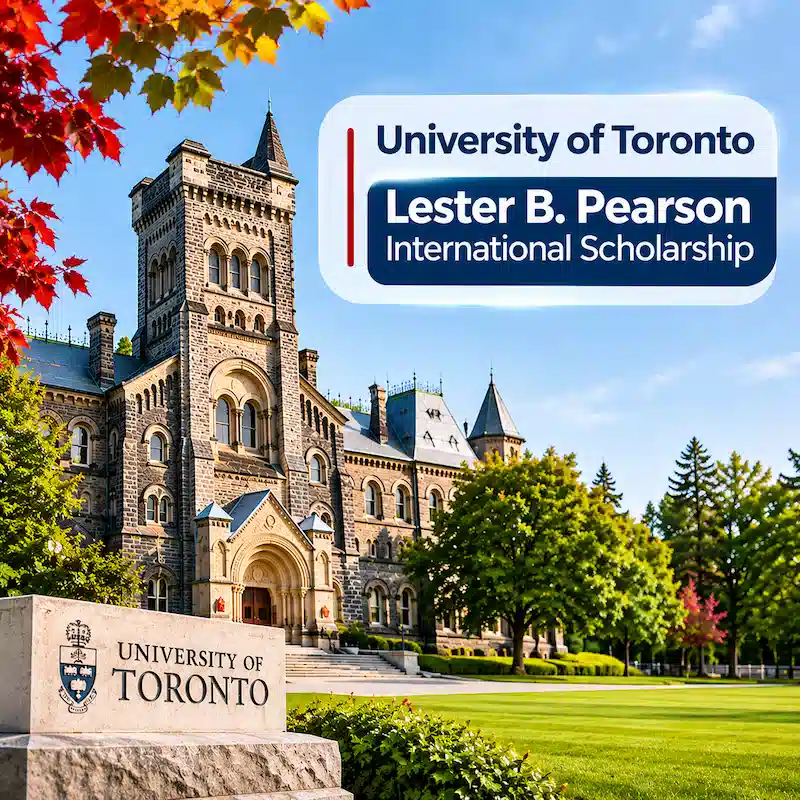
University of Toronto: Lester B. Pearson International Scholarship
The Lester B. Pearson International Scholarship is among Canada’s most substantial undergraduate awards for international students.
The University of Toronto provides approximately 37 Pearson Scholarships annually.
The award covers:
- Tuition fees for four years.
- Books.
- Incidental fees.
- Full residence support for four years.
The scholarship recognizes exceptional academic achievement, creativity, and leadership potential.
However, students cannot apply independently without the required school nomination.
An applicant must be nominated by an eligible high school and apply to an undergraduate program at the University of Toronto.
Each participating high school may nominate only one student per year.
For the September 2027 intake, eligibility also depends on the applicant’s secondary school graduation date and whether they have already started post-secondary education.
The scholarship is intended for students entering their first undergraduate program.
An applicant who has already begun university studies is not eligible simply because they wish to transfer to the University of Toronto.
There is also an important application integrity consideration.
The university explicitly states that the Pearson Scholarship Program does not work with educational agents or agencies to recruit scholarship candidates.
Applicants should follow the university’s official nomination and application procedures.
Official scholarship information: Lester B. Pearson International Scholarship, University of Toronto.

University of British Columbia: International Major Entrance Scholarship
The University of British Columbia offers merit-based entrance awards to outstanding international undergraduate students.
One example is the International Major Entrance Scholarship (IMES).
For the 2027–2028 academic year, UBC lists annual award values between CAD 10,000 and CAD 25,000.
The scholarship can be renewed for up to three additional years, subject to the applicable requirements.
Eligible applicants are generally considered automatically when they apply for undergraduate admission by the university’s deadline.
Applicants must demonstrate strong academic performance and extracurricular involvement.
The award is not designed to cover every student’s full cost of attendance.
UBC specifically advises recipients to prepare a financial plan for the remainder of their educational expenses.
For example, a student receiving CAD 15,000 annually may still face substantial tuition and living costs.
The scholarship reduces the financial burden, but the student must establish how the remaining expenses will be covered.
UBC International Scholars Program
UBC also offers the International Scholars Program for exceptional international students who demonstrate significant financial need.
Unlike its automatic merit-based entrance awards, this program requires a dedicated application.
Students are assessed on academic achievement, leadership, contributions to their communities, and financial circumstances.
The university evaluates family income, expenses, assets, and other relevant financial information.
Applicants must generally be entering their first undergraduate degree directly from secondary school.
Certain degree programs are excluded.
The International Scholars Program therefore serves a different group of applicants from those seeking purely merit-based awards.
Students who require substantial financial assistance should examine the full eligibility criteria before deciding which UBC scholarship route is appropriate.

University of Alberta: President’s International Distinction Scholarship
The University of Alberta offers the President’s International Distinction Scholarship to a limited number of exceptional international undergraduate students.
The award is valued at up to CAD 120,000 over four years.
The university identifies approximately 25 recipients annually.
Applicants are assessed on academic achievement and demonstrated leadership qualities.
The award requires a separate scholarship application after the applicant has applied for an eligible undergraduate degree program.
This is different from scholarships awarded automatically based on admission grades.
The maximum scholarship amount should not be interpreted as a guarantee that every eligible student will receive CAD 120,000.
The university selects a limited number of recipients, and the award remains competitive.

University of Calgary: International Entrance Scholarship
The University of Calgary offers an International Entrance Scholarship valued at CAD 20,000.
The award is renewable in the second, third, and fourth years when recipients meet the renewal conditions.
These include maintaining the required academic performance and continuing to pay international tuition fees.
The university lists two awards under this scholarship.
Because the number of recipients is limited, applicants should not rely on receiving the scholarship when calculating their initial study budget.
The award demonstrates how a renewable entrance scholarship can provide meaningful financial support throughout an undergraduate degree, even when it does not cover the full cost of attendance.
Comparing Major Undergraduate Scholarship Opportunities
The following examples illustrate the different funding models offered by Canadian universities.
| University | Scholarship | Published Funding | Application Method |
|---|---|---|---|
| University of Toronto | Lester B. Pearson International Scholarship | Tuition, books, incidental fees, and residence for four years | School nomination and separate scholarship application |
| University of British Columbia | International Major Entrance Scholarship | CAD 10,000–25,000 annually for 2027–2028; potentially renewable | Automatic consideration with eligible admission application |
| University of British Columbia | International Scholars Program | Substantial need-and-merit-based assistance; individualized assessment | Separate application and nomination |
| University of Alberta | President’s International Distinction Scholarship | Up to CAD 120,000 over four years | Separate scholarship application |
| University of Calgary | International Entrance Scholarship | CAD 20,000, renewable for up to four years | Application through the university’s award process |
The figures above reflect published award terms reviewed in November 2026.
Scholarship amounts, application deadlines, and eligibility conditions may change between admission cycles.
These examples are not a complete list of Canadian undergraduate scholarships, and they should not be interpreted as a ranking of the best universities.
The most suitable opportunity depends on the student’s academic qualifications, financial circumstances, and intended program.
Master’s Scholarships and Funding in Canada
Financial support at the master’s level works differently from undergraduate entrance scholarships.
In particular, students should distinguish between course-based master’s programs and research-based master’s programs.
The distinction can substantially affect the availability of funding.
Research-Based Master’s Programs
Research-based master’s programs usually involve a thesis, major research paper, or other substantial research component.
These programs may provide financial support through scholarships, research assistantships, teaching assistantships, or departmental funding.
For example, the University of Waterloo offers minimum funding arrangements for eligible research-based graduate students.
Its published guidance indicates that full-time research master’s students often receive minimum funding of CAD 12,000 for the first year, while actual funding can vary by program.
Some departments provide higher amounts.
Funding availability is connected to the program’s academic structure and the institution’s policies.
For international applicants, research-based programs can therefore offer opportunities that may not be available in an otherwise similar course-based degree.
Course-Based Master’s Programs
Course-based master’s programs usually emphasize taught courses rather than a substantial independent research project.
These programs are commonly designed for professional development, career advancement, or specialized academic training.
They are not necessarily funded.
The University of Waterloo explicitly states that course-based graduate programs are typically self-funded.
Students are generally expected to pay tuition and incidental fees themselves.
Some programs offer entrance awards or other assistance, but this should not be confused with a guaranteed graduate funding package.
For example, two students may be admitted to master’s programs in engineering at the same university.
One enters a thesis-based program with research funding.
The other enters a course-based professional master’s program and receives no guaranteed financial assistance.
Both are master’s students, but the funding arrangements are substantially different.
Students seeking financial support should investigate the funding policy of the specific academic program, not simply whether the university offers graduate scholarships.
Can International Master’s Students Receive Government Scholarships?
Some government scholarships are restricted by citizenship or immigration status.
An important example is the Canada Graduate Research Scholarship—Master’s (CGRS M).
The program provides CAD 27,000 for 12 months to eligible students.
However, applicants must be Canadian citizens, permanent residents, or qualifying protected persons by the application deadline.
An international student holding only a Canadian study permit does not qualify for this program.
This distinction is important because the scholarship may appear in search results for master’s scholarships in Canada without a clear explanation of the citizenship restrictions.
International applicants should focus on university funding, external scholarships open to their nationality or status, and other eligible forms of graduate assistance.
Research Assistantships and Teaching Assistantships
Some graduate students receive part of their funding through academic employment.
These arrangements can be particularly relevant for research-based master’s and doctoral programs.
However, assistantships should not automatically be described as scholarships.
Research Assistantships
A Research Assistantship (RA) generally involves contributing to a research project under the supervision of a faculty member or research team.
The work may include laboratory research, data analysis, software development, literature reviews, fieldwork, or other academic tasks.
Funding may come from a professor’s research grant or another institutional source.
For example, a master’s student in computer science may assist with a machine learning research project.
The professor may have funding available to support graduate researchers.
However, the availability of that funding depends on the research project, the supervisor, and the institution.
A student who receives admission to a research-based program should not assume that every professor has funding available.
Teaching Assistantships
A Teaching Assistantship (TA) generally involves supporting academic instruction.
Responsibilities may include leading tutorials, grading assignments, conducting laboratory sessions, or assisting with course administration.
Teaching assistant positions are often available to graduate students, but they are not necessarily guaranteed.
The number of positions and the selection procedures vary between faculties and departments.
A student may receive a guaranteed funding package that includes teaching duties, or they may need to apply separately for available positions.
The distinction should be established before the student accepts the admission offer.
Are Assistantships Included in Graduate Funding Packages?
Yes, they can be.
For example, a university may offer a doctoral student an annual funding package composed of:
- A university scholarship.
- Research assistantship compensation.
- Teaching assistantship compensation.
- Departmental funding.
The published funding amount may represent the combined value of these sources.
This matters when interpreting an offer.
A student who receives a CAD 30,000 funding package should not assume they will receive CAD 30,000 in scholarship payments plus additional income from every assistantship.
The assistantships may already be included in the total.
PhD Scholarships in Canada
Doctoral funding is often more substantial than funding available for undergraduate and course-based master’s students.
Many Canadian universities provide financial assistance to eligible PhD students through combinations of institutional awards, research grants, and academic employment.
However, funding arrangements are not identical across universities.
Even within the same institution, eligibility and funding duration can depend on the doctoral program.
UBC: Minimum PhD Funding
The University of British Columbia introduced a significant increase to its doctoral minimum funding policy in September 2026.
Under the updated policy, full-time PhD students at UBC’s Vancouver campus receive a minimum funding package of CAD 40,000 per year during their first four years.
The policy applies to eligible domestic and international doctoral students.
Funding may come from a combination of sources, including:
- Internal or external scholarships.
- Research assistantships.
- Teaching assistantships.
- Graduate academic assistantships.
The CAD 40,000 represents the minimum annual funding package under the relevant policy.
It does not mean that every doctoral student receives a separate CAD 40,000 scholarship in addition to all other funding.
Students must also consider whether tuition and other expenses are deducted from or covered separately by the funding arrangement.
The policy applies to the Vancouver campus and should not automatically be generalized to every UBC campus or every Canadian university.
University of Waterloo: Doctoral Funding
The University of Waterloo also publishes minimum funding arrangements for eligible PhD students.
As of May 1, 2026, its minimum funding for full-time doctoral students is CAD 29,145 annually, for up to four years, subject to the applicable conditions.
Both domestic and international students may qualify under the university’s doctoral funding policies.
This illustrates why students should compare actual funding offers rather than assuming that Canadian PhD programs provide identical financial support.
A program with a larger annual funding package may also be located in a city with higher living costs.
The value of the funding should therefore be considered alongside tuition and expected living expenses.
Canada Graduate Research Scholarship—Doctoral
The Canada Graduate Research Scholarship—Doctoral (CGRS D) is an important federal research award.
It is administered through Canada’s three federal research granting agencies:
- Canadian Institutes of Health Research (CIHR).
- Natural Sciences and Engineering Research Council of Canada (NSERC).
- Social Sciences and Humanities Research Council (SSHRC).
The award provides:
CAD 40,000 annually for 36 months.
The program supports doctoral research across multiple academic disciplines.
Can International Students Apply for CGRS D?
Yes, but the eligibility requirements are restrictive.
International applicants must already be registered in an eligible doctoral program at a Canadian institution by the application deadline.
An applicant who is still living abroad and has only received an admission offer does not satisfy this specific registration requirement.
The program also limits the proportion of awards available to international applicants.
Under the current rules, up to 15% of CGRS D awards may be allocated to international applicants.
This is an important distinction from university funding packages that may be offered to international students before they begin their studies.
An international applicant interested in CGRS D should confirm their registration status and the application procedure with the university’s graduate studies office.
What Happened to the Vanier Canada Graduate Scholarships?
The Vanier Canada Graduate Scholarships program was discontinued in 2025–2026 as Canada reorganized its federal graduate research funding.
The revised structure includes the Canada Research Training Awards Suite.
Existing Vanier recipients may continue to be supported under their award terms, but prospective applicants should not treat Vanier as an active competition for new doctoral scholarships.
Older scholarship websites may still describe Vanier as a current opportunity.
Applicants should use the official federal research agency pages to identify programs that are actually accepting applications.
Government of Canada Scholarships for International Students
The Government of Canada provides international scholarship opportunities through several programs.
However, not all these scholarships are designed to fund complete bachelor’s, master’s, or doctoral degrees.
Some support short-term academic exchanges or research visits.
Others are restricted by nationality, country of study, academic discipline, or the student’s immigration status.
This distinction is especially important when searching for government scholarships.
Study in Canada Scholarships
Global Affairs Canada administers the Study in Canada Scholarships program.
Despite its broad name, the program is primarily intended to support short-term study or research exchanges at Canadian institutions.
It is not a general scholarship covering a complete four-year bachelor’s degree or two-year master’s degree.
The program supports eligible international students from specified countries and territories.
Under the 2026–2027 delivery model, Canadian post-secondary institutions are responsible for identifying and selecting eligible participants.
Individual international students cannot submit direct applications to Global Affairs Canada under this program.
For the relevant exchange period, the Canadian institution applies on behalf of eligible participants.
Students interested in this scholarship should contact their home institution or a potential Canadian host institution to understand the available exchange arrangements.
Emerging Leaders in the Americas Program
The Emerging Leaders in the Americas Program (ELAP) supports eligible students from Latin America and the Caribbean undertaking short-term study or research in Canada.
It is another example of a government-supported exchange opportunity rather than a universal degree scholarship.
Country eligibility, academic requirements, and the application procedure must be checked against the current program guidelines.
Where to Find Government Scholarships
EduCanada, the Government of Canada’s official international education platform, maintains information about scholarship opportunities.
Its scholarship database allows students to explore programs by eligibility criteria and academic circumstances.
However, the existence of a scholarship on EduCanada does not mean every international student is eligible.
Applicants should check whether the award supports a complete degree, a short-term exchange, or a research visit.
They should also confirm whether applications must be submitted by the individual or by a Canadian institution.
Fully Funded Scholarships in Canada: What Does Full Funding Mean?
The term fully funded is frequently used in scholarship advertisements.
However, it can describe different financial arrangements.
Some awards cover tuition and residence.
Others provide a stipend intended to support living expenses.
A doctoral funding package may combine several forms of financial assistance without providing a full tuition waiver.
These differences can materially affect the student’s budget.
Comparing Two Funding Offers
Consider two hypothetical offers.
University A
Annual tuition: CAD 28,000
Tuition scholarship: CAD 28,000
Living-expense funding: None
University B
Annual tuition: CAD 12,000
Annual graduate funding package: CAD 32,000
Tuition waiver: None
University A has eliminated the student’s tuition costs.
However, the student still needs sufficient money for accommodation, food, transportation, health insurance, and other expenses.
University B has offered a larger monetary funding package, but the student must establish whether tuition is paid separately or deducted from that amount.
If the student must pay CAD 12,000 in tuition from the CAD 32,000 package, the remaining amount would be CAD 20,000 before considering other charges or deductions.
The headline funding amount alone does not determine which offer is financially better.
What to Check in a Funding Offer
Before accepting a scholarship or graduate funding package, students should understand:
| Funding Detail | Why It Matters |
|---|---|
| Total award amount | Establishes the published value |
| Tuition coverage | Determines how much tuition remains payable |
| Funding duration | Shows how long support is available |
| Renewal conditions | Identifies academic or other requirements for continued funding |
| Assistantship obligations | Clarifies whether teaching or research work is required |
| Additional fees | Helps identify costs not covered by the award |
| External scholarship adjustments | Shows whether another award reduces university funding |
| Payment schedule | Helps with cash-flow planning |
| Funding after the guaranteed period | Important for programs lasting several years |
A student receiving a scholarship should also review the university’s policies concerning additional awards.
Some funding packages are adjusted when the student receives another scholarship.
In those circumstances, winning an external award does not necessarily increase the total financial support by the full value of that award.
How to Find Scholarships That Match Your Academic Profile
Scholarship research is more effective when it begins with the student’s academic circumstances.
An undergraduate applicant, a prospective research master’s student, and an enrolled PhD candidate should not use exactly the same funding strategy.
Undergraduate Applicants
For students applying directly from secondary school, the university’s international undergraduate scholarship page is usually a useful starting point.
The key distinction is whether an award requires a separate application.
Automatic entrance scholarships may be assessed using the student’s admission application.
Other awards require nominations, essays, financial documentation, or evidence of leadership activities.
Students should also check whether scholarship deadlines occur before the ordinary university admission deadline.
Missing an early scholarship deadline can eliminate an opportunity even when the student remains eligible for admission.
Research-Based Master’s Applicants
For research-based master’s students, funding opportunities are often connected to the academic department and research supervisor.
A student interested in environmental engineering, for example, may find that a professor has funding available for a particular research project.
Another professor at the same university may not have funding available for new students.
This is why researching the department’s faculty members and their work can be useful.
When contacting a potential supervisor, applicants should explain their relevant academic background, research interests, and connection to the professor’s work.
A generic message sent to dozens of professors is unlikely to communicate a serious research interest.
However, not every master’s program requires applicants to contact a supervisor before applying.
Students should follow the admission and funding procedures established by the specific department.
PhD Applicants
For doctoral applicants, the relationship between admission and funding is particularly important.
Some departments assess applicants for admission and financial support through the same process.
Others require additional funding applications.
A prospective PhD student should examine the department’s minimum funding policy, research opportunities, and the terms of the admission offer.
Where a supervisor is involved, the applicant should understand whether the proposed research position has confirmed funding.
It is also useful to ask how long the guaranteed support will last and whether the funding arrangement may change if the doctoral program takes longer than expected.
Can You Get a Scholarship in Canada Without IELTS?
Scholarship eligibility and university language admission requirements are separate matters.
A university may require an approved English-language test for admission but assess scholarships primarily on academic merit or financial need.
Another institution may recognize alternative evidence of English proficiency or provide an exemption under specified circumstances.
Therefore, it is not accurate to assume that every Canadian scholarship requires IELTS.
Equally, the absence of an IELTS requirement in a scholarship description does not mean the university will admit a student without satisfying its language requirements.
For example, an applicant may qualify for an entrance scholarship based on academic grades but still need to demonstrate English proficiency before receiving an unconditional admission offer.
Students should examine both sets of requirements.
A scholarship award also does not independently exempt an applicant from Canadian immigration requirements.
Scholarships for College, Diploma and Certificate Programs
Scholarships are not limited to university degree programs.
Some Canadian colleges and polytechnic institutions offer entrance awards, bursaries, or other financial assistance to eligible international students.
However, funding opportunities can differ substantially by institution and program.
A college may offer a modest entrance scholarship to selected diploma students.
Another may provide awards only after students have completed one or more academic terms.
Certain scholarships may be restricted to specific programs or campuses.
Applicants should not assume that a college diploma offers the same research funding opportunities as a thesis-based master’s or doctoral program.
Before applying, check whether the award is available to new international students, whether it requires prior study at the institution, and whether it can be used toward tuition.
Students considering graduate certificates should also distinguish these credentials from master’s degrees.
A graduate certificate does not automatically qualify for funding programs intended exclusively for master’s students.
Can Scholarships Be Used as Proof of Funds for a Canadian Study Permit?
Yes.
Immigration, Refugees and Citizenship Canada (IRCC) accepts scholarship documentation as evidence of financial support for eligible study permit applicants.
However, the scholarship must be considered alongside the student’s total financial obligations.
For example, a university may award an international student CAD 15,000 toward first-year tuition.
If the annual tuition is CAD 28,000, the student still needs to demonstrate how the remaining CAD 13,000 will be paid.
They must also account for living expenses and transportation costs.
An official scholarship letter can help establish the financial assistance available.
However, an award that only covers tuition does not automatically satisfy the requirements for living expenses.
Government Financial Requirements
For regular study permit applications submitted on or after September 1, 2026, IRCC’s published annual living-expense requirement for one student studying outside Quebec is CAD 23,448.
This amount excludes tuition and transportation costs.
Quebec has separate financial requirements.
For programs lasting more than one year, applicants must demonstrate sufficient resources for the first year and explain how they intend to finance the remainder of their studies.
An official multi-year scholarship can therefore be valuable evidence.
However, receiving a scholarship does not guarantee study permit approval.
IRCC assesses the applicant’s financial resources together with the other immigration requirements.
Questions About Scholarships in Canada
Are There Fully Funded Scholarships for International Students in Canada?
Yes, some Canadian universities offer substantial scholarships that cover tuition and specified living or residence expenses.
Research-based graduate programs may also provide funding packages.
However, the meaning of full funding varies by institution and award.
Applicants should verify the exact coverage and conditions.
Can International Students Apply for Government Scholarships?
Some government scholarships are open to international students, but others are restricted by citizenship or immigration status.
For example, the federal CGRS M program is restricted to Canadian citizens, permanent residents, and qualifying protected persons.
The CGRS D program allows certain international doctoral students to apply under specific conditions.
Can I Receive a Scholarship Before Arriving in Canada?
Yes.
Many undergraduate entrance scholarships are awarded during the admission process, before students begin their studies in Canada.
Research-based graduate students may also receive funding commitments in their admission offers.
However, some awards require students to be enrolled at the institution before applying.
Do All Canadian PhD Students Receive Funding?
No.
Funding policies differ between universities and academic programs.
Some institutions guarantee minimum funding for eligible doctoral students, while others assess support according to departmental resources and individual circumstances.
Applicants should confirm the funding terms before accepting admission.
Can I Combine More Than One Scholarship?
Sometimes.
Whether scholarships can be combined depends on the rules governing each award.
Some universities allow students to hold multiple awards.
Others adjust institutional funding when an external scholarship is received.
The applicable terms should be checked before assuming that all award amounts can be added together.
Choosing a Canadian University With Funding in Mind
For international students, the most valuable scholarship is not necessarily the one advertising the largest amount.
A renewable scholarship that reduces tuition over four years may be more useful than a larger one-time award.
A research master’s program with confirmed funding may be more affordable than a course-based program at the same university.
A doctoral funding package should be evaluated against tuition costs, living expenses, assistantship obligations, and the duration of guaranteed support.
Students should also consider the quality and suitability of the academic program itself.
A scholarship that makes an unsuitable program less expensive does not necessarily make it the right educational choice.
The most useful comparison considers academic fit, admission requirements, total costs, and the actual financial assistance available.
If you are considering a Canadian university or graduate program, understanding how scholarships affect your overall study budget and financial documentation can help you prepare for the study permit process.
Scholarship decisions remain the responsibility of the awarding institutions and organizations. No consultancy can guarantee a competitive scholarship award.
Official Sources: