A Canadian university has offered you admission to your preferred program. You have accepted the offer, prepared your financial documents, and received the provincial attestation letter required for your application.
Does that mean your study permit will be approved?
Not necessarily. Academic admission and immigration approval are separate decisions.
A Canadian university assesses whether you meet its educational requirements. Immigration, Refugees and Citizenship Canada (IRCC) assesses whether you qualify to enter or remain in Canada as an international student.
That assessment goes beyond confirming that you have been accepted into a program.
An immigration officer considers your financial capacity, the purpose of your proposed studies, your immigration circumstances, admissibility, and whether you will respect the conditions of your temporary stay.
Two applicants admitted to the same program can therefore receive different decisions.
For example, an applicant with a credible funding arrangement and a clearly explained academic plan may present a different case from someone whose available funds cannot be adequately documented or whose proposed studies are inconsistent with the information in their application.
A successful study permit application requires more than collecting the mandatory documents. The evidence must establish that the applicant meets Canada’s immigration requirements.
This guide explains how the Canadian study permit system works in 2026, who can apply, which documents are required, how financial capacity is assessed, and what applicants should know before and after receiving a decision.
What Is a Canadian Study Permit?
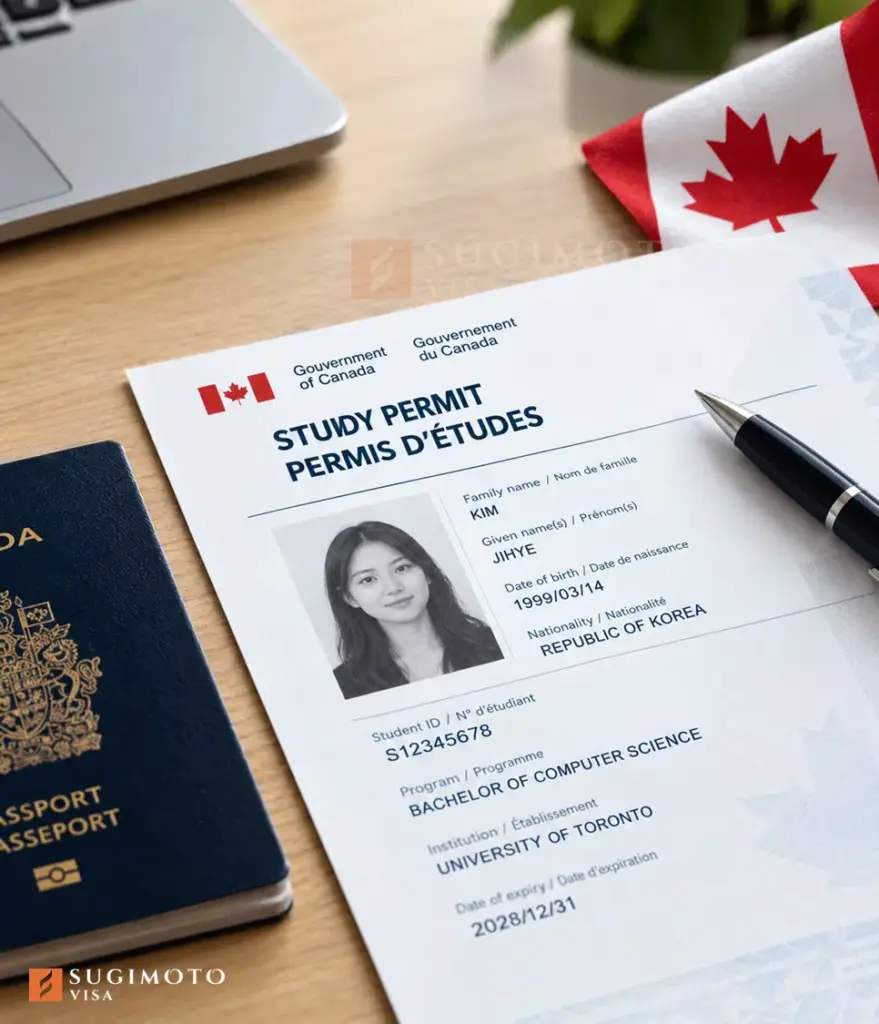
A study permit is an immigration document issued by the Government of Canada that authorizes a foreign national to study in Canada under specified conditions.
Most international students pursuing academic programs lasting longer than six months require a study permit.
The document identifies the conditions under which the holder may study and remain in Canada.
Depending on the circumstances, these conditions may relate to the educational institution, employment authorization, medical restrictions, and the period of authorized stay.
A study permit is not the same as a university admission letter.
It is also not the same as a Canadian visitor visa.
Study Permit vs Student Visa
The expressions student visa and study permit are often used interchangeably, but they have different meanings under Canadian immigration law.
A study permit authorizes studies in Canada.
A Temporary Resident Visa (TRV), commonly called a visitor visa, is a travel document that allows a visa-required foreign national to travel to a Canadian port of entry and request admission.
Travellers from certain visa-exempt countries require an Electronic Travel Authorization (eTA) instead.
| Document | Purpose |
|---|---|
| Letter of Acceptance | Confirms admission to an educational institution |
| PAL/TAL | Confirms an allocation under the applicable provincial or territorial study permit framework |
| CAQ | Quebec’s provincial authorization for studies |
| Study Permit | Authorizes studies in Canada under specified conditions |
| TRV | Allows a visa-required person to travel to a Canadian port of entry |
| eTA | Electronic travel authorization for eligible visa-exempt travellers |
A person may need both a study permit and a TRV or eTA.
For example, a student from a visa-required country who applies from outside Canada and receives approval will generally receive a letter of introduction and the necessary instructions to obtain a visa.
The actual study permit is normally issued when the student arrives at a Canadian port of entry.
Does a Study Permit Guarantee Entry Into Canada?
No. Study permit approval does not eliminate the examination conducted by the Canada Border Services Agency (CBSA) when a traveller arrives.
A border services officer may review the student’s passport, letter of introduction, admission documents, financial circumstances, and other relevant information.
The traveller must continue to satisfy the applicable entry requirements.
An immigration approval obtained before travel is therefore an important authorization, but it does not make the border examination unnecessary.
Who Needs a Study Permit to Study in Canada?
Most foreign nationals undertaking studies in Canada require a study permit unless they qualify for a specific exemption.
The requirement depends on the nature and duration of the studies and the person’s immigration circumstances.
Programs Longer Than Six Months
A foreign national admitted to a full-time university degree or college diploma lasting longer than six months will generally need a study permit.
For example, an international student entering a four-year bachelor’s degree at a public Canadian university will normally require one.
The same general principle applies to master’s degrees, doctoral programs, and eligible college qualifications.
However, some foreign nationals may qualify to study without a permit under specific legislative provisions or temporary public policies.
Those exemptions should be assessed individually.
Programs Lasting Six Months or Less
A study permit is generally not required for a course or program lasting six months or less when it can be completed within the period authorized for the person’s stay in Canada.
For example, a visitor may be able to complete a standalone four-month language course without obtaining a study permit.
However, the exemption has limitations.
A student should not assume that completing a short course without a study permit will automatically allow them to continue into a longer academic program.
Someone planning to pursue a sequence of studies may benefit from obtaining the appropriate study authorization before travelling to Canada.
Short-term study authorization also does not automatically provide permission to work.
Children Attending School in Canada
Different rules apply to minor children.
Some children may study at preschool, primary, or secondary school without a study permit, depending on their immigration circumstances and the status of their parents.
Other children need a study permit.
For example, a minor child travelling to Canada primarily to attend school without a parent may require a study permit and evidence of appropriate care arrangements.
The requirements depend on the child’s age, family circumstances, and intended studies.
Work Permit Holders Who Want to Study
Certain foreign workers may qualify to study without obtaining a separate study permit.
However, this is not a general exemption for everyone holding a Canadian work permit.
For example, a temporary public policy allows specified workers whose work permits or work authorization letters meet the relevant June 7, 2023, conditions to study without a separate study permit.
Other limited measures may apply to qualifying apprentices in certain construction occupations.
Workers should examine the applicable requirements before enrolling.
A person who does not qualify for an exemption generally needs the appropriate study authorization.
Canada Study Permit Eligibility Requirements
IRCC assesses whether applicants satisfy the requirements for temporary residence as students.
The central eligibility conditions are established under Canada’s immigration legislation and regulations.
The applicant generally must demonstrate admission to an appropriate educational institution, sufficient financial resources, admissibility, and the intention to comply with the conditions of temporary residence.
Admission to a Designated Learning Institution
Most international students applying for a post-secondary study permit must have a valid letter of acceptance from a Designated Learning Institution (DLI).
A DLI is an institution approved by a provincial or territorial government to host international students.
However, DLI designation does not automatically mean that every program offered by the institution qualifies graduates for a Post-Graduation Work Permit.
These are separate assessments.
A student choosing a program partly because of post-graduation employment plans should verify both the institution’s designation and the program’s PGWP eligibility.
Sufficient Financial Resources
Applicants must demonstrate that they can finance their studies without relying on employment in Canada.
The financial assessment considers tuition, living expenses, and transportation.
If family members are accompanying the student, their expenses must also be included.
IRCC examines more than the numerical balance shown on a bank statement.
The available funds, their source, and the applicant’s ability to use those resources throughout the proposed studies can all be relevant.
Admissibility to Canada
Applicants must satisfy Canada’s immigration admissibility requirements.
Depending on their circumstances, this may involve medical, criminality, security, or other assessments.
For example, IRCC may request a police certificate or require an immigration medical examination.
The requirement depends on the applicant’s individual circumstances.
A medical examination is not automatically necessary for every student simply because the intended program lasts several years.
Genuine Purpose of Study
An officer must be satisfied that the applicant genuinely intends to pursue the proposed education.
A letter of acceptance helps establish the existence of an academic program, but it does not necessarily explain why the applicant wishes to undertake that program.
The assessment may consider the applicant’s previous education, employment history, proposed studies, and overall circumstances.
For example, a bachelor’s graduate applying for a related master’s degree may have a straightforward academic progression.
An experienced professional applying to a substantially different or lower-level program may need to explain the purpose of the change.
Neither situation automatically guarantees approval or refusal.
The important issue is whether the proposed education and supporting evidence establish a credible study purpose.
Temporary Residence Requirements
A study permit is a form of temporary resident authorization.
Applicants must satisfy an officer that they will leave Canada at the end of their authorized stay if they do not obtain another lawful immigration status.
This requirement does not mean that every international student must permanently abandon the possibility of living in Canada after graduation.
Canadian immigration law recognizes that a person may have both temporary and potential permanent residence intentions.
However, the applicant must still satisfy the requirements for temporary residence.
Understanding Dual Intent in Study Permit Applications
Dual intent is an important concept in Canadian immigration law.
It describes circumstances in which a foreign national intends to enter Canada temporarily while also considering or pursuing permanent residence.
Section 22(2) of the Immigration and Refugee Protection Act recognizes that an intention to become a permanent resident does not automatically prevent someone from obtaining temporary resident status.
However, the applicant must still satisfy the officer that they will leave Canada when required.
Can You Apply for a Study Permit if You Want Permanent Residence Later?
Yes. For example, a student may intend to complete a Canadian degree, gain eligible work experience after graduation, and explore permanent residence if they qualify under a future immigration program.
That possibility is not inherently inconsistent with temporary resident status.
However, the applicant cannot assume that future work authorization or permanent residence will be available.
Study permit holders must comply with their temporary residence conditions.
If the applicant cannot obtain further lawful status, they must be prepared to leave Canada when required.
Is a Statement About Returning Home Mandatory?
Applicants must satisfy the legal requirement concerning departure at the end of their authorized stay.
However, there is no universal requirement that every student must demonstrate ownership of property or permanent employment in their country of citizenship.
An officer considers the evidence relevant to the individual application.
For example, family relationships, career circumstances, previous immigration compliance, financial arrangements, and the purpose of the proposed studies may be relevant.
The assessment is not a simple checklist of possessions or family ties.
A student should provide accurate information about their circumstances rather than constructing an artificial narrative solely to suggest that they have no interest in future Canadian immigration.
Does a Previous Permanent Residence Application Prevent Study Permit Approval?
Not automatically.
An applicant’s immigration history may be relevant to the assessment, but the existence of a previous or pending permanent residence application is not necessarily disqualifying.
The applicant must still establish eligibility for temporary residence.
Failure to disclose relevant immigration history or providing inconsistent information can create additional concerns.
Accuracy and consistency are important throughout the application.
Documents Required for a Canada Study Permit
The document checklist depends on whether the applicant is applying from outside or inside Canada, the intended program, country-specific visa office instructions, and personal circumstances.
Some documents are routinely required.
Others apply only in particular situations.
| Document | General Requirement |
|---|---|
| Valid passport or acceptable travel document | Required |
| Letter of Acceptance | Generally required, subject to limited exceptions |
| PAL/TAL | Required for many applicants unless exempt |
| Quebec CAQ | Generally required for qualifying studies in Quebec |
| Proof of financial support | Required |
| Letter explaining the purpose of study | Recommended by IRCC |
| Immigration medical examination | If required |
| Police certificate | If required |
| Marriage or relationship documents | When relevant |
| Custodianship documents | For certain minor applicants |
| Country-specific supporting documents | Where applicable |
The applicant’s personalized checklist and current IRCC instructions determine the actual submission requirements.
Letter of Acceptance
The Letter of Acceptance (LOA) is issued by the educational institution.
It should contain sufficient information about the intended program.
IRCC’s application guidance identifies information such as the tuition amount, expected start and completion dates, and the deadline for registration.
Applicants should ensure that the letter accurately reflects the program for which they intend to apply.
If the institution has changed the admission date or issued a revised offer, the updated documentation may be necessary.
Verification of Letters of Acceptance
IRCC requires post-secondary DLIs to verify the acceptance documents submitted in study permit applications.
The institution receives a request through IRCC’s verification process.
Under the current procedure, the DLI generally has 10 calendar days to verify the submitted document.
If the institution fails to complete verification within the required period, IRCC may return the application and refund the processing fee.
This requirement makes the accuracy of the admission document particularly important.
Applicants should use acceptance letters issued through the institution’s legitimate admissions procedures.
A document supplied by an intermediary should be independently verifiable with the educational institution.
Provincial or Territorial Attestation Letter
Most new international students applying for undergraduate, diploma, or certificate programs require a PAL or TAL.
The document is normally obtained through the educational institution.
However, important exemptions apply.
Starting January 1, 2026, applicants entering eligible degree-granting master’s or doctoral programs at public DLIs do not need a PAL/TAL.
The exemption does not automatically include graduate certificates or graduate diplomas.
Other exemptions apply to certain primary and secondary students, qualifying exchange students, and specified immigration categories.
Applicants claiming an exemption should provide the relevant supporting evidence.
Quebec Acceptance Certificate
International students planning to study in Quebec must also consider the province’s temporary selection requirements.
Most students entering qualifying programs lasting longer than six months need a Quebec Acceptance Certificate (CAQ).
The federal PAL/TAL exemption for eligible master’s and doctoral students does not automatically eliminate the CAQ requirement.
Quebec’s authorization process should therefore be considered separately.
Passport and Identity Documents
Applicants must provide the required identity documents.
A passport should remain valid for the intended period of travel and study.
IRCC generally cannot issue a study permit beyond the validity of the applicant’s passport or other acceptable travel document.
For example, a student admitted to a four-year degree whose passport expires after 18 months may receive a study permit with a shorter validity period.
The student may subsequently need to renew the passport and apply for an extension.
Additional Documents Based on the Country of Application
IRCC may request documents specific to the visa office processing the application.
For example, a person applying from a country where they are not a citizen may need to demonstrate lawful immigration status there.
Other local instructions may concern translations, civil documents, or additional evidence.
Applicants should consult the instructions associated with their country or territory of application.
The required documents should not be assumed to be identical for every nationality or place of residence.
Study Plan and Letter of Explanation
IRCC recommends including a letter explaining why the applicant wishes to study in Canada and demonstrating an understanding of the responsibilities of an international student.
This document may be described as a Letter of Explanation, Study Plan, or Statement of Purpose.
Universities also use the term Statement of Purpose in academic admissions.
However, an academic admissions essay and an immigration explanation are not necessarily interchangeable.
An academic statement may primarily explain why someone wants to join a particular university.
An immigration explanation should also address information relevant to the applicant’s temporary residence application.
Explaining the Educational Decision
A useful explanation identifies why the proposed program is appropriate for the applicant.
This is more informative than a generic statement that Canada has excellent universities.
The explanation should be supported by the applicant’s actual academic and professional circumstances.
Addressing a Change of Academic Field
Changing fields is not automatically disqualifying.
The applicant should be able to explain the academic connection or professional reason for the change.
A substantial change of discipline may require more detailed supporting information.
However, the applicant does not need to invent an academic connection that does not exist.
A genuine career transition can be explained on its own merits.
Studying After Several Years of Employment
A long period between graduation and a new academic program does not automatically make a person ineligible for a study permit.
Mature students may have legitimate reasons for returning to education.
The application should explain the decision in the context of the person’s career and educational history.
The relevant question is whether the proposed studies are credible and consistent with the available evidence.
Applying for a Lower-Level Credential
An applicant who already holds a master’s degree may choose to pursue a college diploma.
Such an application is not automatically prohibited. However, it may raise questions about the purpose of the proposed education.
The supporting documents should explain why the new credential is useful and how the curriculum differs from the applicant’s previous education.
Canada Study Permit Financial Requirements in 2026
Applicants must demonstrate sufficient funds for their studies without depending on future employment in Canada.
The assessment covers three main categories:
- Tuition and other applicable academic costs.
- Living expenses for the student and accompanying family members.
- Transportation to and from Canada.
IRCC publishes minimum living-expense amounts that are updated periodically.
These amounts are not estimates of what every student will actually spend.
A student may require more money depending on the city, housing arrangements, and individual circumstances.
Financial Requirements Outside Quebec
For regular study permit applications submitted on or after September 1, 2026, IRCC requires the following annual living-expense amounts for applicants studying outside Quebec.
| Family Members, Including Student | Annual Living Expenses (CAD) |
|---|---|
| 1 | $23,448 |
| 2 | $29,192 |
| 3 | $35,888 |
| 4 | $43,572 |
| 5 | $49,419 |
| 6 | $55,736 |
| 7 | $62,054 |
For families with more than seven members, additional amounts apply.
The figures exclude tuition and transportation.
The applicable amount depends on the date the study permit application is submitted.
Example: A Single Student
Consider an applicant admitted to a two-year diploma program in Ontario.
The annual tuition is CAD 20,000.
Assuming the applicant submits the study permit application after September 1, 2026:
| Expense | Amount |
|---|---|
| First-year tuition | $20,000 |
| Required annual living expenses | $23,448 |
| Transportation | Additional |
| Minimum financial plan | $43,448 plus transportation |
The calculation illustrates the financial threshold.
It does not mean every application showing CAD 43,448 will be approved.
IRCC also considers whether the funds are available, properly documented, and consistent with the applicant’s circumstances.
Example: Student Accompanied by a Spouse
Consider a student entering a qualifying master’s program with annual tuition of CAD 24,000.
The student’s spouse intends to accompany them.
The relevant outside-Quebec living-expense amount for two family members is CAD 29,192.
The financial plan must therefore account for:
- CAD 24,000 in first-year tuition.
- CAD 29,192 for annual living expenses.
- Transportation for both family members.
The total begins at CAD 53,192, excluding transportation.
The calculation does not establish whether the spouse qualifies for a work permit.
Family immigration eligibility is assessed separately.
Quebec Financial Requirements
Quebec establishes its own financial requirements.
For applications submitted from January 1, 2026, Quebec’s minimum annual amount for one person’s essential living expenses is CAD 24,617.
For two people, it is CAD 34,814.
These amounts also exclude tuition and international transportation costs.
Students planning to study in Quebec should follow the applicable MIFI instructions and obtain the required provincial authorization.
Proof of Funds for Programs Longer Than One Year
Applicants must demonstrate that sufficient financial resources are available for the first year of study.
However, that is not the entire assessment.
For a program lasting more than one year, IRCC also expects the applicant to explain how the remainder of the education will be financed.
Consider a student entering a four-year bachelor’s degree.
The student does not necessarily need to hold the entire cost of four years of tuition and living expenses in a single bank account at the time of application.
However, the proposed financial arrangement should reasonably demonstrate how the applicant intends to pay for the full program.
For example, a combination of available savings, documented family income, and a renewable scholarship may be relevant.
Future part-time employment in Canada should not be relied upon as the basis for satisfying the financial requirement.
Proof of Funds for a Canada Study Permit ↗
Which Financial Documents Does IRCC Accept?
IRCC identifies several types of evidence that applicants can use to establish financial capacity.
These include bank statements, educational loans, scholarships, tuition payment records, guaranteed investment certificates, and documented financial support from another person.
However, these documents are not interchangeable in every case.
The evidence should establish that the required funds are genuinely available to the applicant.
Bank Statements and Source of Funds
IRCC’s current guidance identifies bank statements covering the previous six months as an example of acceptable financial evidence.
These should include the month of application or the preceding month.
Applicants should also provide documentation showing the source of the income reflected in the statements.
For example, salary deposits may be supported by employment records.
Accumulated savings may be supported by transaction history and evidence of income.
A substantial recent deposit may require additional documentation explaining where the funds came from.
The objective is to demonstrate financial capacity rather than simply display a large closing balance.
Financial Support From Parents or Relatives
Applicants may rely on financial assistance from another person.
For example, parents may undertake to pay a student’s tuition and living expenses.
However, the support arrangement must be adequately documented.
IRCC’s guidance identifies evidence relating to the sponsor’s employment or occupation, relationship to the applicant, other dependants, and the amount of assistance promised.
The financial evidence should be consistent with the sponsor’s circumstances.
A signed support letter without sufficient evidence of financial capacity may not establish that the promised support is available.
Scholarships and University Funding
Scholarships can contribute to a study permit applicant’s financial resources.
For example, a doctoral student may receive a funding package covering tuition and providing an annual stipend.
An official university letter can help establish the amount and duration of the funding.
However, students should examine the actual terms.
A scholarship covering tuition does not necessarily provide the funds needed for living expenses.
Likewise, a stipend may not cover transportation or the costs of accompanying family members.
The financial plan should address any remaining expenses.
Guaranteed Investment Certificates
A Guaranteed Investment Certificate (GIC) from an eligible Canadian financial institution may be used as financial evidence.
However, a GIC is not universally mandatory for every regular study permit application.
The Student Direct Stream, which previously involved specific financial documentation requirements, ended in November 2024.
Regular study permit applicants may use various types of acceptable financial evidence.
The appropriate documentation depends on the applicant’s financial circumstances and the applicable requirements.
How to Apply for a Canada Study Permit From Outside Canada
Most people intending to begin studies in Canada should apply for a study permit before travelling.
The application is generally submitted online through the appropriate IRCC account.
Paper applications are available only in limited circumstances, including certain applicants who cannot apply online because of a disability or who hold specified non-national travel documents.
Preparing the Immigration Application
An applicant should obtain the required admission documents and determine whether a PAL/TAL or CAQ is necessary.
The supporting financial evidence, identity documents, and any additional documentation should also be prepared.
The application must reflect the applicant’s actual circumstances.
For example, someone who is legally residing in a country other than their country of citizenship may need to provide proof of immigration status there.
Completing the Online Application
IRCC uses an online questionnaire to determine which application forms and documents are required.
The resulting checklist depends on the applicant’s responses.
For applications made outside Canada, the required forms may include IMM 1294 and additional family, representative, or supporting forms where applicable.
Applicants should use the current IRCC instructions rather than relying on outdated document checklists.
The information submitted should be consistent across the application forms and supporting records.
Uploading Supporting Documents
Documents must be uploaded in the appropriate sections.
IRCC specifically instructs applicants to place the admission document in the designated Letter of Acceptance field.
Other documents should be uploaded in the corresponding sections.
This matters because IRCC shares the admission document with the DLI for verification.
Where a required document does not have a dedicated upload field, the applicant should follow IRCC’s instructions regarding the appropriate supporting-document section.
Paying Application Fees
Applicants must pay the applicable processing fees.
Biometrics fees are also required when the applicant is not exempt and does not already have qualifying valid biometrics.
After submitting the application, the applicant receives confirmation through the relevant IRCC account.
The application may then proceed through document verification, biometrics, and other assessments.
Applying for a Study Permit From Inside Canada
Not everyone physically present in Canada is eligible to submit an initial study permit application from within the country.
The rules distinguish between different temporary resident categories.
Who Can Apply From Inside Canada?
Certain individuals may qualify, including:
- Holders of valid work or study permits
- Qualifying family members of certain work or study permit holders
- Certain visiting or exchange students
- Individuals who completed an eligible prerequisite course before entering a DLI program
- Certain temporary resident permit holders
- Specific refugee claimants, protected persons, and other eligible applicants
The exact requirements depend on the immigration category.
For example, a worker holding a valid Canadian work permit may be eligible to apply for a study permit from inside Canada.
However, eligibility to submit the application does not automatically authorize the person to begin the proposed studies.
Can a Visitor Apply for a Study Permit From Inside Canada?
Most visitors cannot use the ordinary inside-Canada process to apply for an initial study permit.
A visitor may qualify under a specific exception, but visitor status alone is generally insufficient.
For example, someone visiting Canada who receives an offer from a college should not automatically assume they can submit an initial study permit application from within Canada.
The applicant may need to follow the outside-Canada application process.
Being physically present in Canada does not independently establish eligibility for the inside-Canada process.
Changing From a Work Permit to a Study Permit
A person holding a valid work permit may be eligible to apply for a study permit from inside Canada.
However, the application does not automatically preserve employment authorization after the original work permit expires.
Consider a worker whose permit expires on December 15.
The worker applies for a study permit on November 20.
If the study permit application remains under assessment on December 15, the person cannot assume they may continue working under the expired work permit.
Under the applicable rules, employment authorized by the original work permit must cease when that authorization expires unless another independent basis for working exists.
Similarly, the person cannot normally begin studies requiring a study permit merely because the application has been submitted.
This distinction is particularly important for workers considering a transition into full-time education.
Working While Studying in Canada ↗
Can You Hold a Work Permit and Study Permit at the Same Time?
Potentially, yes. IRCC confirms that a person may hold both permits when they qualify for each and can demonstrate that they are able to satisfy both sets of conditions.
For example, someone employed in Canada may wish to pursue an academic program while continuing authorized employment.
The applicant may need to explain how the work schedule and educational commitments can be managed together.
However, holding both documents does not automatically remove the conditions associated with either permit.
The effect of full-time studies on eligibility for future immigration programs must also be considered.
Canada Study Permit Application Fees
The standard federal study permit processing fee is CAD 150 per applicant.
Biometrics fees are separate where applicable.
| Application Expense | Amount (CAD) |
|---|---|
| Study permit application | $150 |
| Biometrics – individual | $85 |
| Biometrics – qualifying family maximum | $170 |
| Study permit extension | $150 |
| Restoration of student status and new study permit | $396.25 |
These are the applicable federal fees under the current fee schedule.
Additional costs may arise for medical examinations, translations, police certificates, or other third-party services.
Quebec’s CAQ fee is also separate.
Do You Pay Separately for a TRV?
When an eligible outside-Canada study permit application is approved, IRCC generally issues the required TRV or eTA as part of the process.
The applicant does not normally need to submit a separate initial visitor visa application or pay another application fee solely to obtain that travel document.
However, students already in Canada who extend their study permits may need a separate TRV application if they require a new visa for future international travel.
A study permit extension does not automatically renew a TRV.
Biometrics for Study Permit Applicants
Most applicants between the ages of 14 and 79 need to provide fingerprints and a photograph unless they qualify for an exemption or have valid biometrics already on file.
Biometrics for temporary residence applications are generally valid for ten years.
However, the applicant should check whether previously submitted biometrics remain valid for the intended application.
Biometrics Instruction Letter
After submitting a complete application and paying the applicable fee, an applicant who needs biometrics generally receives a Biometrics Instruction Letter (BIL).
The letter explains how and where biometrics must be provided.
Applicants normally have 30 days from the date of the letter to provide biometrics.
However, special instructions can apply.
For example, eligible doctoral applicants seeking faster processing in 2026 must provide biometrics within two weeks of receiving the BIL.
Does Giving Biometrics Mean the Application Is Approved?
No. Biometrics are part of the identity verification and screening process.
Providing them does not establish that the application satisfies the financial or other requirements.
Likewise, receiving a request for biometrics does not guarantee that the final decision will be positive.
Immigration Medical Examinations
Some study permit applicants must complete an immigration medical examination (IME).
The requirement depends on factors such as the intended length of stay, recent residence or travel history, and certain activities involving public health.
For example, a person intending to stay in Canada for more than six months may require an IME if they have lived in or travelled to certain designated countries for six consecutive months or more during the relevant preceding period.
Students intending to work in certain healthcare or childcare settings may also require a medical examination.
Do All International Students Need an IME?
No. The requirement is not determined solely by the fact that someone is applying for a study permit.
For example, two students from the same country may have different medical examination requirements because of their recent travel histories or intended activities.
Applicants should use IRCC’s current medical examination instructions.
Who Can Perform the Examination?
An immigration medical examination must be performed by an approved panel physician.
A routine examination performed by an applicant’s usual doctor does not necessarily satisfy IRCC’s requirements.
The applicant should follow the instructions concerning upfront medical examinations or examinations requested during processing.
Canada Study Permit Processing Time in 2026
Study permit processing times vary.
There is no single processing time that applies to every application submitted from every country.
IRCC considers factors such as application volumes, completeness, verification requirements, and individual circumstances.
Additional medical or security assessments can affect the time required.
The official processing-time tool provides estimates based on the relevant application category and location.
However, published processing times are not guarantees.
When Should You Apply?
Applicants should consider the start date of their academic program, document preparation requirements, and the applicable processing estimates.
For example, a student whose program begins in September may need time to receive the admission letter, obtain a PAL, gather financial records, complete biometrics, and submit the application.
It may also take time to obtain a visa counterfoil after approval.
A student who waits until shortly before the academic start date may face difficulties even if their application ultimately qualifies for approval.
Faster Processing for Doctoral Students in 2026
IRCC introduced faster processing arrangements for certain doctoral applicants.
Eligible applicants must be entering a doctoral degree program, applying online, and submitting the application from outside Canada.
Their accompanying eligible family members may also benefit when applications are submitted together.
IRCC aims to process qualifying applications within approximately two weeks after the relevant prerequisites are completed.
However, incomplete applications and cases requiring additional medical or security screening may not qualify.
This arrangement does not automatically extend to ordinary master’s, bachelor’s, or graduate certificate applicants.
Is the Student Direct Stream Still Available?
No. The Student Direct Stream (SDS) and Nigeria Student Express (NSE) ended on November 8, 2024.
New applications are processed through the applicable regular study permit process.
Applicants should be cautious about services advertising a current SDS application route or guaranteed faster processing based solely on the former program.
What Happens After You Submit Your Study Permit Application?
After submission, IRCC assesses whether the application is complete and whether the applicant meets the relevant requirements.
The process may involve document verification, biometrics, medical examinations, and additional requests.
Applicants should monitor their IRCC accounts and respond to legitimate requests within the specified deadlines.
Letter of Acceptance Verification
Post-secondary institutions are required to verify submitted acceptance documents.
If the institution does not complete verification in the required timeframe, the application may be returned.
Applicants should ensure they remain in contact with their institutions, particularly when they have changed their intake or obtained a revised admission letter.
Requests for Additional Information
IRCC may request additional documents when necessary.
For example, an officer may seek clarification regarding financial resources, immigration history, or other relevant matters.
The applicant should provide accurate information responsive to the request.
Submitting unrelated documents does not necessarily resolve the concern.
Misrepresentation
Providing false information or withholding material facts can have serious immigration consequences.
For example, an applicant who submits altered financial statements or an inauthentic admission letter may face a finding of misrepresentation.
Such a finding can lead to refusal and other consequences under Canadian immigration law, including a possible period of inadmissibility.
Applicants should ensure that all documents and statements accurately represent their circumstances.
The use of an immigration representative does not remove the applicant’s responsibility for the accuracy of the application.
What Happens if Your Study Permit Is Approved?
The next stage depends on whether the applicant applied from outside or inside Canada.
Approval From Outside Canada
Applicants approved from outside Canada normally receive a Port of Entry Letter of Introduction.
This letter confirms the approval but is not the actual study permit.
Applicants who require a TRV must complete the relevant passport submission process.
Visa-exempt travellers who require an eTA generally receive the appropriate authorization electronically.
The student then travels to Canada with the required documents.
Documents to Carry When Travelling
Students should be prepared to present the relevant immigration and admission documents when arriving in Canada.
These may include:
- A valid passport or travel document.
- The Port of Entry Letter of Introduction.
- A valid TRV or eTA where required.
- A current letter of acceptance.
- Evidence of available financial resources.
- Any documents specifically requested by IRCC.
The border services officer may ask questions about the student’s intended studies and circumstances.
Receiving the Study Permit at the Border
For an applicant approved from outside Canada, the actual study permit is normally issued at the port of entry.
Students should review the document before leaving the examination area.
For example, they should check the expiry date, institutional information where applicable, and employment conditions.
An error affecting important details should be brought to the officer’s attention.
Approval From Inside Canada
Applicants who qualify to apply from within Canada receive their study permits through the inside-Canada process.
IRCC generally sends the permit to the Canadian mailing address provided.
When the application is approved, the applicant may receive an approval notification in their online account before the physical document arrives.
IRCC states that eligible inside-Canada applicants may begin studying after receiving the approval letter rather than waiting for the paper permit to arrive.
They must still satisfy any applicable conditions.
Can You Change Your University After Study Permit Approval?
Changing schools can require a new immigration application.
The procedure depends on whether the applicant is outside or inside Canada and whether the study permit has been approved.
Changing DLIs Before Travelling
If a student applied from outside Canada and received study permit approval but then decides to attend a different DLI, they generally must submit a new study permit application.
The new application requires the appropriate admission documents and fees.
An approval associated with University A does not automatically authorize the student to attend University B.
Changing DLIs While an Application Is Pending
An applicant may decide to change educational institutions before IRCC has made a decision.
Under the current instructions, the applicant can notify IRCC through the web form and submit an updated acceptance letter and PAL/TAL where required.
However, the applicant must ensure that the change is properly communicated.
Accepting another admission offer does not automatically update the immigration application.
Changing DLIs After Beginning Studies
Since November 8, 2024, post-secondary students generally need a new study permit when changing to another DLI.
For students already in Canada, this typically involves applying to extend the existing study permit for the new institution.
The student normally must receive approval before beginning studies at the new DLI.
Limited exceptions apply in specified circumstances, such as when the previous institution closes or loses designation.
Academic acceptance and immigration authorization should therefore be coordinated before transferring.
How Long Is a Canadian Study Permit Valid?
A study permit is usually issued for the expected duration of the academic program plus an additional 90 days.
However, the actual validity can be shorter.
For example, the student’s passport may expire before the intended completion date.
The permit’s printed expiry date is important, but students must also understand what happens when they complete their studies earlier than expected.
Completing Studies Before the Printed Expiry Date
When a student finishes their program early, the study permit normally becomes invalid on the earlier of:
- The printed expiry date.
- Ninety days after the official completion of studies.
The completion date is generally connected to the first notification from the institution confirming that the program has been completed.
For example, receiving an official completion letter may begin the relevant 90-day period.
The date of the graduation ceremony is not necessarily the determining date.
Does a Study Permit Remain Valid for 180 Days After Graduation?
No. This is a common misunderstanding.
The 180-day application period associated with PGWP is different from the validity of a study permit.
A graduate may have up to 180 days to apply for PGWP, subject to the applicable conditions.
However, the study permit normally becomes invalid 90 days after completion or on its printed expiry date, whichever comes first.
Students should not assume that the PGWP application window automatically extends their temporary resident status.
Maintaining Study Permit Conditions
A study permit holder must continue meeting the applicable conditions while studying in Canada.
These generally include remaining enrolled at a DLI and actively pursuing studies.
IRCC can assess compliance with these requirements.
Post-secondary DLIs also have obligations to report specified enrolment information.
Full-Time and Part-Time Enrolment
Students must follow the enrolment requirements applicable to their academic program and immigration circumstances.
A student who changes from full-time to part-time status may experience consequences for employment authorization or future PGWP eligibility.
For example, many PGWP applicants must demonstrate that they maintained full-time enrolment during the relevant academic sessions, subject to specified exceptions.
Students should investigate immigration implications before reducing their course load.
Authorized Leave From Studies
Students may be permitted to take an authorized leave of up to 150 days in qualifying circumstances.
Examples may include medical reasons, family emergencies, or other institution-authorized situations.
However, the DLI must authorize the leave.
Students should retain documentary evidence.
An authorized leave does not generally permit the student to continue working under ordinary on-campus or off-campus student work authorization.
Working While Studying
Eligible international students may generally work up to 24 hours per week off campus during regular academic sessions.
Different rules apply to qualifying scheduled breaks and on-campus employment.
However, not every study permit holder automatically qualifies.
For example, students enrolled only in English or French as a second language programs generally do not qualify for ordinary off-campus work authorization.
Students should verify their eligibility before accepting employment.
Mandatory Co-op and Internship Placements
As of April 1, 2026, eligible post-secondary international students no longer need a separate co-op work permit for required student work placements.
The placement must satisfy IRCC’s conditions and be approved by the DLI.
This change does not provide unrestricted authorization for optional internships.
Secondary-level students may still need a separate co-op work permit for qualifying placements.
Extending a Study Permit in Canada
Students who need additional time to complete their programs must apply for the appropriate extension before their study permits expire.
IRCC recommends applying at least 30 days before the expiry date.
Applying earlier may be appropriate when additional documents or provincial authorizations are necessary.
A student studying in Quebec may also need a new CAQ.
What Is Maintained Status?
When an eligible temporary resident submits an extension application before their current status expires, they may be allowed to remain in Canada under maintained status while the application is processed.
However, the conditions governing continued study and employment depend on the person’s circumstances.
Maintained status does not automatically grant new immigration privileges.
For example, a worker applying to change from work permit status to student status cannot simply continue working after the work permit expires.
The legal effect of a pending application depends on the type of authorization being requested.
What if Your Study Permit Already Expired?
A student who has lost temporary resident status may qualify to apply for restoration within 90 days of losing status.
Restoration is subject to specific requirements.
The student must explain the circumstances and pay the applicable fees.
Submitting a restoration application does not automatically authorize continued studies or employment while the application is being assessed.
A person who is not eligible for restoration may need to leave Canada.
The relevant rules should be reviewed before taking further action.
What Happens if a Study Permit Application Is Refused?
A refusal means IRCC has assessed the application and determined that the applicant does not satisfy the relevant requirements.
The refusal letter identifies the officer’s reasons.
Common areas of concern include financial resources, the purpose of the proposed studies, admissibility, and whether the applicant has established that they will comply with temporary residence requirements.
However, not every refusal involves the same issues.
Can You Reapply After Refusal?
In many circumstances, yes.
However, submitting the same application again without addressing the reasons for refusal may not resolve the underlying concerns.
The applicant should examine the decision and determine which evidence or issues require attention.
For example, a refusal related to financial documentation may require a different response from one concerning the purpose of the proposed studies.
Applicants should also consider whether the prior PAL/TAL can be reused.
Under the current rules, a PAL used in a refused study permit application generally cannot be reused for a new application.
A new attestation may be required unless the applicant qualifies for an exemption.
Different rules can apply to a valid Quebec CAQ.
Is There a Right to Appeal a Study Permit Refusal?
There is no ordinary immigration appeal process through which every refused study permit applicant can simply ask a tribunal to substitute a new decision.
Depending on the circumstances, an applicant may consider reapplying, requesting reconsideration, or seeking judicial review in the Federal Court.
Judicial review is subject to specific legal requirements and deadlines.
These options serve different purposes.
A new application is not the same as a legal challenge to the original decision.
Applicants should assess the available options based on the actual refusal and relevant legal circumstances.
Canada Study Permit Refusal Letter ↗
Does a Canadian Study Permit Lead to Permanent Residence?
A study permit authorizes temporary studies.
It does not automatically provide a pathway to permanent residence.
However, some international students may qualify for post-graduation work authorization and later become eligible for economic immigration programs.
For example, an eligible graduate may receive a Post-Graduation Work Permit and gain qualifying Canadian skilled work experience.
That experience may contribute to eligibility for the Canadian Experience Class.
Other applicants may have qualifying foreign skilled work experience or become eligible for provincial immigration pathways.
However, the requirements differ.
Graduating from a Canadian institution does not guarantee PGWP eligibility, employment, an invitation through Express Entry, or permanent residence.
Students should assess educational and immigration goals separately while considering how the two may affect each other.
Canada Study Permit: Frequently Asked Questions
For study permit applications submitted on or after September 1, 2026, a single applicant studying outside Quebec must demonstrate access to CAD $23,448 to cover annual living expenses. In addition to living expenses, you must demonstrate sufficient funds to pay for your first year of tuition and transportation/travel costs to and from Canada. Higher financial thresholds apply if accompanying family members are included.
No, IRCC does not impose a universal IELTS score requirement for regular study permit applications. However, your chosen educational institution will mandate proof of English or French language proficiency for academic admission. Furthermore, an immigration officer must be satisfied that you have the language capability to complete your program.
Most undergraduate and college diploma applicants must include a PAL/TAL with their study permit application. However, you can apply without one if you qualify for an explicit exemption—for instance, starting January 1, 2026, students entering degree-granting Master’s or Doctoral (PhD) programs at public DLIs are exempt from the PAL/TAL requirement.
Generally, no. Entering Canada on a temporary visitor visa does not automatically make you eligible to submit an initial study permit application from inside the country. Inside-Canada study permit applications are restricted to specific eligible categories, such as valid work permit holders, temporary resident permit holders, exchange students, or certain family members of status holders in Canada.
No. Simply submitting a study permit application does not grant temporary work authorization. You must hold an independent legal status that explicitly allows employment (such as an active, valid work permit). If your current work permit expires while your study permit application is pending, you cannot continue working unless you satisfy specific maintained status rules for workers.
Yes, family members can apply concurrently for visas or temporary status alongside the main student applicant. However, being a student’s spouse does not guarantee a Spousal Open Work Permit (SOWP). SOWP eligibility is limited to spouses of students enrolled in Master’s degrees (16+ months duration), Doctoral programs, or select professional university degrees (e.g., Engineering, Medicine, Nursing, Law, Education).
No. PGWP eligibility depends on the specific institution (public vs. private DLI), degree level, field of study (for college diplomas), minimum program duration, and meeting mandatory post-graduation language requirements (CLB 7 for degree graduates, CLB 5 for diploma graduates). You should verify that your program meets all IRCC PGWP criteria prior to enrolling.
There is no restriction against reapplying after a study permit refusal. However, submitting the exact same application will likely result in a repeat refusal. Before reapplying, you should request the officer’s detailed GCMS notes to understand the specific grounds for refusal (e.g., purpose of visit, ties to home country, or financial sufficiency) and address every concern directly with new supporting documentation.
Your study permit automatically becomes invalid 90 days after you receive official written notification of program completion (such as a final transcript or graduation letter), or on the expiration date printed on your permit, whichever comes first. To remain in Canada legally beyond those 90 days, you must apply for a PGWP, transition to another temporary resident status, or leave the country.
While the underlying federal immigration law (IRPA/IRPR) applies nationwide, actual document instructions and evidentiary expectations vary by country. Depending on your nationality and country of residence, IRCC visa offices may require specialized financial proof, local tax records, biometric collection, police clearance certificates, or specific medical exams.
Preparing a Study Permit Application That Reflects Your Circumstances
Applying for a Canadian study permit involves more than securing a place at an educational institution.
The applicant must establish eligibility under Canadian immigration law and provide evidence that supports the proposed studies.
For some applicants, the central issue may be demonstrating financial capacity.
For others, the application may require a detailed explanation of a change in academic direction, previous employment, or immigration circumstances.
Students applying from inside Canada must also determine whether they qualify to use that application process.
Similarly, applicants accompanied by family members should understand how their circumstances affect financial requirements and available immigration authorizations.
A study permit application should be prepared using the rules that apply to the applicant’s actual situation rather than assumptions based on another student’s experience.
Sugimoto Visa provides Canadian immigration consulting services to international students and prospective applicants.
If you are considering studies in Canada, an assessment of your academic admission, financial resources, immigration history, and intended program can help identify which study permit requirements apply and what supporting evidence may be necessary for your application.
Official Sources: