Invest in Alberta is one of the most promising moves you can make in 2026. Alberta is Canada’s economic engine, now growing beyond oil into a high-tech and green energy hub. For global investors, the province offers a mix of financial safety and high profit potential.
Quick Answer: How to Invest in Alberta
To Invest in Alberta and secure a path to residency, you generally need to start or buy a business with an investment starting at $100,000 CAD. The Alberta Advantage Immigration Program (AAIP) rewards entrepreneurs who create jobs for locals and settle in growing communities.
At a Glance: The Alberta Investment Path
- Eligibility: 3–5 years of business ownership or senior management experience.
- Key Steps: Submit an online profile (EOI), get invited, then apply for your work permit.
- Typical Timeline: 18–24 months from your first submission to permanent residency.
- Core Documents: Net worth audit, detailed business plan, and language test results.
- Fees: $200 CAD for the initial profile and $3,500 CAD for the full application.
Eligibility Requirements for Invest in Alberta »
To secure your spot, you’ll need to meet specific 2026 rules. Whether you use the Rural Entrepreneur Stream or the Foreign Graduate pathway, these are the basics:
1. Money Matters (Investment & Net Worth)
Your “entry price” depends on where you want to live. Alberta wants to grow its smaller towns, so it’s cheaper to start there.
- Net Worth: You must prove you own at least $300,000 CAD in total assets.
- Big Cities (Calgary/Edmonton): You’ll need at least $200,000 CAD to invest.
- Rural Towns: For towns under 100,000 people, the minimum is $100,000 CAD.
2. Your Experience
Alberta isn’t just looking for your cash; they want your brain. You usually need 3 to 5 years of experience as a business owner or a top-level manager. It helps if your past work matches the business you want to start here.
3. A Real Business Plan
In 2026, a simple one-page plan won’t work. Your plan needs:
- A clear explanation of how you’ll help the local economy.
- Money predictions for at least 3 years.
- A look at the local Alberta market and your competitors.
4. Creating Jobs
One of the main goals of the program is to help Canadians find work. You’ll need to hire at least one or two full-time workers who are Canadian citizens or permanent residents.
5. Language Skills
You need to show you can talk to customers and staff. You’ll need a “CLB 4” or “CLB 5” score in English or French. This is a basic-to-intermediate level.
| Requirement | Details |
|---|---|
| Minimum Investment | $100k+ (Urban) / $50k+ (Rural) |
| Experience | 3-5 years (Owner/Senior Manager) |
| Language Skill | CLB 4/5 Minimum (English or French) |
| Job Creation | 1-2 Full-time positions |
| Net Worth | $300,000 CAD (Minimum) |
Step-by-Step Roadmap to Invest in Alberta
Investing in Alberta is a structured journey. For 2026, the provincial government has streamlined the process through the Alberta Advantage Immigration Program (AAIP) portal, focusing on “shovel-ready” businesses that can immediately contribute to the economy.
» Phase 1: Market Intelligence & Strategy
Before any legal filings, success starts with data.
- Market Analysis: You must identify whether your business aligns with Alberta’s priority sectors (Tech, Agri-food, Energy, or Tourism).
- The Pitch Deck: Unlike traditional business plans, 2026 requirements often include a “Pitch Deck” for designated agencies to review your concept’s viability before you even apply.
» Phase 2: Business Structure & Legal Registration
Once your strategy is set, you need to establish your legal presence in the province.
- Choosing Your Structure: Most foreign investors opt for Incorporation. Alberta offers a unique advantage here: as of recent updates, you can incorporate a business in Alberta without needing a resident Canadian director (in many cases), making it highly “investor-friendly.”
- NUANS Report: You must obtain an Alberta NUANS report to ensure your business name is unique and compliant with provincial standards.
» Phase 3: The AAIP Pathway (EOI Submission)
For those seeking residency through their investment:
- Expression of Interest (EOI): This is a points-based system. You submit your profile online, and Alberta invites the highest-ranking candidates to apply.
- The Recommendation Letter: If you are applying via the Foreign Graduate Entrepreneur Stream, you must secure a recommendation letter from an AAIP-approved designated agency.
» Phase 4: Licensing & Regulatory Compliance
Alberta is known for cutting “red tape,” but compliance is non-negotiable.
- Business Licensing: Depending on your industry (e.g., cannabis, childcare, or construction), you may need specific provincial licenses.
- CRA Program Accounts: You’ll need to register for a Business Number (BN) and set up accounts for GST (Goods and Services Tax), payroll, and corporate income tax.
» Phase 5: Capital Deployment & Job Creation
This is the execution phase where your “Business Performance Agreement” kicks in.
- Funding: Ensure your funds are transferred through verifiable channels.
- Hiring Locally: To fulfill the requirements for permanent residency, you must begin the recruitment process for Canadian citizens or PR holders as outlined in your business plan.
Investment Costs in Alberta
Understanding the financial landscape is the first step toward a successful venture. While Alberta remains the most cost-effective province in Canada for business, inflation and evolving provincial mandates have shifted the pricing slightly for 2026.
The Baseline: Immigration Program Investments
If your goal is permanent residency through investment, the minimum thresholds for 2026 are categorized by location:
- Urban Investment (Calgary/Edmonton): Minimum $200,000 CAD
- Rural Investment: Minimum $100,000 CAD (in communities with a population under 100,000)
Pro Tip: While these are the “minimums,” successful applicants in 2026 often demonstrate higher capital ready for deployment to gain more points in the AAIP scoring grid.
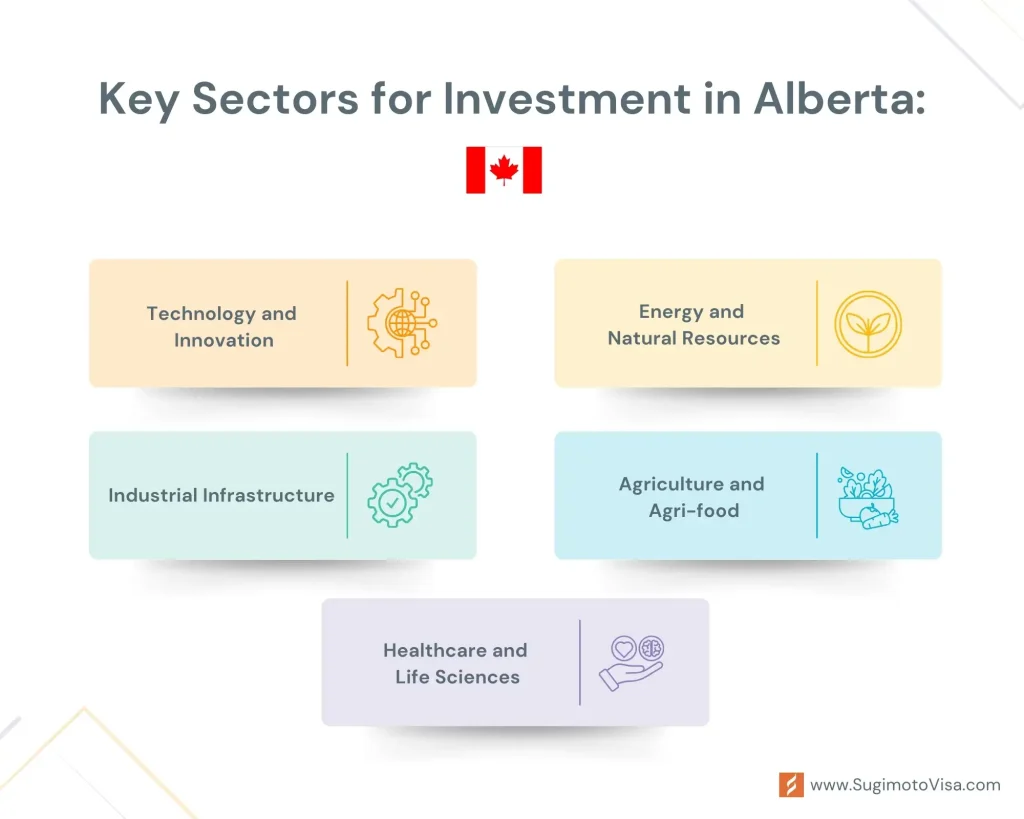
⭐ Key High-Growth Sectors for 2026
1. Energy & Natural Resources: Beyond Oil
Alberta remains a global energy titan, but the narrative has shifted. While oil and gas continue to drive the GDP, the real “buzz” in 2026 is around Clean Tech and Hydrogen.
- The Hydrogen Frontier: Alberta is positioning itself as a world leader in blue and green hydrogen production.
- Renewables & Storage: Following the 2024-2025 policy shifts, the focus has moved toward large-scale battery storage and solar integration, with Alberta accounting for over 90% of Canada’s recent solar capacity growth.
2. Technology & Artificial Intelligence
Calgary and Edmonton have officially cemented their status as “Silicon Valley North.”
- AI & Machine Learning: Home to the Alberta Machine Intelligence Institute (Amii), the province is a magnet for AI startups.
- Government Support: The 2025-2026 Technology and Innovation Strategy has allocated over $200 million to Alberta Innovates, ensuring that tech entrepreneurs have the capital and research support they need to scale globally.
3. Agri-Food & Sustainable Farming
Agriculture is Alberta’s oldest industry, but in 2026, it’s one of its most innovative.
- Value-Added Processing: The government now offers the Agri-Processing Investment Tax Credit, a 12% refundable tax credit for projects over $10 million.
- Global Export Hub: From plant-based proteins to world-class beef, Alberta’s proximity to Asian markets and advanced logistics make it the ideal base for food-tech companies.
4. Life Sciences & Healthcare Innovation
Alberta’s healthcare sector is booming, particularly in Biotechnology and Pharmaceuticals.
- Medical Breakthroughs: Leveraging AI for drug discovery and precision medicine, Alberta is attracting billions in biotech licensing deals.
- Infrastructure: With a unified health system (AHS) providing a massive data pool, it is the perfect “living lab” for clinical trials and med-tech development.
| Investment Area | Why it Matters in 2026 |
|---|---|
| Clean Energy | Massive shift toward Hydrogen and carbon capture (CCUS) projects. |
| Advanced Agri-Tech | New tax credits for large-scale food processing facilities. |
| Digital Infrastructure | Expansion of 5G and high-speed fiber across rural Alberta. |
| Commercial Real Estate | Industrial and logistics hubs in Calgary and Edmonton are at record demand. |
Final Notes
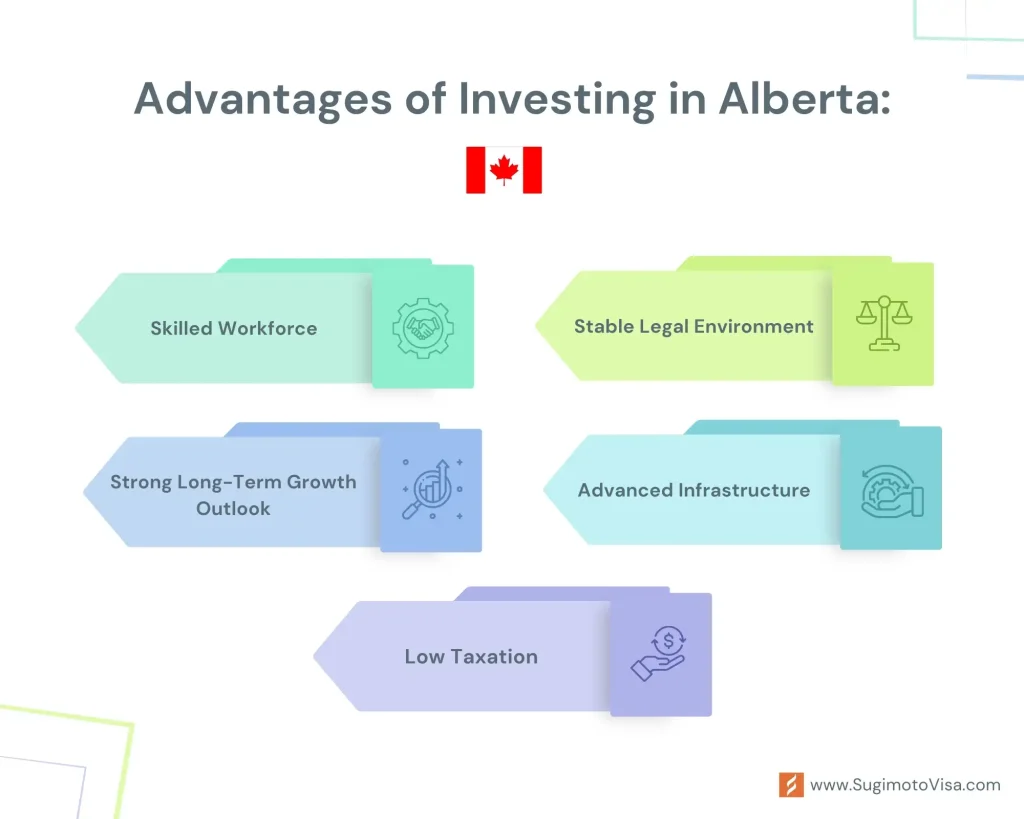
Alberta’s narrative in 2026 is one of resilience and rapid modernization. By combining its traditional strengths in natural resources with a forward-thinking approach to AI, renewable energy, and agri-tech, the province has created a “safe haven” for global capital.
Whether you are a seasoned entrepreneur looking for lower taxes or a visionary aiming to lead in the clean-tech sector, Alberta provides the infrastructure, the talent, and, most importantly, the political stability to protect and grow your investment.
FAQs
Yes, Alberta is a top choice due to its rapid population growth, the absence of Provincial Sales Tax (PST), and its diverse economy.
The minimum investment is $100,000 for rural areas and $200,000 for urban centers like Calgary and Edmonton.
It is a one-time tax credit called “Alberta is Calling” for skilled tradespeople who relocate to the province.
The technology sector (AI), renewable energy (hydrogen), and diversified Exchange-Traded Funds (ETFs) are the best options.
Assuming an average annual return of 7%, you would have approximately $71,650 after five years.
The USA is better for rapid tech growth, while Canada is better for economic stability and reliable dividends in the banking and energy sectors.
Yes, this amount is above average and is quite suitable for a comfortable lifestyle in Alberta, especially for an individual.