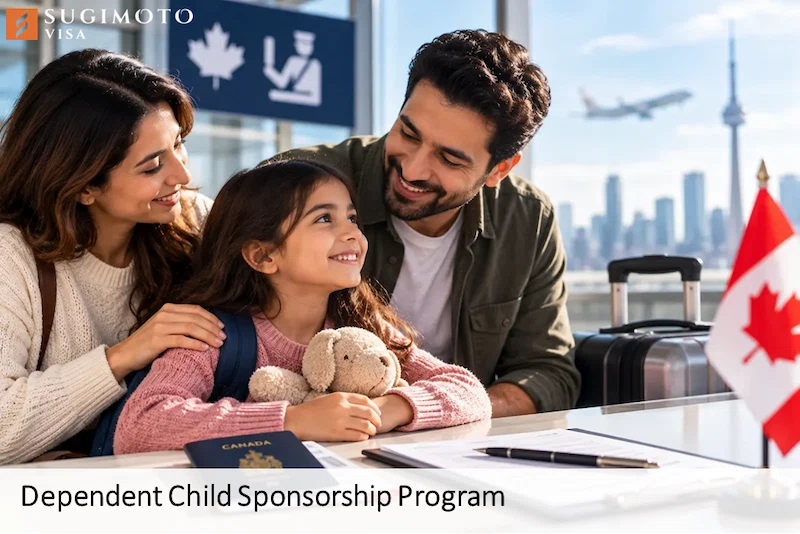
Canadian citizens and permanent residents can sponsor an eligible dependent child to become a permanent resident of Canada.
For many families, the basic eligibility rule looks simple: a dependent child is generally under 22 and not married or in a common-law relationship.
The cases that require more care usually involve what happens around that rule.
A child may turn 22 while the application is being processed. A child over 22 may still qualify because of a physical or mental condition. Another parent may have custody.
A child from a previous relationship may not be accompanying the family. And if the sponsor is a Canadian citizen, a child born abroad may already be Canadian-in which case permanent residence sponsorship may not be the right application at all.
These issues should be resolved before the sponsorship package is submitted.
IRCC’s dependent-child sponsorship program remains open in 2026. It is part of Family Class immigration and allows eligible children to obtain permanent residence when both the sponsor and the child meet the applicable requirements.
Who Qualifies as a Dependent Child?
Under the current definition, a child qualifies as a dependant if they:
- are under 22 years old; and
- do not have a spouse or common-law partner.
A child who is 22 or older can still qualify, but only if both of these conditions are met:
- they have depended substantially on their parent for financial support since before turning 22; and
- they are unable to support themselves financially because of a physical or mental condition.
The definition can apply to:
- the sponsor’s biological child;
- the child of the sponsor’s spouse or common-law partner;
- and, in appropriate cases, a dependent child’s own dependent child.
Adopted children require additional care because IRCC uses a separate sponsorship process for adopted children and children being adopted. The standard spouse/partner/dependent-child application guide specifically tells sponsors to use the adopted-child sponsorship package instead.
Dependent Child Sponsorship: The Under-22 Rule
To sponsor a child for Canadian Permanent Residence, they must meet Immigration, Refugees and Citizenship Canada’s (IRCC) definition of a dependent child. Eligibility relies on two core factors: Age and Marital Status.
1.The Age Requirement & Lock-In Date
- Under 22 Years Old: To qualify under standard rules, the child must be under 22 years of age (i.e., 21 years old or younger) on the date IRCC receives the complete application.
- Turning 22: If a child turns 22 before the application is officially received, they no longer qualify under the standard age rule.
- The Age “Lock-In” Rule: Once IRCC receives a complete application, the child’s age is frozen (“locked in”). Even if processing takes 8 to 12 months and the child turns 22 during that time, they remain eligible based on their age at submission.
2.The Exception for Children 22 or Older
A child aged 22 or older can only qualify as an over-age dependant if both of the following conditions are met:
- They are unable to financially support themselves due to a physical or mental condition.
- They have continuously depended on their parents for financial support since before turning 22.
Note: Full-time students over age 22 no longer qualify under this exception unless they meet the medical/financial dependency criteria above.
3.Marital Status & Ongoing Eligibility
- Single Status Required: Regardless of age, the child must not be married and must not be in a common-law relationship.
- Continuous Compliance: While the lock-in rule protects the child’s age, it does not protect their marital status. The child must remain single and unmarried throughout the entire processing period until they land in Canada as a Permanent Resident. Getting married or entering a common-law relationship prior to landing will immediately disqualify them.
Age Lock-In
The lock-in date is one of the most important rules in dependent-child sponsorship.
IRCC does not simply check how old the child is when the officer finally makes a decision.
For spouse, partner and dependent-child Family Class applications, the child’s age is generally locked in on the date IRCC receives the complete permanent residence application.
Once the age is locked in, the child does not lose dependent status merely because they have a birthday while IRCC processes the application.
Example
Suppose IRCC receives a complete dependent-child sponsorship application when the child is 21 years and 10 months old.
The child turns 22 two months later.
If the child met the dependent-child definition on the lock-in date, IRCC continues using the locked-in age when assessing age eligibility.
Turning 22 during processing does not by itself make the child ineligible.
However, the lock-in rule protects age, not every eligibility factor.
If that child later marries or enters a common-law relationship while the application is still being processed, they may no longer qualify as a dependent child.
This distinction is critical:
Turning 22 after lock-in can be acceptable. Becoming married or common-law generally is not.
Children Age 22 or Older
A child who is already 22 or older can still qualify as a dependant in a much narrower situation.
IRCC requires both:
- financial dependence on the parent since before age 22; and
- inability to financially support themselves because of a physical or mental condition.
Being financially dependent on parents by itself is not enough.
For example, a 24-year-old child who is unemployed, attending university or living with their parents does not automatically qualify as a dependent child merely because the parents continue paying their expenses.
There must also be a qualifying physical or mental condition that prevents the child from supporting themselves financially.
Likewise, having a medical condition alone is not enough if the child is financially self-sufficient.
Both requirements must be established.
Evidence for an Overage Dependent Child
Depending on the circumstances, the application may need evidence showing:
- the history of financial support;
- when financial dependence began;
- medical documentation relating to the physical or mental condition;
- how the condition affects the person’s ability to support themselves;
- employment history, if any;
- education and living arrangements;
- bank transfers or household expenses paid by the parent.
Because the financial dependence must generally extend back to before age 22, evidence covering only the months immediately before the application may not be enough.
Who Can Sponsor a Child?
A sponsor must generally:
- be at least 18;
- be a Canadian citizen, permanent resident or person registered under the Indian Act;
- meet the applicable residence requirement;
- not be receiving prohibited social assistance;
- be able to provide for the child’s basic needs;
- and not be subject to a sponsorship restriction.
Canadian Citizen Living Abroad
A Canadian citizen may be eligible to sponsor a dependent child while living outside Canada. The sponsor must demonstrate an intention to return to Canada and live there when the sponsored child becomes a permanent resident. Supporting evidence may include plans for housing, employment, schooling, or relocation, depending on the family’s circumstances.
Permanent Resident Living Abroad
A Canadian permanent resident must be living in Canada to sponsor a dependent child. Permanent residents living outside Canada cannot sponsor a child under this program. This eligibility requirement should be confirmed before preparing an application, particularly when the parent and child are currently living together abroad.
Is There a Minimum Income Requirement?
For most dependent-child sponsorship applications, there is no Minimum Necessary Income (MNI) requirement, setting this program apart from pathways like the Parents and Grandparents Program. However, sponsors must still demonstrate the capacity to provide for the child’s basic needs and fulfill the legal sponsorship undertaking.
A formal income threshold typically only applies if the dependent child being sponsored has a child of their own (the sponsor’s grandchild). In such cases, Immigration, Refugees and Citizenship Canada (IRCC) evaluates income based on the applicable Low-Income Cut-Off (LICO).
To summarize:
- The dependent child has no children of their own: There is normally no fixed MNI requirement.
- The dependent child has their own child: A formal income assessment may be required.
Note: If the application is processed through Quebec, distinct provincial financial rules apply, which are detailed later in this guide.
The Sponsorship Undertaking
Sponsoring a child creates a legally binding financial commitment.
The sponsor agrees to provide basic needs such as:
- food;
- clothing;
- housing;
- everyday living expenses;
- dental care;
- eye care;
- and other health needs not covered by public health services.
Outside Quebec, the length of the undertaking depends on the child’s age when they become a permanent resident.
| Child at PR | Federal Undertaking Outside Quebec |
|---|---|
| Under 22 | 10 years or until age 25, whichever comes first |
| 22 or older | 3 years |
This creates an important distinction from the age lock-in rule.
Lock-in age determines whether the child meets the immigration definition of dependant.
Age when PR is granted can affect how long the sponsor’s undertaking lasts.
Those are two different calculations.
Example
A child is 21 when the complete application is received.
Their age is locked in at 21 for dependent-child eligibility.
If they become a permanent resident at 23, the undertaking rules use their age when they become a permanent resident, not the locked-in immigration age. IRCC’s guidance specifically states that undertaking duration is tied to the person’s age on the date they become a PR.
Once the undertaking takes effect, it cannot simply be cancelled or shortened because the sponsor’s financial situation changes or because the child later becomes a Canadian citizen.
Sponsoring a Child as the Principal Applicant
When only the dependent child is being sponsored, the child becomes the principal applicant.
If the child is under 18, the parent or legal guardian signs the application on the child’s behalf.
If more than one dependent child is being sponsored separately as principal applicants, IRCC requires a separate complete application for each child. One sibling is not simply added as the dependant of another sibling.
This differs from a spousal sponsorship application.
If a sponsor is sponsoring a spouse or partner together with that person’s dependent children, the spouse or partner is normally the principal applicant and the children are listed as dependants on that application.
Children From Previous Relationships
Children from previous relationships require particularly careful disclosure.
If the sponsored person has a child who is in the sole custody of another parent, that child may still need to be declared-even when:
- they will not immigrate to Canada;
- the sponsored person does not have custody;
- a court order gives custody to another parent;
- or there is a written agreement stating that the child will remain abroad.
IRCC states that these children must still be listed and generally undergo the required medical examination and applicable background or security checks.
The purpose is not necessarily to force the child to immigrate.
Proper declaration preserves the possibility that the child may later become eligible for sponsorship if custody or family circumstances change.
Failing to declare family members can have much more serious immigration consequences.
Consent From the Other Parent
If a minor child has another parent or legal guardian who is not immigrating to Canada, IRCC requires evidence that the non-accompanying parent or guardian consents to the child’s permanent immigration.
The main federal form used for this purpose is:
IMM 5604 – Declaration from Non-Accompanying Parent/Guardian for Minors Immigrating to Canada.
The non-accompanying parent or guardian normally completes and signs the declaration by hand.
Custody documentation may also be relevant.
Examples include:
- custody orders;
- divorce or separation agreements;
- parental responsibility documents;
- death certificates where applicable;
- or other legal documents explaining why another parent’s consent is not available.
A parent should not assume that having physical custody of the child automatically eliminates the need to address the other parent’s legal rights.
Where there is a custody dispute or the other parent refuses consent, the immigration application can become significantly more complex because IRCC cannot simply override foreign or Canadian family-law rights through a sponsorship application.
If the Child Has Their Own Child
A dependent child may themselves have a dependent child.
If so, the grandchild must be declared in the application, whether or not the grandchild will immigrate to Canada.
This situation also changes the financial analysis.
A sponsor who normally would not have to meet a Minimum Necessary Income requirement may become subject to an income requirement when the dependent child being sponsored has a dependent child of their own.
The grandchild must also independently meet the definition of a dependent child.
Child Born Outside Canada to a Canadian Parent
Before sponsoring a child born outside Canada, a Canadian citizen should first determine whether the child is already a Canadian citizen.
A Canadian citizen cannot sponsor someone for permanent residence if that person is already Canadian.
IRCC specifically directs Canadian parents to check the child’s citizenship status before filing dependent-child sponsorship.
This area became particularly important after Canada’s citizenship-by-descent rules changed on December 15, 2025.
Child Born Before December 15, 2025
Under the new rules, a person born outside Canada before December 15, 2025, to a Canadian parent may already be a Canadian citizen, including in many cases affected by the former first-generation limit.
What this means: The appropriate next step may be an application for a citizenship certificate rather than permanent residence sponsorship.
Child Born on or After December 15, 2025
Eligibility depends partly on the Canadian parent’s citizenship history. If the parent was born or adopted outside Canada, they generally need to demonstrate at least 1,095 cumulative days of physical presence in Canada before the child’s birth to pass on citizenship by descent under the new rules.
If this requirement is not met, the child may not automatically be Canadian, and permanent residence sponsorship may be relevant.
Parent Became Canadian After the Child Was Born
A child does not automatically acquire Canadian citizenship simply because their parent becomes Canadian after the child’s birth. IRCC confirms that citizenship acquired later by a parent does not, on that basis alone, make the child a Canadian citizen.
Before applying: Determine whether the child should apply for proof of Canadian citizenship or be considered for dependent-child permanent residence sponsorship.
Adopted Children
An adopted child can potentially immigrate through family sponsorship, but adoption cases should not simply be treated as ordinary dependent-child sponsorship.
IRCC uses a separate process for:
- children already adopted abroad;
- and children who will be adopted as part of an intercountry adoption.
The adoption must also satisfy immigration and adoption-law requirements.
The standard dependent-child sponsorship guide explicitly directs sponsors of adopted children to the separate adopted-child sponsorship package.
Citizenship can also be relevant for adopted children of Canadian citizens.
Canadian law provides specific routes for citizenship through adoption, and the December 2025 citizenship changes also affected some foreign adoptions.
The correct route should therefore be determined before filing either a PR sponsorship or citizenship application.
Medical and Admissibility Requirements
A sponsored dependent child must generally complete the required immigration medical examination and satisfy Canada’s applicable admissibility requirements.
There is, however, an important medical rule in their favour.
Dependent children sponsored as members of the Family Class are among the groups exempt from medical inadmissibility based on excessive demand on Canadian health or social services.
That means a child with a disability or significant medical needs is not automatically refused simply because treatment or social services could be expensive.
Other medical inadmissibility grounds can still apply, including concerns relating to danger to public health or public safety.
Other grounds of inadmissibility, including criminality, security concerns or misrepresentation, also remain relevant depending on the child’s age and circumstances.
For a broader explanation, the site’s existing Medical Inadmissibility in Canada and Criminal Inadmissibility guides can be linked from this section.
Non-Accompanying Children Still Matter
A child who will remain outside Canada should not automatically be left off an immigration application.
IRCC distinguishes between:
- accompanying dependants, who plan to immigrate with the principal applicant; and
- non-accompanying dependants, who are declared but are not immigrating at that time.
Non-accompanying dependent children generally need to be disclosed and examined so that they can remain eligible for possible sponsorship later.
This issue has become even more important in late 2026.
Previously Undeclared Children
The temporary public policy that allowed certain previously undeclared family members to be sponsored ended on September 10, 2026.
IRCC continues applying that policy only to eligible applications received between May 31, 2019 and September 10, 2026.
For applications submitted after September 10, previously undeclared family members do not benefit from that temporary exception.
For new permanent residence applications, correctly declaring all children is therefore especially important.
The Application Process
Dependent-child sponsorship involves two related applications. The sponsorship application and the child’s permanent residence application are submitted together online through Canada’s Permanent Residence Portal.
Sponsorship Application
The application to assess the parent’s eligibility to sponsor the dependent child.
Child’s Permanent Residence Application
The application through which the child seeks permanent resident status in Canada.
Documents You May Need
The required documents depend on the family’s circumstances, the child’s age, custody arrangements and country-specific requirements.
- Proof of the sponsor’s Canadian citizenship or permanent residence
- Birth certificates or other evidence of the parent-child relationship
- Passport or travel documents
- Custody documents, where applicable
- Form IMM 5604, where required when another parent or guardian is not accompanying the child
- Medical examination, as instructed
- Police certificates or background documents, where applicable
- Photographs meeting application specifications
- Translations of documents, where required
- Additional country-specific documents
Applicants Aged 22 or Older
Applications involving children aged 22 or older also require evidence of ongoing financial dependence and a physical or mental condition that prevents the applicant from financially supporting themselves.
Parentage and Custody Documentation
Missing or incomplete documents establishing parentage or custody can delay an otherwise straightforward sponsorship application. Review these records carefully before submitting the application.
Dependent Child Sponsorship Fees in 2026
The current federal fee to sponsor a dependent child is:
CAD $180 per child.
That amount includes the sponsorship fee and the permanent residence processing fee.
A sponsored dependent child does not pay the Right of Permanent Residence Fee. IRCC explicitly exempts dependent children from the RPRF, including a dependent child who is the principal applicant.
Other expenses may include:
| Cost | What to Expect |
|---|---|
| Federal sponsorship/processing | CAD $180 per child |
| Medical examination | Varies by panel physician and country |
| Biometrics | If required based on age and circumstances |
| Translations | Varies |
| Legal/custody documents | Depends on the family situation |
| Passport or document services | Varies |
| Quebec undertaking | Additional provincial fee where applicable |
If several children are being sponsored separately as principal applicants, each child requires their own complete application and applicable fee.
Processing Time
IRCC does not currently publish a permanent fixed processing time exclusively for every dependent-child sponsorship scenario.
Children are generally reported together with spouses and partners within the broader Family Class processing data.
IRCC reported that between August 2025 and July 2026, applications for spouses, partners and children submitted inside and outside Canada and destined outside Quebec were processed in approximately 15 months overall.
Earlier detailed 2026 reporting showed overseas spouse, partner and children cases outside Quebec at approximately 12.6 to 13 months, with forward-looking estimates around 13 to 14 months at different reporting points.
These figures should not be interpreted as a guarantee for an individual child sponsorship application.
Factors That Affect Processing Times
Processing times for dependent-child sponsorship can vary depending on the circumstances of the case and the additional steps required to assess the application.
Country of residence
Completeness of custody documentation
Medical examinations or background checks
Requests for additional documents
Quebec-specific processing, where applicable
Completeness of the application
Available admissions spaces
IRCC’s processing-time tool now provides forward-looking estimates that change based on current inventory and processing capacity.
Can the Child Visit Canada While Waiting?
A dependent child outside Canada may be able to apply for a Visitor Visa while the permanent residence sponsorship is being processed.
Approval is not automatic.
The child still needs to satisfy the applicable temporary resident requirements.
IRCC’s family sponsorship guidance specifically confirms that a dependent child outside Canada may apply for a visitor visa while waiting for a PR decision.
For children who need to join their parents in Canada before the permanent residence application is finalized, this can be worth considering.
Suggested Article: Canada Visitor Visa →
Sponsoring a Child to Quebec
A child destined to Quebec requires an additional provincial stage after the federal sponsorship process begins.
The sponsor first submits the application to IRCC.
After IRCC confirms federal sponsor eligibility, Quebec normally requires an undertaking application to the Ministère de l’Immigration, de la Francisation et de l’Intégration (MIFI).
Dependent Children Are Exempt From Quebec’s Current Family Cap
Quebec introduced family-reunification intake limits for the period from July 2, 2026 to June 30, 2028.
However, sponsorship applications for a sponsor’s dependent child are specifically exempt from those numerical ceilings.
That is an important distinction from Quebec spouse and parent sponsorship, where intake caps can directly affect when an undertaking application can be submitted.
Quebec Income Requirement
For a standard dependent-child sponsorship, Quebec does not generally require the sponsor to demonstrate financial capacity.
An income assessment becomes relevant if the dependent child being sponsored has a dependent child of their own.
Quebec Undertaking Period
Quebec uses different age brackets from the federal undertaking rules.
For a dependent child:
| Child’s Age | Quebec Undertaking |
|---|---|
| Under 16 | At least 10 years or until age 18, whichever period is longer |
| 16 or older | At least 3 years or until age 25, whichever period is longer |
Once the sponsored child receives permanent residence, the Quebec undertaking cannot simply be cancelled because the sponsor’s circumstances later change.
Quebec Fees in 2026
As of January 1, 2026, Quebec charges CAD $335 to review an undertaking application where the dependent child is the main sponsored person.
If more than one dependent child is being sponsored separately, Quebec requires a separate undertaking and the full CAD $335 fee for each child.
For example, sponsoring three dependent children as separate principal applicants would result in Quebec undertaking fees of CAD $1,005.
MIFI currently states that most complete dependent-child undertaking applications are processed within approximately three months.
Situations That Need Extra Attention
Some dependent-child applications are straightforward. Others need a more careful legal and documentary review.
Child Is Almost 22
The date IRCC receives the complete application can determine whether the standard under-22 definition applies. An incomplete submission may put eligibility at risk.
Child Over 22
Financial dependence must normally date back to before age 22, alongside evidence of a physical or mental condition that prevents financial self-support.
Other Parent Does Not Consent
Custody orders, parental-responsibility issues or refusal to sign IMM 5604 may need to be addressed before the child can immigrate.
Child Was Not Declared Previously
An undeclared family member can create serious immigration complications, particularly following the reported September 10, 2026 end of the relevant public policy.
Sponsor Is Canadian and Child Was Born Abroad
Check whether the child already has Canadian citizenship before applying for sponsorship. Changes introduced in December 2025 may affect eligibility for citizenship by descent.
Child Is Adopted
Intercountry adoption and citizenship rules may apply, so the ordinary dependent-child sponsorship process should not be assumed to be appropriate.
Child Has Their Own Dependent Child
The application may involve an additional dependant and could affect the sponsor’s applicable income requirements.
Frequently Asked Questions
A child normally qualifies as a dependant if they are under 22 years old and do not have a spouse or common-law partner. A child aged 22 or older may qualify if they have depended financially on their parents since before age 22 and cannot support themselves financially due to a physical or mental condition.
No. Under IRCC rules, the child’s age is “locked in” on the date IRCC receives the complete permanent residence application. If the child was under 22 and met all other requirements on the lock-in date, turning 22 during processing does not make them ineligible.
No. While the lock-in rule freezes the child’s age, it does not freeze marital status. The child must remain single (unmarried and not in a common-law relationship) continuously throughout processing until they officially become a permanent resident.
Yes, but only under specific medical conditions. The child must have depended financially on you since before turning 22 and must be continuously unable to support themselves financially due to a physical or mental condition.
Usually no. In most dependent child sponsorships, there is no minimum income requirement for the sponsor. A specific income requirement generally only applies if the dependent child being sponsored has a dependent child (grandchild) of their own.
Yes. Canadian citizens living abroad can sponsor their dependent child, provided they demonstrate a clear plan to reside in Canada once the child becomes a permanent resident. (Note: Permanent residents living abroad are not permitted to sponsor from outside Canada).
Yes. If the minor child has a non-accompanying parent or legal guardian, IRCC requires that parent/guardian to complete form IMM 5604 (Declaration from Non-Accompanying Parent/Guardian) and may request supporting custody documentation to ensure the child can legally immigrate.
All family members and parental relationships must be correctly declared regardless of legal custody. Official legal custody documents and the specific circumstances of the non-accompanying parent must be fully disclosed in the application package.
Yes. A stepchild (the child of your spouse or common-law partner) fits the immigration definition of a dependent child. If you are sponsoring your spouse/partner, the child is typically included as an accompanying dependant on that same application.
Potentially, yes. If a parent was a Canadian citizen at the time of the child’s birth, citizenship by descent should be verified prior to filing a sponsorship application. Major statutory changes took effect on December 15, 2025, which revised the citizenship-by-descent rules for children born abroad.
Effective December 15, 2025, Canada repealed the strict first-generation limit on citizenship by descent. For children born abroad on or after December 15, 2025, to a Canadian parent who was also born or adopted outside Canada, the parent can pass on Canadian citizenship if they accumulated at least 1,095 days (3 years) of physical presence in Canada prior to the child’s birth or adoption.
The standard federal fee is CAD $180 per sponsored dependent child ($75 sponsorship fee + $105 processing fee). Dependent children are exempt from paying the Right of Permanent Residence Fee (RPRF).
Outside Quebec, the undertaking lasts 10 years from the day the child becomes a permanent resident or until the child turns 25 years old (whichever comes first). For a child 22 or older, the undertaking lasts 3 years from the day they become a permanent resident.
No. Dependent children sponsored under the Family Class are explicitly exempt from medical inadmissibility based on excessive demand on health or social services. Other health and security admissibility grounds (such as public safety risks) still apply.
Potentially, yes. A dependent child living outside Canada can apply for a Visitor Visa (TRV) or eTA while the permanent residence application is in progress. However, temporary entry approval is assessed independently by an immigration officer.
Final Takeaway
Dependent-child sponsorship is often described as one of Canada’s simpler family sponsorship programs, but the age rule is only the beginning of the analysis.
For most applications, the child needs to be under 22 and unmarried or not in a common-law relationship when the relevant age is locked in. If IRCC receives the complete application while the child is still under 22, aging past the limit during processing does not normally remove eligibility.
Cases involving children over 22 require a different test: continuing financial dependence from before age 22 and an inability to become financially self-supporting because of a physical or mental condition.
Custody can be equally important. A child from a previous relationship cannot simply be omitted because they live with another parent, and a minor immigrating without the other parent will normally require consent and supporting documentation.
Canadian citizens should also resolve citizenship status before preparing a PR application for a foreign-born child. Since the December 15, 2025 changes to citizenship by descent, some children who previously might have appeared to need sponsorship may already be Canadian.
For most dependent-child sponsorships there is no fixed minimum income requirement, but the sponsor still signs a financial undertaking. The current federal application fee is CAD $180 per child, and dependent children are exempt from the Right of Permanent Residence Fee.
Quebec adds another provincial stage, but dependent-child sponsorship has an important advantage under the current 2026–2028 intake rules: it is exempt from Quebec’s numerical family-reunification caps.