Family sponsorship allows eligible Canadian citizens and permanent residents to help certain family members become permanent residents of Canada.
But “family sponsorship” is not one immigration program with one set of rules.
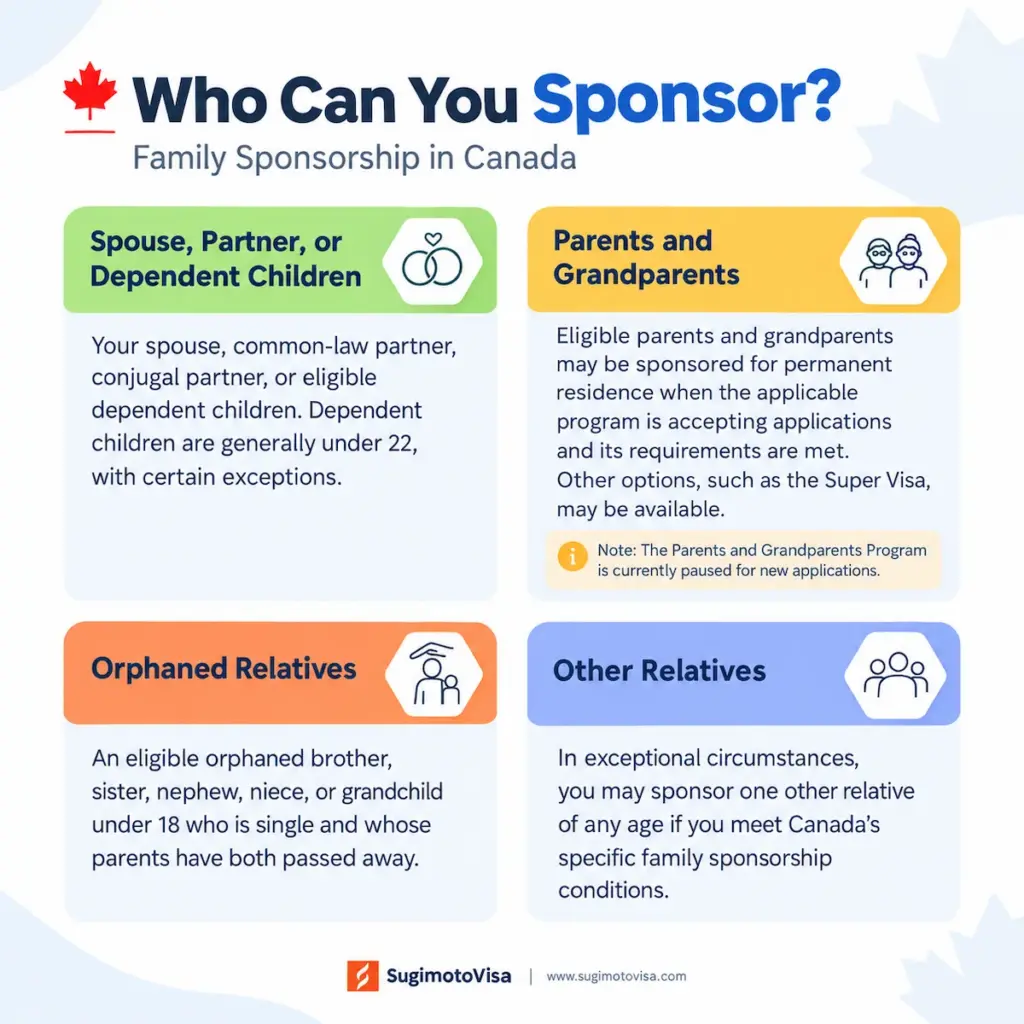
Canada uses different sponsorship rules depending on whether the person being sponsored is:
- a spouse or partner;
- a dependent child;
- a parent or grandparent;
- an adopted child;
- an orphaned close relative;
- or, in very limited circumstances, another relative.
The requirements can differ considerably.
A person sponsoring a spouse will usually face no fixed minimum income threshold. Someone sponsoring parents or grandparents must meet a much stricter financial test. A Canadian citizen may be able to sponsor a spouse or child while living abroad, but a permanent resident generally cannot. Other-relative sponsorship is available only in narrow situations.
The status of the individual program also matters in 2026.
Spousal and dependent-child sponsorship remain open, while the Parents and Grandparents Program is currently paused for new intake. Quebec has also introduced new numerical limits and intake rules for family reunification applications.
Canada’s 2026 Immigration Levels Plan continues to treat family reunification as a major immigration category, with the family class representing approximately 22% of planned permanent resident admissions for 2026.
Family Sponsorship Is Not Available for Every Relative
Canadian immigration law does not allow a citizen or permanent resident to sponsor any relative simply because they are family.
IRCC currently provides family sponsorship routes for:
| Family Member | Sponsorship Route |
|---|---|
| Spouse | Spousal Sponsorship |
| Common-law partner | Partner Sponsorship |
| Conjugal partner | Family Class Sponsorship |
| Dependent child | Dependent Child Sponsorship |
| Adopted child | Adoption / Family Class process |
| Parent or grandparent | Parents and Grandparents Program |
| Orphaned sibling, nephew, niece or grandchild | Limited Family Class sponsorship |
| Another relative | Available only in exceptional circumstances |
There is no general sponsorship category for:
- friends;
- fiancés simply because they are engaged;
- adult independent children who no longer meet the dependent-child definition;
- ordinary adult siblings;
- cousins;
- aunts or uncles,
unless the person fits one of the specific exceptions discussed later in this guide.
Who Can Be a Sponsor?
The basic federal requirements are similar across several family sponsorship categories.
A sponsor generally needs to:
- be at least 18 years old;
- be a Canadian citizen, permanent resident or person registered under the Indian Act;
- satisfy the applicable residence requirement;
- sign a sponsorship undertaking;
- provide the basic needs of the sponsored person;
- and not be subject to a sponsorship bar or other disqualification.
However, the residence rule changes depending on the relationship being sponsored.
Canadian Citizens Living Outside Canada
A Canadian citizen living abroad may potentially sponsor a:
- spouse;
- common-law partner;
- conjugal partner;
- dependent child;
- or adopted child,
if they can demonstrate that they intend to live in Canada when the sponsored person becomes a permanent resident.
This exception does not mean a Canadian citizen abroad can use every Family Class program from overseas.
Parents and grandparents sponsorship and the general other-relative sponsorship rules require the sponsor to live in Canada.
Permanent Residents Living Outside Canada
A Canadian permanent resident generally cannot sponsor a family member while residing abroad. For spouse, partner, and dependent-child sponsorships, Immigration, Refugees and Citizenship Canada (IRCC) explicitly mandates that a permanent resident sponsor must live in Canada.
Permanent residents planning to sponsor family members should therefore distinguish between:
- Simply holding Canadian PR status, and
- Actively meeting the mandatory sponsorship residency requirement.
For more details on maintaining and using your status, see Canada Permanent Residence and PR Card.
When Someone Cannot Sponsor
Sponsorship eligibility is not automatic even when the family relationship qualifies.
Depending on the sponsorship category and circumstances, a person may be unable to sponsor if they:
- are in prison;
- receive social assistance for a reason other than disability;
- have an undischarged bankruptcy where the rule applies;
- have failed to repay certain immigration loans or performance bonds;
- are behind on court-ordered family support payments;
- previously sponsored someone and failed to meet the undertaking;
- are subject to a removal order;
- or have certain violent, sexual or family-related criminal convictions.
The effect of a criminal conviction depends on the offence, relationship to the victim, sentence and other legal factors.
A criminal record should therefore not simply be treated as an automatic yes-or-no sponsorship rule.
See also: Criminal Inadmissibility in Canada →
Sponsoring a Spouse or Partner
Spousal sponsorship is one of Canada’s main family reunification pathways.
A sponsor can potentially sponsor a:
Spouse
A spouse must:
- be legally married to the sponsor;
- be at least 18;
- be in a genuine relationship;
- and not be inadmissible to Canada.
A legal marriage certificate is important, but a marriage is not automatically sufficient for immigration purposes.
IRCC must also be satisfied that the relationship is genuine and was not entered into primarily to obtain immigration status.
Common-Law Partner
A common-law partner must have lived with the sponsor in a conjugal relationship for at least 12 consecutive months.
Short and temporary periods apart may be acceptable, but the couple must genuinely have established continuous cohabitation.
Dating for a year is not the same as living together for a year.
Conjugal Partner
A conjugal partner:
- lives outside Canada;
- has been in an exclusive, mutually interdependent relationship with the sponsor for at least one year;
- and has been prevented from marrying or living together because of significant legal, immigration, social, cultural, religious or similar barriers.
Conjugal sponsorship should not be treated as a simple alternative for couples who have chosen not to marry and have never lived together.
Income Requirement for a Spouse or Partner
Most spouse or partner sponsorships do not have a Minimum Necessary Income requirement.
A formal income threshold generally applies only where:
- the sponsored spouse or partner has a dependent child;
- and that dependent child has a dependent child of their own.
The sponsor still assumes a financial obligation even when no fixed income threshold applies.
Three-Year Undertaking
Outside Quebec, the sponsorship undertaking for a spouse, common-law partner or conjugal partner lasts three years from the day the sponsored person becomes a permanent resident.
The obligation continues even if:
- the couple separates;
- they divorce;
- the sponsor loses their job;
- the sponsored person becomes a Canadian citizen;
- or either person moves elsewhere.
Once permanent residence has been granted and the undertaking has started, it cannot simply be cancelled because the relationship has ended.
For the complete rules, see Spousal Sponsorship Canada →
Inland and Outland Spousal Sponsorship
Spouses and common-law partners may sometimes have more than one application route.
The two commonly used terms are:
- Inland, formally the Spouse or Common-Law Partner in Canada Class;
- Outland, generally the Family Class.
The difference is not simply the applicant’s physical location.
A spouse or common-law partner physically living in Canada may still use the Family Class in appropriate circumstances.
The choice can affect:
- travel during processing;
- cohabitation requirements;
- temporary status;
- open work permit eligibility;
- and possible appeal rights after refusal.
A sponsored spouse or partner living in Canada may also qualify for an open work permit under current IRCC rules while the permanent residence application is being processed.
See also: What Is an AOR in Canadian Immigration? →
Sponsoring a Dependent Child
A child generally qualifies as a dependent if:
- they are under 22; and
- they do not have a spouse or common-law partner.
A child who is already 22 or older can still qualify if:
- they have depended financially on their parent since before turning 22;
- and they cannot support themselves financially because of a physical or mental condition.
Age Lock-In Rule
A child’s age is generally locked in when the complete application is received by IRCC. Other eligibility conditions must still be met.
Children from Previous Relationships
All children must be declared, including non-accompanying children and those who live with another parent.
Children Born Outside Canada
Verify citizenship by descent before filing a permanent residence sponsorship application.
Related Articles:
Sponsoring an Adopted Child
International adoption involves more than a standard dependent-child sponsorship application.
For most international adoptions, families must complete both:
- the adoption process; and
- the immigration or citizenship process.
Canadian provinces and territories are responsible for adoption procedures, while IRCC handles the immigration or citizenship component.
Under the immigration route, a sponsor generally must:
- be at least 18;
- be a Canadian citizen, permanent resident or person registered under the Indian Act;
- meet the applicable residence rules;
- sign an undertaking;
- and satisfy the relevant adoption requirements.
The adoption must also comply with:
- the laws of the child’s country;
- the applicable Canadian provincial or territorial rules;
- and, where relevant, the Hague Convention on Intercountry Adoption.
A Canadian citizen adopting a child abroad should also determine whether the appropriate route is:
- immigration followed by citizenship;
- or the direct citizenship process available for certain adopted children.
Parents and Grandparents Sponsorship
The Parents and Grandparents Program (PGP) provides permanent residence to eligible sponsored parents and grandparents.
However, the situation is different in 2026.
IRCC announced on July 15, 2026 that new intake under the PGP is paused.
IRCC:
- is not accepting new Interest to Sponsor forms;
- is not issuing new invitations until further notice;
- continues processing existing applications;
- and plans to approve up to 15,000 people for permanent residence through PGP in 2026.
This means someone cannot currently submit a new PGP application simply because they meet the income requirement.
An invitation is required.
PGP Sponsor Requirements
When PGP accepts an application, the sponsor must generally:
- be at least 18;
- live in Canada;
- be a Canadian citizen, permanent resident or person registered under the Indian Act;
- have been invited to apply;
- meet the required income threshold;
- and sign the sponsorship undertaking.
PGP Income Requirement
Outside Quebec, PGP uses a much stricter financial test than spouse or child sponsorship.
For the most recent 2025 intake, sponsors needed to meet the required income for three consecutive taxation years:
- 2024
- 2023
- 2022
For example:
| Family Size | 2024 | 2023 | 2022 |
|---|---|---|---|
| 2 | CAD $47,549 | CAD $44,530 | CAD $43,082 |
| 3 | CAD $58,456 | CAD $54,743 | CAD $52,965 |
| 4 | CAD $70,972 | CAD $66,466 | CAD $64,306 |
| 5 | CAD $80,496 | CAD $75,384 | CAD $72,935 |
| 6 | CAD $90,784 | CAD $85,020 | CAD $82,259 |
| 7 | CAD $101,075 | CAD $94,658 | CAD $91,582 |
These figures belonged to the most recent intake and should not be assumed to be the income table for a future PGP reopening.
If IRCC resumes intake, it may designate different tax years and publish new thresholds.
PGP Undertaking
Outside Quebec, a parent or grandparent sponsorship undertaking lasts 20 years from the day the sponsored person becomes a permanent resident.
Quebec uses a 10-year undertaking for parents and grandparents.
Super Visa While PGP Is Paused
The Super Visa is not a permanent residence sponsorship program, but it has become particularly relevant while new PGP intake is paused.
Eligible parents and grandparents can potentially stay in Canada for up to five years at a time and receive multiple-entry authorization for up to ten years.
The Super Visa also received important financial changes in 2026.
New Ministerial Instructions took effect on March 31, 2026, changing how host and applicant income can be calculated.
The Super Visa remains temporary resident status.
It should therefore be viewed as an extended family-visit option, not a substitute for permanent residence.
Other Relatives
Family Class sponsorship outside the immediate family is much more limited.
There are two major exceptions.
Orphaned Close Relative
A sponsor may potentially sponsor an orphaned:
- brother;
- sister;
- nephew;
- niece;
- or grandchild,
if the relative:
- is related by blood or adoption;
- is under 18;
- has lost both parents;
- and is not married or in a common-law relationship.
The person does not qualify under this rule if:
- one parent is still alive;
- the parents’ location is unknown;
- the parents abandoned the child;
- the parents are incarcerated;
- or another person is caring for the child while a parent remains alive.
One Other Relative
Canada also allows sponsorship of one relative of any age in a very narrow situation.
The sponsor must:
- be related to the person by blood or adoption;
- have no living spouse, partner, child, parent, grandparent or eligible orphaned close relative they could sponsor instead;
- and have no Canadian citizen, permanent resident or registered Indian relative in Canada who falls within the specified family relationships.
This is sometimes informally referred to as the “lonely Canadian” rule, but that expression is not the legal name of a separate immigration program.
Eligibility should be tested against the actual IRCC criteria.
For example, simply being emotionally close to an adult sibling, cousin, aunt or uncle does not create sponsorship eligibility.
Income Requirements Depend on Who You Sponsor
There is no single financial rule for Family Sponsorship.
The correct income test depends on the family relationship.
| Sponsorship | General Income Rule Outside Quebec |
|---|---|
| Spouse / partner | Usually no fixed MNI |
| Dependent child with no child of their own | Usually no fixed MNI |
| Spouse whose dependent child has a dependent child | MNI applies |
| Dependent child who has their own dependent child | MNI applies |
| Parents / grandparents | Three-year PGP income test |
| Other relatives | Minimum Necessary Income applies |
| Adopted child with no child of their own | Standard MNI generally does not apply |
Other-Relative Income Test
When the standard financial evaluation applies outside Quebec, IRCC uses IMM 1283 to calculate whether the sponsor meets the Minimum Necessary Income.
IRCC’s currently published federal LICO table is:
| Family Unit | Minimum Necessary Income |
|---|---|
| 1 | CAD $30,526 |
| 2 | CAD $38,002 |
| 3 | CAD $46,720 |
| 4 | CAD $56,724 |
| 5 | CAD $64,336 |
| 6 | CAD $72,560 |
| 7 | CAD $80,784 |
| Each additional person | + CAD $8,224 |
For these sponsorships, IRCC considers the sponsor’s household, the sponsored person and family members, and previous or current undertakings when determining family size.
The form can use CRA income information and, in certain situations, income earned during the preceding 12 months.
A spouse or common-law partner may be able to co-sign where a financial requirement applies.
A spouse being sponsored cannot simply co-sign their own sponsorship.
The Sponsorship Undertaking
An undertaking is not just a declaration that the sponsor intends to help the family member.
It is a legally binding financial commitment.
The sponsor agrees to provide the sponsored person’s basic needs and ensure that they do not need to rely on social assistance.
If qualifying social assistance is paid during the undertaking period, the sponsor can become liable for repayment.
Outside Quebec, current undertaking periods are:
| Sponsored Person | Undertaking Period |
|---|---|
| Spouse / common-law / conjugal partner | 3 years |
| Dependent child under 22 | 10 years or until age 25, whichever comes first |
| Dependent child 22+ | 3 years |
| Parent or grandparent | 20 years |
| Other relative | 10 years |
For dependent children, the undertaking period is based on the child’s age when they become a permanent resident, which is different from the age lock-in rule used to determine dependent-child eligibility.
Separation Does Not Cancel an Undertaking
For spouse sponsorship, the undertaking continues even after separation or divorce.
Likewise, financial difficulty or the sponsored person becoming a Canadian citizen does not automatically cancel an undertaking that has already begun.
This is why sponsorship should be understood as a financial commitment, not simply an immigration formality.
Family Sponsorship Fees in 2026
Federal permanent residence fees increased on April 30, 2026.
Current base fees include:
| Sponsorship | Current Federal Fee |
|---|---|
| Spouse / partner including RPRF | CAD $1,260 |
| Parent / grandparent including RPRF | CAD $1,260 |
| Other adult relative including RPRF | CAD $1,260 |
| Dependent child | CAD $180 |
| Dependent child added to parent/grandparent application | CAD $180 |
| Adopted child under 22 | From CAD $180 |
| Adopted child 22 or older | From CAD $1,260 |
Dependent children do not pay the Right of Permanent Residence Fee.
Other expenses may include:
- biometrics;
- immigration medical examinations;
- police certificates;
- translations;
- certified civil documents;
- passport or visa services;
- Quebec undertaking fees;
- and professional representation, if used.
See also: Canada Immigration Fees →
The Application Has Two Sides
Family sponsorship generally contains two connected decisions.
IRCC must assess:
- whether the sponsor qualifies to sponsor; and
- whether the family member qualifies for permanent residence.
For spouse, partner and dependent-child applications, the principal applicant submits the sponsorship and PR applications together online through the Permanent Residence Portal.
Other programs use their own application packages and procedures.
Parents and grandparents are particularly different because a valid PGP application currently requires an invitation.
An applicant cannot bypass the paused intake simply by submitting a complete permanent residence package.
Declaring Family Members Correctly
One of the most consequential mistakes in Canadian immigration is failing to declare a family member.
Permanent residence applicants generally need to disclose relevant:
- spouses or partners;
- dependent children;
- and dependent children of their dependent children,
even when those people are not immigrating to Canada.
A child living with another parent cannot simply be omitted.
A non-accompanying family member may still need:
- a medical examination;
- background checks;
- security screening;
- and proper disclosure in the PR application.
Major 2026 Change for Undeclared Family Members
The temporary public policy that allowed certain previously undeclared family members to be sponsored ended on September 10, 2026.
IRCC continues applying the policy only to eligible sponsorship applications received between May 31, 2019 and September 10, 2026.
The exception does not apply to applications submitted after September 10, 2026.
For new permanent residence applications, correctly declaring family members is therefore especially important.
Medical and Criminal Admissibility
Being an eligible family member does not eliminate Canada’s admissibility requirements.
Sponsored family members may need:
- immigration medical examinations;
- police certificates;
- biometrics;
- criminality checks;
- and security screening.
However, medical rules differ depending on the family relationship.
Sponsored spouses, common-law partners and dependent children benefit from an exemption from medical inadmissibility based on excessive demand on Canadian health or social services.
Parents, grandparents and many other relatives do not receive that same exemption.
A medical condition should therefore be assessed in the context of the actual sponsorship category rather than assuming all Family Class applicants are treated identically.
Likewise, a criminal record does not automatically mean the outcome will be the same in every case.
The offence, equivalent Canadian offence, sentence and time elapsed can all matter.
Related Articles: Medical Inadmissibility in Canada →
Processing Times Depend on the Sponsorship Category
There is no meaningful single number called “Canada family sponsorship processing time.”
Processing differs by:
- relationship;
- whether the application is inside or outside Canada;
- country;
- Quebec destination;
- application inventory;
- annual admission spaces;
- background processing;
- and whether additional documents are required.
For example, IRCC reported that spouse, partner and child applications destined outside Quebec and processed between August 2025 and July 2026 took approximately 15 months overall.
PGP has been considerably slower: early-2026 IRCC data reported approximately 23 months outside Quebec and 46 months for Quebec PGP cases.
Other-relative and adoption processing can vary by country. IRCC explicitly lists adopted-child and other-relative processing as country-dependent.
Applicants should therefore use the current IRCC processing tool rather than relying on an old generic sponsorship estimate.
Sponsoring Family Members to Quebec
Family sponsorship works differently when the sponsored person intends to settle in Quebec.
The process normally has:
- a federal IRCC sponsorship and permanent residence stage;
- and a Quebec undertaking stage through the Ministère de l’Immigration, de la Francisation et de l’Intégration (MIFI).
Sponsors should generally wait until the appropriate federal stage before submitting the Quebec undertaking.
Quebec’s 2026–2028 Intake Rules
From July 2, 2026 to June 30, 2028, Quebec set a maximum of 15,700 family-reunification undertaking applications:
- 13,300 for spouses, common-law partners and conjugal partners;
- 2,400 for parents, grandparents and specified other relatives.
Quebec also created an intake schedule based on the date of the IRCC sponsorship eligibility letter or, for certain Inland spouse/common-law cases, the Acknowledgment of Receipt.
Applications Exempt From the Cap
The current numerical limits and intake schedule do not apply to several categories, including:
- the sponsor’s dependent child;
- a minor child being adopted;
- an orphaned minor sibling, niece, nephew, grandchild;
- and certain adult dependent children who remain financially dependent because of a physical or mental condition.
Quebec therefore cannot be treated as simply the federal sponsorship program plus one extra fee.
Income, undertaking length, intake timing and application availability can all differ.
Family Sponsorship and Temporary Entry
A permanent residence sponsorship application does not automatically give the sponsored family member a right to enter or remain in Canada temporarily.
For example:
- a spouse outside Canada may still need a Visitor Visa or eTA;
- a spouse living in Canada may need to maintain temporary status;
- a parent using a Super Visa remains a temporary resident;
- and a dependent child waiting abroad may separately apply for a Visitor Visa.
Temporary residence and permanent residence are separate legal questions.
An approved or pending sponsorship can be relevant to a temporary application, but it does not eliminate the normal temporary-entry requirements.
What Happens After Permanent Residence Is Approved?
Successful sponsorship gives the family member permanent resident status, not Canadian citizenship.
Once PR is granted, the person can generally:
- live in Canada;
- work or study without needing the same temporary permits;
- obtain a PR card if applicable;
- and later potentially qualify for citizenship if they satisfy the citizenship requirements.
The sponsor’s undertaking continues for the applicable period even if the sponsored person later becomes a Canadian citizen.
Common Family Sponsorship Problems
Family sponsorship applications often fail or become complicated for reasons unrelated to whether the people involved are genuinely related.
Assuming Any Relative Can Be Sponsored
Canada limits family sponsorship to defined categories.
An adult sibling or cousin is not normally sponsorable unless a specific exception applies.
Using the Wrong Relationship Category
A boyfriend, girlfriend or fiancé does not automatically qualify for spousal sponsorship.
The relationship must meet the definition of spouse, common-law partner or, in more limited circumstances, conjugal partner.
Incorrect Common-Law Dates
Common-law status normally requires 12 consecutive months of qualifying cohabitation.
The date a couple began dating is not the common-law eligibility date.
Missing Children or Previous Relationships
Family members from prior relationships still need to be declared where required.
The end of the undeclared-family public policy in September 2026 makes this issue particularly important for current applicants.
Incorrect Income Calculation
Income rules vary dramatically across sponsorship categories.
A sponsor should not use the PGP three-year income test for a spouse application or assume that no income rule applies to an other-relative sponsorship.
Ignoring an Existing Undertaking
A previous sponsorship obligation can continue for years and may affect eligibility for a new sponsorship.
Treating Sponsorship as a Guarantee of Admission
The relationship can qualify while the sponsored person still faces a medical, criminal, security or misrepresentation issue.
Using Outdated PGP Information
Articles instructing people to simply submit an Interest to Sponsor form are no longer current.
New PGP intake has been paused since July 15, 2026.
Frequently Asked Questions
Depending on your eligibility as a sponsor, you may sponsor a spouse, common-law partner, conjugal partner, dependent child, adopted child, parent, or grandparent. Sponsoring other relatives (such as siblings, aunts, uncles, or cousins) is subject to extremely strict and narrow exceptions.
Usually no. You cannot sponsor an adult sibling as a standalone family category. An orphaned brother or sister may qualify if they are under 18, unmarried, not in a common-law relationship, and both parents are deceased. An adult sibling may only qualify under the highly restricted “lonely Canadian” (one other relative) rule if all legal conditions are met.
Only under the extremely narrow “lonely Canadian” rule, which requires that you have no living spouse, partner, child, parent, grandparent, sibling, aunt, uncle, niece, or nephew who is a Canadian citizen/PR or whom you could otherwise sponsor. Having a close personal relationship with a cousin is not sufficient on its own.
Canada does not have a dedicated fiancé sponsorship category. To sponsor a partner, your relationship must first meet the legal definition of a legally married spouse, a common-law partner (12 consecutive months of cohabitation), or a conjugal partner.
No. There is no general employment requirement or fixed Minimum Necessary Income (MNI) threshold for sponsoring a spouse or partner. However, you must meet basic sponsor eligibility rules, not be receiving prohibited social assistance, and sign a legally binding financial undertaking.
No. New PGP intake is currently paused. IRCC announced that it is not accepting new Interest to Sponsor forms or issuing new invitations until further notice, though it continues to process previously submitted applications.
Potentially, yes. The Super Visa remains open and provides eligible parents and grandparents with a multi-entry visitor visa that allows stays of up to 5 years per entry. Note that a Super Visa grants long-term temporary status, not permanent residence.
A dependent child must generally be under 22 years old and not married or in a common-law relationship. A child aged 22 or older may qualify if they have depended financially on their parent since before age 22 and cannot support themselves financially due to a physical or mental condition.
It depends on the category. Most spousal, partner, and dependent child sponsorships do not require a Minimum Necessary Income (MNI). However, the Parents and Grandparents Program (PGP), other-relative sponsorships, and cases where a sponsored child has a dependent child of their own do carry strict financial income requirements.
Outside Quebec, the financial undertaking period is: 3 years for a spouse/partner; 10 years (or until age 25) for a dependent child under 22; 3 years for a dependent child 22+; 20 years for parents and grandparents; and 10 years for other relatives.
Canadian citizens living abroad can sponsor a spouse, partner, or dependent child if they prove they intend to reside in Canada when the sponsored relative becomes a permanent resident. Permanent residents living outside Canada cannot sponsor. Sponsorship of parents, grandparents, or other relatives requires the sponsor to reside in Canada.
Potentially, though rules vary by category. Sponsored spouses, common-law partners, and dependent children are explicitly exempt from medical inadmissibility based on “excessive demand” on healthcare services. Parents, grandparents, and other relatives do not have this exemption and must undergo full medical admissibility screening.
For new applications, failing to declare a family member normally results in a lifetime bar under Section 117(9)(d) of the IRPR. The temporary public policy that previously exempted certain undeclared family members ended on September 10, 2026, and does not apply to applications submitted after that date.
Final Takeaway
Family sponsorship remains one of Canada’s main routes for permanent family reunification, but the term covers several very different immigration programs.
Spouses and partners have relatively flexible financial rules but must prove both the legal relationship and its genuineness.
Dependent children are usually assessed under the under-22 rule, with special provisions for older children who remain financially dependent because of a physical or mental condition.
Parents and grandparents face a very different system: strict income requirements, a 20-year federal undertaking outside Quebec and, in 2026, a complete pause on new PGP intake.
Other relatives can be sponsored only in carefully defined circumstances.
Across all of these categories, the sponsor’s responsibility should not be underestimated. Sponsorship creates a legal undertaking that can remain in force for anywhere from three to twenty years depending on the relationship.
The most useful starting point is therefore not simply asking:
“Can I sponsor a family member?”
The better question is:
Which family relationship applies, does that person fit Canada’s legal sponsorship category, what financial obligation will the sponsor assume, and are there any residence, admissibility or previous-sponsorship issues that change the case?
Once those questions are answered correctly, the right Family Class route becomes much clearer.
Official Resources
- IRCC — Family Sponsorship
Official overview of Canada’s family sponsorship programs and eligible family members.
Family Sponsorship — Canada.ca - IRCC — Sponsor Your Spouse, Partner or Child
Official requirements and application guidance for spouses, partners and dependent children.
Sponsor Your Spouse, Partner or Child — Canada.ca - IRCC — Parents and Grandparents Program
Official information on PGP eligibility, current intake status and sponsorship requirements.
Parents and Grandparents Program — Canada.ca - Government of Quebec — Family Sponsorship
Official Quebec rules for family sponsorship, undertakings and current intake restrictions.
Family Sponsorship — Quebec.ca