
Moving to Canada from China in 2026 is possible through several permanent and temporary immigration pathways.
For skilled Chinese professionals, Express Entry and Provincial Nominee Programs (PNPs) are among the main routes to permanent residence. Other applicants may qualify through Canadian work permits, family sponsorship, study permits, regional immigration programs, or selected provincial entrepreneur streams.
Chinese citizens should also pay close attention to several country-specific issues, including:
- Canadian visitor visa requirements
- biometrics and Visa Application Centres in China
- Chinese police certificates
- translation requirements
- recognition of Chinese education and professional credentials
- the current status of Canada’s business immigration programs
- tighter study permit rules in 2026
This guide explains the main options for moving from China to Canada and how to plan the process under current 2026 rules.
Can Chinese Citizens Move to Canada?
Yes.
Citizens of the People’s Republic of China can apply for Canadian temporary or permanent immigration status if they meet the requirements of the relevant program.
The main pathways fall into two groups.
Permanent Ways to Move to Canada
- Express Entry
- Provincial Nominee Programs
- Family Sponsorship
- Atlantic Immigration Program
- Selected community immigration programs
- Provincial entrepreneur programs
Temporary Ways to Move to Canada
- Employer-specific work permits
- LMIA-exempt work permits where eligible
- Intra-company transfers
- Study permits
- Visitor status
A temporary work or study permit may sometimes help a person qualify for permanent residence later, but temporary status does not guarantee Canadian PR.
Do Chinese Citizens Need a Visa to Enter Canada?
Yes. Citizens travelling on an ordinary passport issued by the People’s Republic of China are currently visa-required travellers.
They generally need a valid Canadian visitor visa to enter or transit through Canada by air, land, or sea.
This is different from some other nationalities that can travel with an eTA.
China Is Not Currently Part of Canada’s Special eTA Program
Canada currently allows citizens of several visa-required countries to use an eTA instead of a visitor visa if they meet specific conditions.
The People’s Republic of China is not on that current list.
That means most mainland Chinese passport holders should plan around a Canadian visitor visa rather than an eTA.
Hong Kong SAR Passport Holders Are Different
A person travelling with a Hong Kong Special Administrative Region passport is treated differently under Canada’s entry rules and is generally in the eTA-required category rather than the standard mainland China visitor visa category.
This article focuses primarily on applicants holding ordinary People’s Republic of China passports.
Does a Visitor Visa Let You Work in Canada?
No.
A visitor visa allows travel to Canada as a temporary visitor.
It does not automatically give permission to:
- work
- study long-term
- live permanently in Canada
You normally need the appropriate work permit, study permit, or permanent resident status.
Can Chinese Travellers Transit Through Canada Without a Visa?
In limited situations.
Chinese passport holders are one of the nationalities that may qualify for Canada’s Transit Without a Visa Program when travelling through Canada to or from the United States and meeting all program requirements.
This is a transit arrangement only.
It is not a pathway for visiting, working, studying, or moving to Canada.
Canada Immigration in 2026: Key Numbers
Canada is reducing temporary immigration while continuing to prioritize permanent economic immigration.
| Canada Immigration Indicator | 2026 Target |
|---|---|
| Total permanent residents | 380,000 |
| Economic immigration | 239,800 |
| Federal High Skilled | 109,000 |
| Provincial Nominee Program | 91,500 |
| Atlantic Immigration Program | 4,000 |
| Federal economic pilots | 8,175 |
| Family immigration | 84,000 |
| New temporary residents | 385,000 |
| Temporary workers | 230,000 |
| New international students | 155,000 |
Canada’s 2026 target is 380,000 permanent residents, including 239,800 economic immigrants. The government is also increasingly focused on transitioning people who already have Canadian skills and work experience to permanent residence.
Canada Immigration Statistics for Chinese Applicants
China remains one of Canada’s major source countries for both permanent and temporary immigration.
In 2024:
- 17,775 Chinese citizens were admitted through economic immigration
- 8,320 Chinese citizens were admitted through family reunification
- 26,285 Chinese citizens received permits through the International Mobility Program
- 56,355 Chinese citizens were admitted under Canada’s study permit program
China ranked fourth among the top source countries for economic immigration and second for study permits in the latest full annual IRCC data.
| Latest Available Official Data | China |
|---|---|
| Economic immigration admissions in 2024 | 17,775 |
| Family reunification admissions in 2024 | 8,320 |
| International Mobility Program admissions | 26,285 |
| Study permit admissions | 56,355 |
| 2026 Canadian economic immigration target | 239,800 |
| 2026 PNP target | 91,500 |
These numbers show that Chinese applicants continue to represent an important part of both Canada’s permanent and temporary immigration system.
Which Canadian Immigration Path May Be Right for You?
| Your Situation | Pathway to Check First |
|---|---|
| Skilled professional in China | Express Entry |
| Occupation targeted by a province | Provincial Nominee Program |
| Canadian employer wants to hire you | Work Permit |
| Employee transferring to Canadian office | Intra-Company Transfer |
| Spouse or partner is Canadian | Family Sponsorship |
| Already have Canadian work experience | Canadian Experience Class |
| Want to study in Canada | Study Permit |
| Experienced entrepreneur | Provincial Entrepreneur Program |
| Strong French ability | Express Entry French Category |
Permanent Ways to Move From China to Canada
Express Entry
Express Entry is one of Canada’s main immigration systems for skilled workers seeking permanent residence.
It manages three federal immigration programs:
- Federal Skilled Worker Program
- Canadian Experience Class
- Federal Skilled Trades Program
For professionals applying directly from China, the Federal Skilled Worker Program is usually the most relevant Express Entry starting point.
Federal Skilled Worker Program
Applicants generally need to meet requirements related to:
- skilled work experience
- education
- English or French ability
- age
- admissibility
- settlement funds where required
Chinese education normally needs an Educational Credential Assessment (ECA) if you want to claim Express Entry points for a foreign qualification.
You also normally need an approved language test.
Accepted tests can include:
- IELTS General Training
- CELPIP-General
- PTE Core
- TEF Canada
- TCF Canada
Having completed university in English or working for an international company does not remove the formal language testing requirement.
Canadian Experience Class
The Canadian Experience Class is primarily relevant to Chinese applicants who have already obtained qualifying skilled work experience in Canada.
This can include people who first entered Canada through:
- a Canadian work permit
- an intra-company transfer
- a post-graduation work permit
- another qualifying temporary work pathway
Canada is placing greater emphasis on candidates with Canadian work experience in 2026.
Federal Skilled Trades Program
Chinese tradespeople may also qualify through the Federal Skilled Trades Program if they meet its specific requirements.
Possible applicants can include experienced workers in:
- construction
- industrial trades
- manufacturing
- maintenance
- certain technical occupations
However, Canadian trade certification and immigration eligibility are separate issues.
Express Entry Categories in 2026
Canada currently uses ten category-based selection groups:
- French-language proficiency
- Healthcare and social services
- STEM
- Trades
- Education
- Transport
- Physicians with Canadian work experience
- Senior managers with Canadian work experience
- Researchers with Canadian work experience
- Skilled military recruits
For occupation-based categories, candidates generally need at least one year of eligible work experience in a single qualifying occupation during the previous three years.
Why This Matters for Chinese Applicants
Category-based selection may be especially relevant for Chinese applicants working in:
- software and technology
- engineering
- scientific research
- healthcare
- education
- transport
- skilled trades
The new Canadian-experience categories may also be relevant to:
- senior managers
- researchers
- physicians
who have already worked in Canada.
However, being in a targeted profession does not automatically result in permanent residence.
You must first qualify for Express Entry and meet the requirements of the relevant category.
Provincial Nominee Programs
Provincial Nominee Programs allow Canadian provinces and territories to select immigrants based on regional labour market needs.
A PNP may be worth checking if:
- your occupation is needed in a particular province
- you have a Canadian employer
- you studied or worked in Canada
- you have a connection to a province
- your CRS score is not competitive enough by itself
- your business experience fits a provincial entrepreneur stream
Canada plans 91,500 PNP admissions in 2026, making provincial immigration one of the largest economic immigration routes.
Express Entry-Aligned PNPs
Some provincial nominations are connected to Express Entry.
An enhanced provincial nomination can add 600 CRS points to an Express Entry profile.
For a Chinese applicant with a moderate CRS score, finding the right provincial opportunity can therefore completely change the competitiveness of the profile.
Atlantic Immigration Program
The Atlantic Immigration Program allows qualifying skilled workers and international graduates to obtain permanent residence when they have an eligible job offer from a designated employer in:
- Nova Scotia
- New Brunswick
- Prince Edward Island
- Newfoundland and Labrador
Canada’s 2026 admissions target for the program is 4,000 permanent residents.
This route may be useful for Chinese applicants who are flexible about living outside Canada’s largest metropolitan areas.
Family Sponsorship
Chinese citizens with eligible close family members in Canada may qualify through family sponsorship.
Canadian citizens and permanent residents can potentially sponsor eligible:
- spouses
- common-law partners
- dependent children
Separate programs exist for parents and grandparents.
Canada plans 84,000 family-class admissions in 2026, including 69,000 spouses, partners, and children.
In 2024, 8,320 Chinese citizens became Canadian permanent residents through family reunification.
Unlike Express Entry, spousal sponsorship does not use a CRS score.
Business and Entrepreneur Immigration
Business immigration is particularly relevant to some Chinese applicants, but the federal landscape changed significantly in 2026.
Canada’s Start-Up Visa Is Currently Paused
The federal Start-Up Visa Program stopped accepting new applications on June 30, 2026.
IRCC continues to process applications submitted before the deadline, but new applications are currently not being accepted.
This means Chinese entrepreneurs should be cautious with websites or representatives still promoting the Start-Up Visa as an open 2026 pathway.
What Business Options Remain?
Potential alternatives may include provincial entrepreneur programs.
These programs commonly assess:
- business ownership experience
- senior management experience
- net worth
- investment
- business plan
- job creation
- active operation of the business
- intended province or community
Buying a Canadian property or simply investing passive capital does not automatically create immigration eligibility.
Most entrepreneur programs expect the applicant to actively manage the business.

Temporary Ways to Move From China to Canada
Canadian Work Permit
Chinese citizens can apply for temporary Canadian work permits when they meet the requirements of a qualifying work category.
Canada has two broad work permit types:
Employer-Specific Work Permit
This permit normally ties the worker to:
- a specific employer
- occupation
- location or other conditions
A job offer is required.
Most employer-specific jobs also require the Canadian employer to determine whether an LMIA is needed.
Open Work Permit
An open work permit can allow a person to work for most eligible employers.
However, these permits are only available in specific circumstances.
You cannot simply choose to apply for an open work permit because you prefer flexibility.
Can You Get a Canadian Work Permit From China With a Job Offer?
Potentially. But a Canadian job offer is not automatically a work permit.
For an LMIA-required position, the employer normally needs to provide:
- positive LMIA
- employment contract
- job offer letter
For an LMIA-exempt position, the employer generally needs to complete the appropriate Employer Portal process and provide the required offer number.
Chinese applicants applying outside Canada may also be asked to provide evidence such as:
- current employer letter
- previous employer references
- proof of work experience
- résumé
- professional licence where the occupation is regulated
Intra-Company Transfer
An intra-company transfer can be particularly relevant to Chinese executives, managers, or specialists working for multinational companies.
If your Chinese employer has a qualifying:
- parent company
- subsidiary
- branch
- affiliate
in Canada, you may have an LMIA-exempt work permit option under Canada’s international mobility rules.
This can be relevant in sectors such as:
- technology
- manufacturing
- finance
- engineering
- logistics
- telecommunications
- life sciences
An intra-company transfer is temporary status, but Canadian work experience may later improve permanent residence options.
Study in Canada From China
Chinese students remain one of Canada’s largest international student groups.
In 2024, 56,355 Chinese citizens were admitted through Canada’s study permit program, the second-highest total among source countries in IRCC’s annual report.
However, Canada’s international student system is significantly tighter in 2026.
The government plans only 155,000 new international student arrivals in 2026.
Basic Study Permit Requirements
Applicants generally need:
- acceptance from a Designated Learning Institution
- sufficient financial resources
- a valid passport
- academic records
- evidence supporting their study plan
- any required provincial or territorial attestation
- evidence that they meet temporary resident requirements
Important Financial Change From September 1, 2026
This is particularly important because the requirement changes immediately after August 31.
For applications submitted up to August 31, 2026, a single student studying outside Quebec needs at least:
CAD 22,895
for first-year living expenses, excluding tuition and transportation.
For applications submitted on or after September 1, 2026, that amount increases to:
CAD 23,448.
| Study Permit Application Date | Minimum Living Funds for 1 Applicant |
|---|---|
| Through August 31, 2026 | CAD 22,895 |
| From September 1, 2026 | CAD 23,448 |
Tuition and transportation costs are additional.
Studying in Canada Does Not Guarantee PR
Students should evaluate the full sequence before paying tuition:
Study Permit → PGWP eligibility → Canadian occupation → qualifying work experience → PR program
A Canadian school acceptance does not automatically mean:
- the program is PGWP-eligible
- the graduate will get a work permit
- Canadian work experience will qualify for PR
- the student will eventually become a permanent resident
Can You Move From China to Canada Without a Job Offer?
Yes. Several pathways do not necessarily require a Canadian job offer.
These may include:
- Federal Skilled Worker Program
- certain Provincial Nominee Programs
- family sponsorship
- study permits
- selected entrepreneur programs
A job offer can still improve access to certain provincial and temporary work pathways.
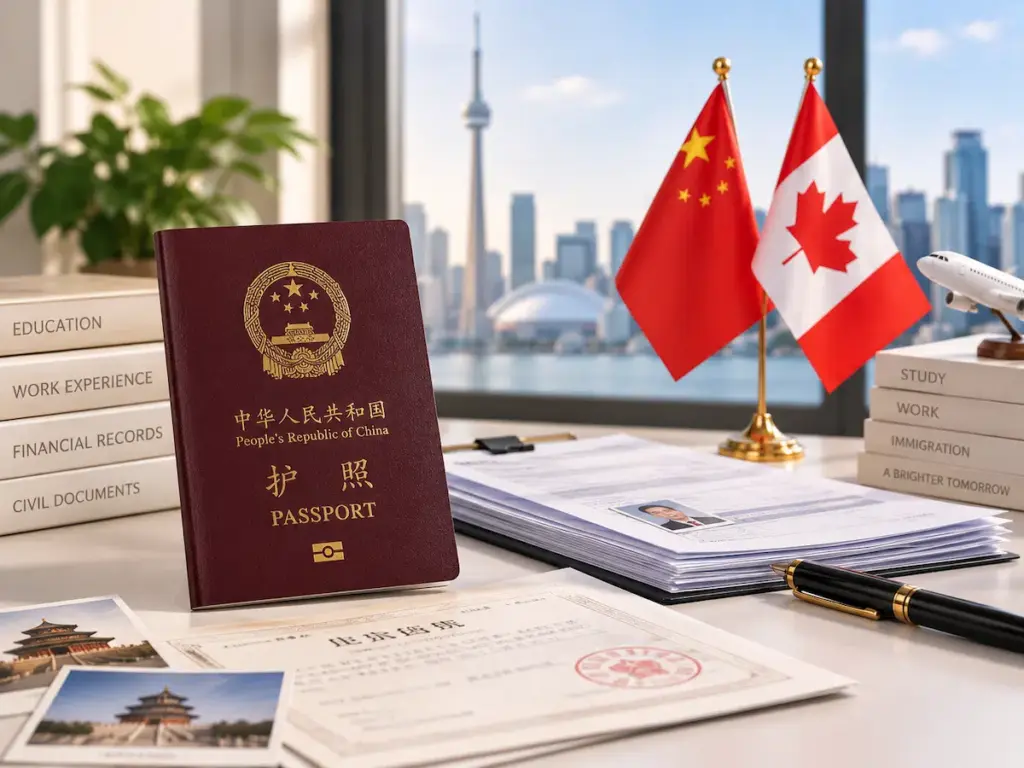
Key Documents for Chinese Immigrants
Chinese Police Certificate
IRCC identifies the Chinese police document as:
Certificate of No Criminal Record
or, when a criminal record exists:
Notification of Non-issuance of Certificate of No Criminal Record.
Chinese citizens living in China can generally apply through:
- local Public Security Bureau
- local Public Security police station
- local government service website or app where available
The procedure may depend on the city.
Hukou Can Be Important
Applicants may need documents including:
- national ID card
- hukou booklet
- proof of residence
If the hukou registration has been cancelled, a Certificate of Residence Cancellation may be required.
This is one of the more country-specific documentation issues Chinese applicants should prepare for early.
Your Certificate Should Cover the Required Period
IRCC currently states that for Chinese citizens, the Certificate of No Criminal Record should cover the period from birth to the current date.
Translation Is Required
Chinese police documents must be accompanied by the appropriate notarized or certified translation when required by IRCC.
Applicants should not upload only the translated document.
IRCC generally requires both:
- the original document
- the certified English or French translation
If You Cannot Obtain a Complete Chinese Police Certificate
IRCC acknowledges that obtaining full historical police documentation can sometimes be difficult.
If a certificate cannot be obtained for a specific part of your residence history, the applicant should provide an explanation and evidence of the attempts made to obtain it.
IRCC then decides whether the explanation is acceptable.
Biometrics in China
Most Chinese applicants who require Canadian biometrics can use Canada’s network of VACs in mainland China.
Current locations include:
| Canadian VAC Locations in China |
|---|
| Beijing |
| Chengdu |
| Chongqing |
| Guangzhou |
| Hangzhou |
| Jinan |
| Kunming |
| Nanjing |
| Shanghai |
| Shenyang |
| Wuhan |
These locations are listed by IRCC as authorized Canadian Visa Application Centres and biometrics collection points.
Applicants should use the official VAC system and should not pay unofficial intermediaries claiming to have special access to Canadian visa appointments.
Recognition of Chinese Qualifications in Canada
An immigration approval does not automatically give you professional recognition in Canada.
This matters especially for regulated professions.
Examples include:
- physicians
- nurses
- engineers
- teachers
- pharmacists
- accountants
- architects
- skilled trades
You may need two different assessments:
Immigration Assessment
Determines whether your education and experience count for immigration.
Professional Licensing
Determines whether you can legally practise the profession in a Canadian province.
A Chinese degree may help you qualify for Express Entry while still requiring substantial additional licensing before you can work in your profession.
Chinese Tech and STEM Professionals
STEM remains a category within Canada’s 2026 Express Entry system.
This can make Canada relevant for Chinese professionals working in areas such as:
- software development
- cybersecurity
- engineering
- data
- scientific research
- selected technical occupations
However, the category occupation list should always be checked before building an immigration strategy around it.
A profession that seems broadly “STEM-related” is not automatically eligible for a STEM category draw.
Chinese Researchers Moving to Canada
Researchers are particularly interesting in 2026 because Canada introduced a category for researchers with Canadian work experience.
For Chinese researchers already working at Canadian:
- universities
- laboratories
- research institutes
- qualifying private-sector research organizations
Canadian work experience may therefore have increased strategic value for permanent residence.
How Much Does It Cost to Move From China to Canada?
There is no single amount.
Applicants should separate costs into three categories.
1. Immigration Costs
Possible expenses include:
- government application fees
- biometrics
- language tests
- ECA
- medical exams
- police documents
- certified translations
- provincial fees
- licensing costs
2. Proof of Funds
Certain economic immigration programs require settlement funds.
The required amount depends on family size and is updated periodically.
Use the latest IRCC table when submitting the application.
3. Actual Moving Costs
Relocation expenses may include:
- flights
- temporary housing
- rental deposit
- furniture
- transportation
- food
- winter clothing
- phone and internet
- school costs
- emergency savings
Toronto and Vancouver generally require a very different settlement budget from smaller Canadian cities.
Moving Money From China to Canada
Large international transfers should be planned carefully.
Keep documentation showing:
- source of funds
- account ownership
- transfer history
- sale of assets where relevant
- legitimate origin of large deposits
This may also be important if the funds are being used as immigration settlement funds.
Travellers entering Canada with CAD 10,000 or more in currency or monetary instruments must declare it to Canadian border authorities.
The money itself is not prohibited, but failure to declare it can create serious problems.
Chinese applicants should also check current Chinese foreign-exchange and outbound-transfer rules with their bank or a qualified financial adviser before planning large transfers.
Healthcare After Moving to Canada
Canada’s healthcare systems are provincial and territorial.
Your eligibility depends on:
- immigration status
- province
- residency requirements
Permanent residents generally become eligible for provincial health coverage once they satisfy the applicable rules.
Some workers and students may also qualify.
Public healthcare does not necessarily cover everything.
You may still need coverage for:
- dental care
- prescription medication
- vision care
- physiotherapy
- other supplementary services
Best Places in Canada for Chinese Newcomers
The best Canadian city depends on employment, cost of living, family connections, language, and immigration strategy.
Toronto and the Greater Toronto Area
Suitable for:
- finance
- technology
- professional services
- business
- healthcare
- education
Toronto also has a large Chinese-speaking population and extensive Chinese community infrastructure.
The major disadvantage is housing cost.
Vancouver and the Lower Mainland
Vancouver has one of Canada’s largest Chinese communities.
It can be attractive for:
- trade
- technology
- real estate-related industries
- professional services
- international business
- proximity to Asia
Housing remains expensive.
Calgary
Calgary may appeal to people working in:
- engineering
- energy
- technology
- construction
- professional services
Housing may be more accessible than Toronto or Vancouver, although affordability has changed significantly in recent years.
Ottawa
A strong option for:
- technology
- engineering
- research
- professional services
- government-related industries
Montreal
Montreal can be attractive for:
- AI
- research
- aerospace
- technology
- universities
- creative industries
However, French becomes much more important for both employment and daily life in Quebec.
Quebec also operates a separate economic immigration selection system.
Smaller Canadian Cities
Smaller cities can offer:
- lower housing costs
- regional immigration pathways
- specific labour shortages
But they also have smaller employment markets.
Choosing a province based on your occupation and immigration opportunity is usually more useful than simply moving to Canada’s largest Chinese community.
Expert View: What Should Chinese Applicants Focus on in 2026?
For Chinese applicants, immigration planning in 2026 should begin with one question:
Do you already have a competitive profile for direct permanent residence, or would Canadian experience materially improve your chances?
For skilled applicants with strong education, language scores, and professional experience, Express Entry and PNPs should usually be assessed before choosing a more expensive study pathway.
Chinese STEM professionals may benefit from Canada’s category-based selection, but occupation eligibility needs to be checked carefully rather than assuming every technology or engineering job qualifies.
For researchers, senior managers, and other experienced professionals, obtaining the right Canadian work experience may have increased strategic value because Canada has introduced new categories specifically targeting certain candidates with Canadian experience.
For entrepreneurs, the strategy has changed considerably. The federal Start-Up Visa Program is currently paused, so applicants should not structure a 2026 immigration plan around new SUV applications. Provincial entrepreneur programs may be more relevant, but their investment, ownership, residence, and active-management requirements need to be evaluated province by province.
Students should also be more selective. Canada is reducing international student arrivals, and the minimum living-funds requirement increases on September 1, 2026. A Canadian education should therefore make sense academically and financially even before considering possible immigration benefits.
For many Chinese applicants, the strongest sequence is:
assess direct Express Entry → check PNP opportunities → evaluate employer or intra-company work options → use study only when the academic and career case is strong.
Common Mistakes Chinese Applicants Make
- Assuming a Visitor Visa Lets You Work
It does not.
A visitor visa is a travel document, not work authorization.
- Confusing Mainland China and Hong Kong Entry Rules
Mainland PRC passport holders generally require a visitor visa.
Hong Kong SAR passport holders fall under different Canadian entry-document rules.
- Waiting Too Long to Prepare the Police Certificate
Chinese police certificate procedures vary by city and may involve hukou, local police offices, representatives, notarization, and translation.
Start early.
- Uploading Only a Translation
IRCC generally requires the original police certificate together with the appropriate certified translation.
- Assuming a Chinese Professional Licence Transfers Automatically
Immigration approval and professional licensing are separate.
- Building a Business Plan Around the Start-Up Visa
Canada paused new Start-Up Visa applications on June 30, 2026.
- Choosing a Canadian School Only for PR
A Canadian degree does not guarantee permanent residence.
- Ignoring the September 2026 Student Funds Increase
For applications from September 1, 2026, the minimum first-year living amount for one applicant outside Quebec rises from CAD 22,895 to CAD 23,448.
Frequently Asked Questions
Yes. Chinese citizens can qualify for permanent residence through programs such as Express Entry, PNPs, family sponsorship, the Atlantic Immigration Program, and other eligible immigration pathways.
Yes. Ordinary People’s Republic of China passport holders are currently visa-required travellers to Canada.
Ordinary mainland Chinese passport holders are not currently included in Canada’s special eTA program for selected visa-required nationalities.
Different rules apply to certain other Chinese travel documents, including Hong Kong SAR passports.
Yes. Possible options include: Federal Skilled Worker Program, selected PNP streams, family sponsorship, study, qualifying business programs.
Yes. Express Entry eligibility is based on Canadian immigration requirements rather than exclusion by Chinese nationality.
Yes. STEM remains one of the current category-based selection groups.
Not for new applications. The program was paused on June 30, 2026. IRCC continues processing previously accepted applications.
IRCC identifies the required document as the Certificate of No Criminal Record, or the relevant notification when a criminal record prevents issuance.
Applicants need the appropriate notarized or certified translation when the document is not in English or French.
Canada currently lists VACs in Beijing, Chengdu, Chongqing, Guangzhou, Hangzhou, Jinan, Kunming, Nanjing, Shanghai, Shenyang, and Wuhan.
Yes. However, Canada has reduced its 2026 target for new international student arrivals to 155,000.
Potentially. Graduates who qualify for a PGWP may gain Canadian work experience and later become eligible for Express Entry or a PNP. However, study does not guarantee PR.
Potentially, particularly through selected provincial entrepreneur programs. The federal Start-Up Visa, however, is currently paused for new applications.
Conclusion
Moving to Canada from China in 2026 remains possible through several pathways, but successful applicants need to choose a strategy based on current Canadian immigration priorities rather than older assumptions.
For skilled Chinese professionals, Express Entry and Provincial Nominee Programs remain important permanent residence options. Applicants in STEM, healthcare, education, trades, transport, and other priority areas should also check whether their exact occupation fits a current Express Entry category.
For employees of international companies, an employer-supported work permit or intra-company transfer can provide an alternative route into the Canadian labour market.
Students should be more cautious than in previous years because Canada has reduced new student admissions and increased financial requirements.
Entrepreneurs should also note that Canada’s federal Start-Up Visa is currently paused for new applications, making current provincial options more important to investigate.
The strongest 2026 strategy is therefore to compare direct PR, provincial nomination, Canadian work experience, and study or business options based on the applicant’s occupation, education, language ability, finances, and long-term goals.