Your study permit is approaching its expiry date, but you still have courses to complete. Perhaps your research project is taking longer than expected, your university has extended your program, or you have received admission to another Canadian institution.
Whatever the reason, continuing your education beyond your study permit’s validity may require a new application to Immigration, Refugees and Citizenship Canada (IRCC).
For most international students already in Canada, this means applying for a study permit extension before their current permit expires.
The timing matters. Applying while your permit is still valid can allow you to continue studying under your existing conditions while IRCC processes your application. Waiting until after it expires can leave you unable to attend classes or work until your status has been restored.
The requirements also depend on whether you are staying at the same institution, changing schools, moving to a different level of study, or studying in Quebec.
This guide explains how Canadian study permit extensions work, what documents you need, and how the rules affect your ability to remain in Canada legally.
When Do You Need to Extend Your Study Permit?
A Canadian study permit authorizes you to study under specific conditions for a limited period.
Most study permits are issued for the expected duration of the academic program, usually with an additional 90 days. However, the expiry date printed on your permit is not always the date on which your authorization actually ends.
For example, if you complete your program earlier than expected, your study permit generally becomes invalid 90 days after you complete your studies or on its printed expiry date, whichever comes first.
If you need more time to complete your studies, you must ensure that you have the appropriate authorization to remain enrolled.
Several academic situations can make an extension necessary.
| Your Situation | What You Should Know |
|---|---|
| Your program is taking longer than expected | Apply for an extension before your current study permit expires. |
| You need an additional semester to graduate | You generally need an extension if your permit will expire before you complete the semester. |
| You are changing to another post-secondary institution | You generally need a new study permit for the new DLI, obtained through the extension process. |
| You are starting a different academic program | Requirements depend on whether you are changing institutions, education levels, or conditions attached to your permit. |
| Your study permit has already expired | You may need to restore your student status rather than submit an ordinary extension. |
| You have completed your studies | An extension is not automatically the appropriate option. Your next steps depend on your immigration plans and eligibility. |
Students who are continuing at the same institution may have a relatively straightforward extension application.
However, those changing universities or educational levels should pay particular attention to the provincial attestation requirements introduced in 2025 and updated in 2026.
When Should You Apply for a Study Permit Extension?
IRCC advises international students to apply at least 30 days before their current study permit expires.
Submitting your application earlier is generally preferable, especially if you need to obtain additional documentation from your institution.
For example, consider a student whose study permit expires on August 31, 2027, but whose academic program will not finish until December 2027.
Waiting until the final week of August could create unnecessary difficulties if the university has not issued the necessary enrolment documents or if the online application requires additional evidence.
Applying several months in advance gives the student more time to address those issues.
The official processing time should also be considered when deciding how early to apply.

What Happens if You Apply Less Than 30 Days Before Expiry?
Although IRCC recommends applying at least 30 days before expiry, the critical requirement for maintained status is that a valid, complete extension application is submitted before your existing status expires.
For example, a student who submits a complete application 10 days before their study permit expires may still qualify for maintained status if the relevant conditions are satisfied.
However, submitting an application at the last minute is risky.
An application that IRCC returns as incomplete may be treated as though it was never submitted. If the student’s original permit has already expired, this can have serious consequences for their immigration status.
You should also consider the expiry date of your passport.
A Canadian study permit cannot be extended beyond the validity of the passport used for the application.
If your passport expires soon, renewing it before requesting a longer study permit may prevent you from receiving a shorter authorization than you need.
Study Permit Extension Requirements
The central question in a study permit extension application is whether you continue to meet the conditions for studying in Canada.
IRCC must be satisfied that you have a legitimate academic reason to remain in Canada and that you meet the applicable immigration requirements.
For a student continuing at the same institution, the application will generally need to establish that:
- You are enrolled at an eligible Designated Learning Institution (DLI).
- You need additional time to complete your program.
- You have sufficient financial resources to continue studying.
- You have respected the conditions of your existing study permit.
- You meet any additional requirements applicable to your circumstances.
IRCC also expects international students to remain enrolled and actively pursue their studies.
An extension is not automatically approved simply because the university agrees to let a student remain registered.
Academic Progress and Continued Enrolment
Your institution plays an important role in supporting your application.
A letter confirming your current enrolment, academic program, and expected completion date can help demonstrate why additional study authorization is necessary.
Suppose a master’s student initially expected to graduate in April but needs another semester to complete a thesis.
The university may provide an official enrolment letter confirming the revised completion date.
This document helps IRCC understand why the student is requesting more time.
In some cases, transcripts or other academic records may also be relevant, particularly when an applicant has experienced delays, interruptions, or changes in academic progress.
Where necessary, a clear explanation of the circumstances may help establish the reason for the extension.
Financial Requirements for Continuing Students
International students applying for extensions must demonstrate that they can financially support themselves while continuing their education.
This includes the remaining tuition costs, living expenses, and other applicable financial obligations.
IRCC applies its updated financial requirements to study permit extension applications but assesses whether the applicant has sufficient resources to continue supporting themselves during their remaining studies.
For applications submitted on or after September 1, 2026, the published annual living-expense requirement for a single student outside Quebec is CAD 23,448, excluding tuition and transportation.
However, students extending their permits should not assume that every application is assessed using an identical financial calculation regardless of the time remaining in their program.
The officer considers the applicant’s financial circumstances and ability to support their continued stay.
For example, a student with several months of studies remaining may have different financial circumstances from a student beginning another two-year program.
Relevant financial evidence may include bank statements, scholarship documentation, funding from an institution, or support from an eligible financial sponsor.
Students receiving research funding or graduate assistantships should obtain clear documentation establishing the amount and expected duration of that funding.
Having permission to work while studying does not remove the obligation to demonstrate adequate financial resources.
Documents Required for a Study Permit Extension
IRCC generates a personalized document checklist when you apply online.
The specific documents depend on your immigration status, academic circumstances, and whether you are changing your institution or program.
For most post-secondary students, the application includes several core documents.
Proof of Enrolment or Acceptance
Your Designated Learning Institution must provide an appropriate document confirming your studies.
Depending on your situation, this may be:
- A current letter of enrolment.
- A letter of acceptance for a new program.
- An official document confirming your revised program completion date.
The letter should clearly identify the institution and relevant academic details.
For a continuing student, it is particularly useful when the institution confirms why additional time is required.
IRCC requires post-secondary institutions to verify letters of acceptance or enrolment submitted in support of study permit applications.
When completing an extension application, the letter should be uploaded in the designated letter-of-acceptance field.
If the institution does not verify the document within IRCC’s required timeframe, the application may be returned.
Passport and Existing Immigration Documents
You will generally need copies of your passport and current study permit.
Ensure that your passport remains valid for the period you intend to study.
Applicants may also need to provide evidence of their current immigration status in Canada and other documents identified in the personalized checklist.
Proof of Financial Support
Financial evidence should demonstrate your ability to cover the remaining costs of your studies.
Depending on your circumstances, useful documents may include:
- Recent bank statements.
- Scholarship or funding confirmation.
- Proof of available savings.
- Documentation of financial support from a family member or sponsor.
- Evidence of tuition already paid.
A student who relies on a scholarship that expires before their revised graduation date may need additional evidence showing how the remaining expenses will be covered.
The documents should be sufficient to explain the applicant’s actual financial situation rather than simply present a bank balance without context.
Letter of Explanation
A letter of explanation can be helpful when an extension involves unusual or complex circumstances.
For example, a student may have experienced an approved medical leave, a research delay, or a change in academic requirements.
The purpose of this letter is to explain why the extension is necessary and how the supporting evidence relates to the application.
It should be factual, consistent with the academic records, and relevant to the request.
A letter of explanation does not replace required documents or establish eligibility on its own.
Do You Need a New PAL or TAL to Extend Your Study Permit?
Not every study permit extension requires a new Provincial Attestation Letter (PAL) or Territorial Attestation Letter (TAL).
Under the rules applicable in 2026, students extending their permits at the same Designated Learning Institution and at the same level of study are generally exempt from providing a new PAL/TAL.
This distinction is important because the rules are different for students changing institutions or educational levels.
Extending Your Permit at the Same Institution
Consider an undergraduate student at a Canadian university who needs one additional semester to finish their bachelor’s degree.
The student is remaining at the same DLI and continuing at the same educational level.
In this situation, the student generally does not need a new PAL/TAL for the extension application.
However, the student must still meet the other requirements for extending the study permit.
The PAL/TAL exemption is not an exemption from obtaining a new study permit.
Changing Your Institution or Level of Study
Since January 22, 2025, international students changing post-secondary institutions or educational levels generally need a new PAL/TAL unless an exemption applies.
For example, moving from one college to another is different from extending a permit to finish the same program at the same college.
Similarly, changing from an undergraduate program to another educational level may affect the documentation required.
There is an important exception for certain graduate students.
Since January 1, 2026, students entering degree-granting master’s or doctoral programs at public DLIs are exempt from PAL/TAL requirements.
Therefore, a student moving from a bachelor’s degree into an eligible master’s program at a public university may not need a PAL/TAL, even though the student is changing educational levels.
The exemption depends on the type of institution and academic program. It should not be applied automatically to every graduate certificate, graduate diploma, or private institution.
PAL/TAL Requirements When Restoring Student Status
Restoring an expired study permit is different from extending a valid permit.
IRCC states that students applying to restore their status generally need a new PAL/TAL, even when they intend to continue at the same DLI and educational level.
The exemption normally available for an ordinary extension at the same institution does not automatically carry over to restoration applications.
Other independent exemptions may still apply, such as the exemption for eligible master’s and doctoral programs at public DLIs.
Applicants should confirm the applicable requirement before submitting a restoration application.
How to Apply for a Canada Study Permit Extension
Most international students must submit their study permit extension applications online through the IRCC Secure Account.
This is the application system used to extend or change conditions on an existing study permit from inside Canada.
Even if you submitted your original study permit application through a different IRCC account, the extension application must be completed using the account specified in the current IRCC instructions.
You will need to complete the application questionnaire and provide the supporting documents requested for your circumstances.
Application Form IMM 5709
The form generally used for this process is:
The form allows eligible applicants to request an extension or changes to their existing study authorization.
The information provided should reflect the student’s actual academic circumstances, immigration status, and intended period of study.
When requesting an extension, the proposed end date should be supported by the documentation from the educational institution.
Applicants should use the current version of the form available through IRCC.
Submitting an outdated or incomplete form can lead to the application being returned.
Submitting Your Application Online
The online application process includes answering IRCC’s eligibility questions, completing the required forms, uploading supporting documents, and paying the applicable government fees.
Once submitted, the application can be monitored through the IRCC Secure Account.
IRCC may request additional information or documentation during processing.
Keep copies of your submitted application, payment confirmation, and supporting documents.
These records can be particularly important if your original study permit expires while the extension is still being processed.
Official application instructions are available through IRCC’s study permit extension application page.
Study Permit Extension Fees in 2026
The standard government processing fee for a Canadian study permit extension is CAD 150.
Additional charges may apply if you are required to provide biometrics or if you are applying to restore an expired immigration status.
| Application Type | Government Fee |
|---|---|
| Study permit extension | CAD 150 |
| Restoration of student status | CAD 246.25 |
| Restoration of student status plus new study permit | CAD 396.25 |
| Biometrics, if required | CAD 85 |
The restoration fee increased to CAD 246.25 on December 1, 2025.
Therefore, students who need both restoration of status and a new study permit generally pay CAD 396.25 in government fees, excluding any additional charges.
These are the published federal fees as of October 2026.
The fee for an ordinary study permit extension is separate from any additional provincial application fees, including applicable fees in Quebec.
How Long Does a Study Permit Extension Take?
Study permit extension processing times are not fixed.
IRCC updates its processing time estimates regularly, and the time required to assess an application depends on several factors.
These include the completeness of the application, the need to verify supporting documents, and the number of applications being processed.
A student who requires additional academic verification or has unresolved immigration issues may experience a longer processing period.
Rather than relying on an outdated processing-time estimate, students should consult IRCC’s official processing time tool before applying.
Faster Processing for Students Changing Institutions
IRCC currently provides a specific 60-day processing arrangement for eligible students changing to a new post-secondary DLI.
Students using this process must correctly identify that they are changing institutions in the online application questionnaire.
This arrangement should not be confused with the general processing time for all study permit extensions.
It also does not mean that every extension application will necessarily be finalized within 60 days.
Students changing institutions must still meet the applicable eligibility and documentation requirements.
Can You Continue Studying While Waiting for an Extension?
In many situations, yes.
If you submit a complete study permit extension application before your existing permit expires and remain in Canada, you may benefit from maintained status.
Maintained status allows certain temporary residents to remain in Canada legally while IRCC processes an application submitted before their previous authorization expired.
For students extending their study permits, it can allow them to continue studying under the conditions of their previous permits.
Consider a student whose study permit expires on June 30.
The student submits a complete extension application on May 20, but IRCC has not issued a decision by June 30.
If the student remains in Canada and meets the applicable requirements, they can generally continue studying under the conditions of their original study permit while waiting for a decision.
This is different from a student whose permit expired before an extension application was submitted.
Can You Work While on Maintained Status?
A student who qualified to work under the conditions of their study permit may generally continue working while on maintained status, provided they continue to meet the applicable student employment requirements.
For eligible students working off campus, the regular academic-session limit is generally 24 hours per week.
However, maintained status does not create new employment rights.
A student who was not authorized to work before the extension application does not automatically receive work authorization because an application is pending.
The student must continue respecting the conditions applicable to their studies and employment.
Work eligibility may also change if the student completes their program, stops being enrolled, or no longer satisfies the applicable requirements.
What Happens if IRCC Refuses Your Extension?
If IRCC refuses your extension application, maintained status normally ends when the refusal decision is made.
You must stop any studies or employment that are no longer authorized.
Depending on your circumstances, you may have options to apply for restoration of status or take other appropriate immigration action.
However, submitting a new application after a refusal does not automatically restore your previous authorization to study or work.
The available options depend on your status, the reason for refusal, and the applicable time limits.
What if Your Study Permit Has Already Expired?
If your study permit expires before you submit a valid extension application, you generally lose your student status.
In that situation, an ordinary extension application is no longer sufficient.
You may need to apply for restoration of status as a student.
IRCC generally allows eligible temporary residents to apply for restoration within 90 days of losing their status.
However, restoration is not automatic, and submitting an application does not guarantee approval.
Can You Continue Attending Classes During Restoration?
No. If your student status has expired and you are applying for restoration, you generally cannot continue studying until IRCC restores your status and issues the necessary study permit.
You must also stop any work that is no longer authorized.
This can create difficulties for students whose academic terms are already underway.
For example, a student may need to arrange an approved interruption of studies while waiting for a decision.
The educational institution may be able to explain its policies regarding enrolment, deferrals, and academic deadlines, but it cannot independently authorize a student to study without the required immigration status.
How Restoration Differs From Maintained Status
The distinction is particularly important.
| Situation | Can You Remain in Canada While IRCC Processes the Application? | Can You Continue Studying? |
|---|---|---|
| Complete extension application submitted before permit expiry, with maintained-status conditions met | Yes | Generally yes, under the original permit conditions |
| Permit expired before a valid extension application was submitted; eligible restoration application pending | Generally yes, while the restoration application is processed | No, until restoration and a new study permit are approved |
| Restoration application submitted outside the permitted restoration period | Restoration generally unavailable through the ordinary process | No, unless another legal authorization applies |
The 90-day restoration period should not be confused with the additional 90 days normally associated with the validity of a study permit after completing an academic program.
They are different rules serving different purposes.
If more than 90 days have passed since the loss of status, the student may need to leave Canada and determine the appropriate immigration options from outside the country.
What About Family Members?
If your spouse, common-law partner, or dependent children are also in Canada, their immigration status must be considered separately.
A family member does not automatically receive maintained status or restoration of status simply because the principal student has applied.
Where restoration is required, each affected family member may need to submit a separate application and pay the applicable fees.
Changing Universities or Colleges During Your Studies
Transferring to another institution can affect your study permit even if your current permit has not expired.
Under the rules introduced on November 8, 2024, students changing post-secondary DLIs generally need to obtain a new study permit for the new institution.
For students already in Canada, IRCC uses the study permit extension process for this purpose.
For example, a student enrolled at a college in Ontario who receives an offer from a different college in British Columbia cannot assume that the existing study permit automatically authorizes enrolment at the new institution.
The new school must be a Designated Learning Institution.
The student must also satisfy any applicable PAL/TAL requirements.
Can You Begin Studying at the New Institution Before Approval?
Generally, students must wait until their new study permit is approved before beginning studies at a different post-secondary DLI.
However, IRCC recognizes limited exceptions.
These may apply when the original institution closes, discontinues the student’s program, loses its designated status, or is placed on the suspension list.
Additional conditions apply, including remaining in Canada after receiving the new letter of acceptance and continuing to comply with the previous study permit.
For an ordinary voluntary transfer between two functioning universities or colleges, students should not assume that the exception applies.
Moving to a different institution without following the required procedure can create compliance problems and affect future immigration applications.
Current requirements are explained in IRCC’s guidance on changing schools or programs.
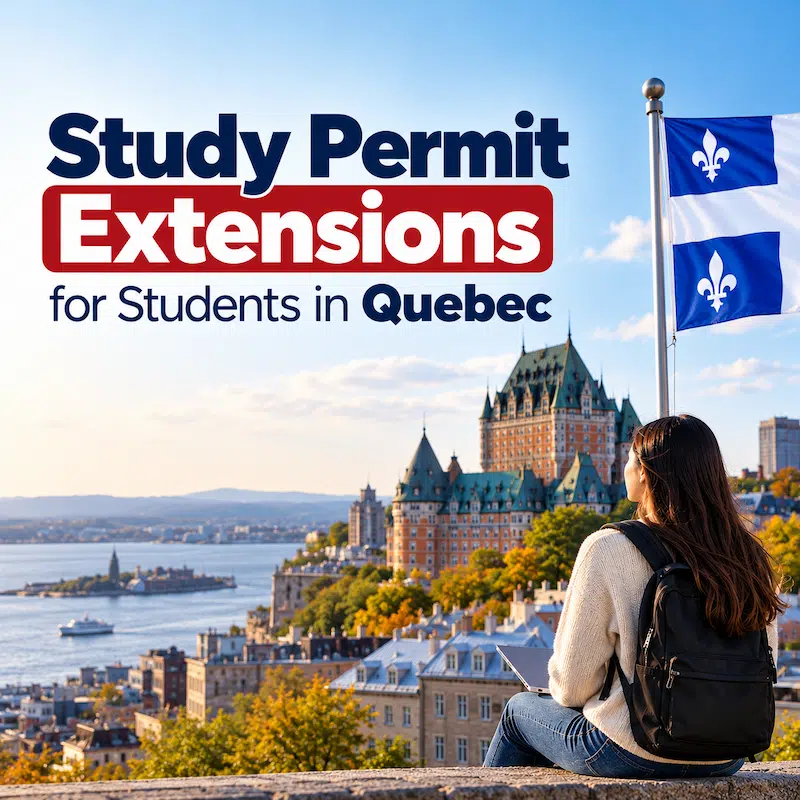
Study Permit Extensions for Students in Quebec
International students studying in Quebec must consider both federal immigration requirements and Quebec’s provincial authorization rules.
Most foreign students studying in Quebec need a Quebec Acceptance Certificate (CAQ) in addition to their federal study permit.
If the student’s academic program extends beyond the validity of the existing CAQ, a new application for temporary selection for studies may be required.
A new CAQ application may also be necessary when changing educational levels or institutions.
Quebec has specific exceptions for certain students changing institutions, including some holders of CAQs issued before December 6, 2024.
When Should Quebec Students Renew Their CAQ?
The Government of Quebec strongly recommends applying for the necessary provincial authorization at least three months before the CAQ and study permit expire.
This is particularly important because the student may need to obtain the new CAQ documentation before completing the federal study permit application.
For example, a student at a Montreal university whose research project requires an additional academic year may need both updated provincial authorization and a federal study permit extension.
Receiving a new CAQ does not automatically extend the federal study permit.
The two authorizations have different legal purposes.
Students in Quebec should review Quebec’s official guidance on renewing study authorizations before applying.
Travelling Outside Canada While Your Extension Is Being Processed
A study permit is not a travel document.
Depending on your citizenship and immigration circumstances, you may also need a valid Temporary Resident Visa (TRV) or Electronic Travel Authorization (eTA) to return to Canada.
This becomes particularly important when travelling during the processing of a study permit extension.
If your original study permit expires while you are outside Canada, you should not assume that you can return and immediately resume your studies simply because you submitted an extension application before leaving.
IRCC explains that an applicant whose extension remains pending may be admitted to Canada as a visitor.
In that situation, the applicant cannot resume studying until the new study permit is approved.
Re-entry is also subject to assessment by the border services officer.
A valid visa, eTA, or pending immigration application does not guarantee admission to Canada.
Students with upcoming international travel should assess the timing of their study permit extension and the validity of their travel documents before leaving.
Extending a Study Permit After Completing Your Program
Not every student who wants to remain in Canada after graduation needs a study permit extension.
Your next immigration application should reflect what you actually intend to do.
For example, an international student who has completed an eligible program and wants to work in Canada may need to consider the Post-Graduation Work Permit (PGWP) rather than extending their study permit.
Students who intend to begin a new academic program may have different requirements.
Study Permit Validity After Graduation
A study permit normally becomes invalid on the earlier of:
- The expiry date printed on the permit.
- 90 days after completion of the academic program.
The completion date is generally determined by the first official notification from the institution that the student has completed their studies.
This could be a completion letter, transcript, or other qualifying academic document.
The 90-day period should not be interpreted as automatic authorization to continue working under the same conditions that applied during full-time studies.
Work authorization after completing a program depends on the applicable immigration rules and, where relevant, the requirements for a PGWP application.
Study Permit Extension vs Post-Graduation Work Permit
These two applications serve different purposes.
A study permit extension allows an eligible student to continue an academic program or pursue studies under the appropriate conditions.
A PGWP, on the other hand, allows eligible graduates of qualifying Canadian programs to obtain an open work permit after completing their studies.
PGWP eligibility depends on multiple factors, including the institution, program, educational credential, and applicable immigration requirements.
Extending a study permit does not establish PGWP eligibility.
Students who plan to work in Canada after graduation should verify their PGWP options before completing their program.
Questions About Study Permit Extensions
Yes. International students who remain eligible can apply to extend their study permits while staying in Canada. Most applicants submit their extension applications online through their IRCC Secure Account. (Note: If you leave Canada before an extension is granted, different application processes may apply upon re-entry).
No, there is no fixed limit on the number of times a study permit can be extended. However, each extension application is evaluated individually and must be supported by valid academic reasons (such as continuing your studies or starting a new program) and proof that you continue to meet all eligibility conditions. Repeated extensions are not approved automatically.
No. IRCC does not require students to retake a language test simply to extend their study permit. However, if you are changing programs or enrolling in a new educational institution, your school may independently require an updated language proficiency score for admission.
No. A Canadian study permit cannot be issued or extended past the expiration date of your passport. IRCC recommends renewing your passport before applying for a study permit extension to ensure the new permit covers the full duration of your remaining studies.
Maintained status (formerly implied status) only applies if IRCC receives a complete application before your current study permit expires. If your application is returned as incomplete or rejected for missing forms/fees, it is treated as though it was never submitted, and you will not have maintained status.
Planning Your Study Permit Extension
A study permit extension is more than an administrative renewal.
For an international student already enrolled in Canada, the outcome can determine whether they are able to continue attending classes, maintain their immigration status, and remain eligible for certain employment activities.
The appropriate application also depends on the student’s academic circumstances.
Someone extending a research program at the same university may face different requirements from someone transferring to another college, beginning a new degree, or seeking restoration after their permit has expired.
Understanding those differences before submitting an application can help avoid an interruption to your studies.
Sugimoto Visa provides professional immigration consulting services to international students who need assistance understanding Canadian study permit requirements, preparing extension applications, or addressing changes in their immigration status.
If your current permit is approaching its expiry date, reviewing your academic and immigration circumstances in advance can help you determine which application is appropriate and what supporting evidence you may need.
Official Sources: