Canada’s Parents and Grandparents Program (PGP) allows eligible Canadian citizens and permanent residents to sponsor their parents or grandparents for permanent residence.
In 2026, however, the first question is no longer simply whether a sponsor meets the financial requirements.
It is whether a new PGP application can be submitted at all.
On July 15, 2026, Immigration, Refugees and Citizenship Canada (IRCC) announced that it was pausing new intake under the Parents and Grandparents Program. The department will continue processing applications already in the system, but it will not accept new Interest to Sponsor forms or issue new invitations to apply until further notice. IRCC plans to admit up to 15,000 people as permanent residents through the PGP in 2026.
That distinction matters.
The program itself has not disappeared, and existing applications have not been cancelled. But someone who has never submitted a PGP application cannot simply begin a new sponsorship application in 2026.
For families who want their parents or grandparents in Canada sooner, the Super Visa is currently the main active federal alternative. It allows eligible parents and grandparents to visit Canada for up to five years at a time, with multiple entries over a visa validity period of up to ten years.
Where the PGP Stands in 2026
The status of the program changed substantially during the year.
The most recent active intake took place in 2025.
IRCC invited people who had originally submitted an Interest to Sponsor form in 2020. Starting July 28, 2025, the department sent 17,860 invitations, with the goal of receiving up to 10,000 complete applications.
That intake closed on October 9, 2025.
No new Interest to Sponsor form was opened for the public.
Then, in July 2026, IRCC confirmed that new PGP intake would be paused.
As of now:
- no new Interest to Sponsor form is available;
- no new invitation round is being issued;
- new PGP applications cannot be submitted without an invitation;
- applications already received continue to be processed;
- and IRCC plans to admit up to 15,000 PGP permanent residents in 2026.
An application submitted without an invitation is returned by IRCC.
For someone researching parent sponsorship today, this is the most important fact to understand before looking at income tables or application forms.
Why the Program Is Paused
Demand for parent and grandparent sponsorship has consistently exceeded the number of permanent residence spaces available under Canada’s immigration levels plans.
IRCC manages this by controlling how many applications enter the system.
For 2026, the Immigration Levels Plan allocates approximately 15,000 admissions to parents and grandparents, with the same target planned for 2027 and 2028.
At the same time, tens of thousands of PGP applicants are already waiting in the processing inventory.
As of January 31, 2026, IRCC reported approximately:
- 48,400 parents and grandparents in the inventory for destinations outside Quebec;
- 12,100 in the Quebec inventory.
The July pause is therefore primarily an intake-management decision: IRCC is continuing to work through existing applications without adding another new intake at this time.
Sponsor Eligibility
When the PGP accepts applications, the sponsor must satisfy more than the financial requirement.
IRCC currently requires the sponsor to:
- be at least 18 years old;
- live in Canada;
- have their primary residential address in Canada from the time the application is submitted until IRCC makes a decision;
- be a Canadian citizen, permanent resident or person registered under the Indian Act;
- meet the required income threshold;
- sign the sponsorship undertaking;
- and satisfy the other sponsorship requirements under Canadian immigration law.
The residence requirement is important.
Unlike some spousal sponsorship situations, a Canadian citizen living abroad cannot simply submit a PGP application while remaining outside Canada.
For parent and grandparent sponsorship, the sponsor must be living in Canada.
Sponsorship Restrictions
A person may also be prevented from sponsoring parents or grandparents if, for example, they:
- are incarcerated;
- have failed to repay certain immigration loans or performance bonds;
- are in default of court-ordered support payments;
- failed to honour an earlier sponsorship undertaking;
- have an undischarged bankruptcy;
- receive social assistance for a reason other than disability;
- have certain violent, sexual or family-related criminal convictions;
- or are subject to a removal order.
The financial requirement is therefore only one part of sponsor eligibility.
Parents and Grandparents You Can Sponsor
The PGP covers a sponsor’s own biological or adopted parents and grandparents.
The application structure can become more complicated when there are step-parents, remarriages or more than one generation being sponsored.
Parents and Their Partners
If a sponsor is sponsoring a biological or adopted parent, that parent must be the principal applicant.
A step-parent cannot normally be substituted as the principal applicant if they are not directly related to the sponsor.
Instead, the step-parent can generally be included as the spouse or partner of the sponsored parent.
Grandparents
Where a grandparent couple is being sponsored, one grandparent is designated as the principal applicant and the other is included as the spouse or common-law partner.
Once the application has been submitted, the principal applicant cannot simply be changed.
Sponsoring Parents and Grandparents Together
If someone intends to sponsor both their parents and their grandparents, separate sponsorship applications are generally required for each family unit.
Parents-in-Law
A person cannot use their own PGP invitation to sponsor their spouse’s parents or grandparents.
The spouse must be the person invited to sponsor their own parents.
The other spouse or common-law partner may then be able to act as a co-signer.
PGP invitations are not transferable between spouses.
Income Requirements
PGP has a much more demanding financial requirement than spousal or dependent-child sponsorship.
Outside Quebec, the sponsor must demonstrate sufficient income for each of the three consecutive taxation years immediately before the application.
A spouse or common-law partner may co-sign the application and combine their income with the sponsor’s.
The important detail in 2026 is that there is no new PGP intake currently open, so applicants should not treat an old income table as a new 2026 application threshold.
The most recent completed intake was the 2025 intake.
For that intake, IRCC assessed income from:
- 2024;
- 2023;
Income Levels Used for the 2025 Intake
| Family Size | 2024 | 2023 | 2022 |
|---|---|---|---|
| 2 | CAD $47,549 | CAD $44,530 | CAD $43,082 |
| 3 | CAD $58,456 | CAD $54,743 | CAD $52,965 |
| 4 | CAD $70,972 | CAD $66,466 | CAD $64,306 |
| 5 | CAD $80,496 | CAD $75,384 | CAD $72,935 |
| 6 | CAD $90,784 | CAD $85,020 | CAD $82,259 |
| 7 | CAD $101,075 | CAD $94,658 | CAD $91,582 |
For each additional person above seven, the required amount increased by:
- CAD $10,291 for 2024;
- CAD $9,636 for 2023;
- CAD $9,324 for 2022.
These figures are useful for understanding how the program works, but they should not be presented as a confirmed income table for a future intake.
If PGP reopens, IRCC can publish new instructions and new applicable taxation years.
Read More: PGP Income Requirement Canada
Family Size
The required income depends on more than the number of parents or grandparents being sponsored.
IRCC calculates the people for whom the sponsor is financially responsible.
Depending on the circumstances, this can include:
- the sponsor;
- the sponsor’s spouse or common-law partner;
- dependent children;
- people covered by previous sponsorship undertakings that are still active;
- the parent or grandparent being sponsored;
- their spouse or partner;
- and qualifying dependent family members.
Family size is calculated separately for each of the three relevant taxation years because the household may have changed over time.
For example, the birth of a child or a new marriage can affect the income threshold for some or all of the years being assessed.
This is one of the areas where PGP applications are often more complicated than simply comparing CRA income with one table.
Using a Co-Signer
A sponsor’s spouse or common-law partner may co-sign the PGP application.
Their income can then be combined with the sponsor’s income when IRCC assesses the three-year financial requirement.
The co-signer must meet the applicable sponsorship eligibility requirements and provide the required proof of income.
They also become legally responsible for the sponsorship undertaking.
This is not simply a way to borrow someone’s income for the application.
The sponsor and co-signer share responsibility for fulfilling the financial obligations created by the undertaking.
Other relatives, such as siblings, cannot act as PGP co-signers merely because they want to help meet the income requirement.
The 20-Year Sponsorship Undertaking
Parent and grandparent sponsorship creates one of the longest financial commitments in Canadian family sponsorship.
Outside Quebec, the undertaking lasts 20 years from the day the sponsored parent or grandparent becomes a permanent resident.
In Quebec, the undertaking period is 10 years.
During the undertaking, the sponsor commits to providing basic needs such as:
- food;
- clothing;
- housing;
- everyday living costs;
- dental care;
- eye care;
- and certain health needs not covered by public insurance.
If the sponsored person receives qualifying social assistance, the sponsor can be required to repay it.
The undertaking does not disappear because:
- the sponsored parent becomes a Canadian citizen;
- the sponsor loses their job;
- the family relationship changes;
- either person moves to another province;
- or the sponsor experiences financial difficulties.
Once the sponsored person has become a permanent resident, the undertaking generally cannot be cancelled or shortened.
This long-term commitment is one of the biggest differences between PGP and temporary options such as the Super Visa.
Applications Already in Process
Families who successfully submitted a PGP application in a previous intake do not need to submit a new Interest to Sponsor form because the 2026 intake is paused.
Their applications remain in the processing inventory.
IRCC continues to assess:
- sponsor eligibility;
- income;
- family composition;
- the permanent residence application;
- medical admissibility;
- criminal and security admissibility;
- and any other relevant requirements.
The July 2026 pause applies to new intake, not to the continuation of valid applications already received.
If IRCC requests documents, Canada biometrics, medical examinations or other information, applicants still need to respond within the deadline shown in the request.
Processing Times
PGP processing has been significantly affected by the size of the existing application inventory and Canada’s annual admissions targets.
The latest detailed IRCC processing dataset available from February 28, 2026 reported:
| Destination | 80th-Percentile Processing Time | Estimated Wait for New Applicant |
|---|---|---|
| Outside Quebec | 23 months | about 3 years |
| Quebec | 46 months | about 4 years |
A January 2026 IRCC briefing reported a similar pattern, with approximately 23 months for non-Quebec PGP files and 46 months for Quebec cases.
These numbers should not be treated as permanent processing guarantees.
PGP processing is strongly influenced by:
- the existing backlog;
- annual admissions targets;
- Quebec’s family-class levels;
- application completeness;
- medical and security checks;
- and how quickly requested information is provided.
Because intake is paused, the more useful distinction in 2026 is between the processing of existing files and the inability to submit a new PGP application.
Medical Requirements
Sponsored parents and grandparents must complete Canada’s required immigration medical examination.
PGP applicants should not assume that the same medical exemptions available to sponsored spouses apply to them.
Canada’s exemption from medical inadmissibility based on excessive demand on health or social services applies to certain family-class applicants such as spouses, common-law partners and dependent children.
Parents and grandparents are not included in that general exemption.
IRCC assesses medical admissibility individually, considering matters such as:
- the person’s current health condition;
- prognosis;
- expected use of health and social services;
- and the projected cost or impact of required services.
A medical condition does not automatically result in refusal.
But where a parent or grandparent has a significant medical condition or long-term care needs, medical admissibility may require closer review than in a spousal sponsorship case.
Government Fees in 2026
Current federal PGP fees are:
| Application | Fee |
|---|---|
| Sponsor one parent or grandparent, including RPRF | CAD $1,260 |
| Same application without paying RPRF upfront | CAD $660 |
| Add spouse or partner of sponsored parent/grandparent | CAD $1,260 |
| Add dependent child | CAD $180 |
Biometrics may also be required.
Other costs can include:
- immigration medical exams;
- police certificates;
- document translations;
- identity or civil-status documents;
- and professional representation where used.
Read More: Canada Immigration Fees
Quebec Parent and Grandparent Sponsorship
Quebec adds a separate provincial sponsorship stage.
Sponsors who live in Quebec must satisfy both the federal PGP requirements and Quebec’s family-reunification rules.
IRCC first assesses the federal sponsorship. If the sponsor is approved to proceed, Quebec may then require an undertaking application with the Ministère de l’Immigration, de la Francisation et de l’Intégration (MIFI). Sponsors should not submit the Quebec undertaking before IRCC instructs them to do so.
Quebec Intake Cap
From July 2, 2026 to June 30, 2028, Quebec set a maximum of 2,400 undertaking applications for parents, grandparents and certain other relatives.
Quebec’s current immigration rules page indicates that the maximum number for parent, grandparent and other applicable family sponsorship undertakings has already been reached.
Quebec Income Rules
Quebec calculates financial capacity differently from the federal PGP system.
For parent and grandparent sponsorship, Quebec assesses the sponsor’s income and financial capacity under provincial rules rather than applying the federal three-year income table.
The 2026 Quebec amounts are based on:
- the sponsor’s own family size;
- the number and age of sponsored persons;
- and any existing undertakings.
The undertaking for sponsored parents and grandparents in Quebec lasts 10 years, rather than 20 years elsewhere in Canada.
Read More: Quebec Family Sponsorship 2026
Super Visa as the Current Alternative
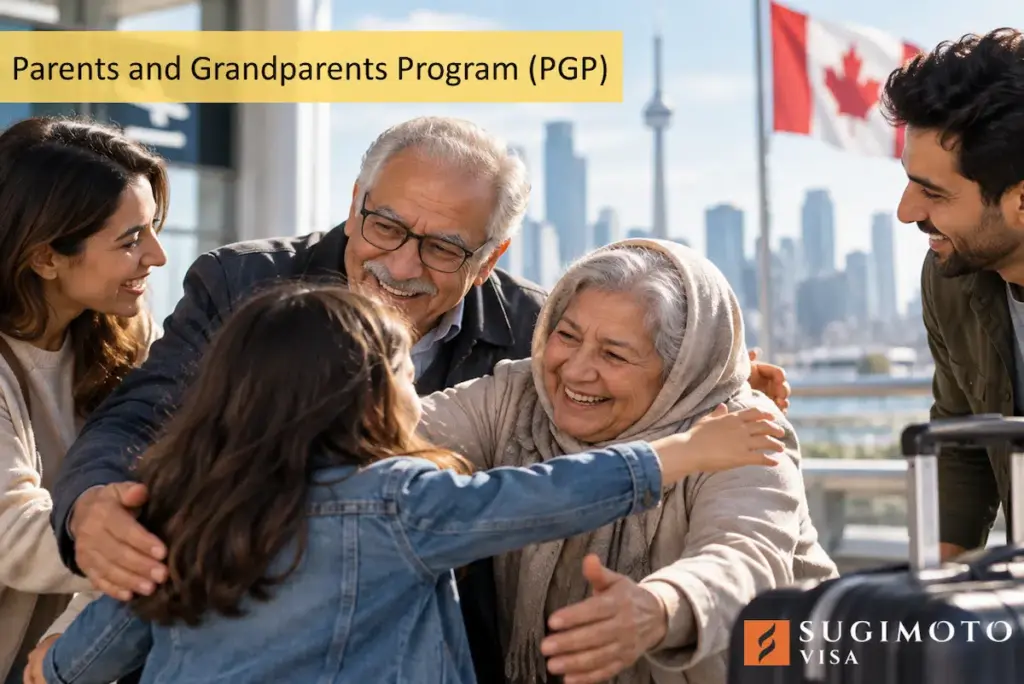
With new PGP intake paused, the Super Visa has become particularly important for families who want parents or grandparents to spend extended periods in Canada.
The Super Visa does not provide permanent residence.
It is a temporary resident pathway.
Eligible parents and grandparents can stay in Canada for up to five years at a time and may receive multiple-entry authorization valid for up to 10 years.
The program also changed in 2026.
From March 31, 2026, IRCC introduced more flexible ways to meet the Super Visa income requirement.
A host may now meet the income threshold using either of the two taxation years before the application.
In certain cases, if the host reaches at least the required minimum proportion of the threshold, qualifying income from the visiting parent or grandparent can also be added.
Private medical insurance remains another important requirement.
For a family that has never received a PGP invitation, the Super Visa is currently the main federal route designed specifically for long-term visits by parents and grandparents.
PGP and Super Visa Serve Different Goals
It is useful to keep the two programs separate.
- PGP is a permanent residence pathway.
- Super Visa is a temporary residence pathway.
A parent who receives PR through PGP becomes a permanent resident and can eventually become eligible for a PR card renewal, certain social benefits and potentially Canadian citizenship if the applicable requirements are later met.
A Super Visa holder remains a temporary resident.
They may stay for extended periods, but the visa does not convert into permanent residence simply because they have spent several years in Canada.
For families deciding between the two, the real distinction is therefore not simply processing time.
It is the family’s objective:
permanent immigration versus long-term temporary family reunification.
What a Future PGP Intake Could Look Like
It is important not to predict that PGP will reopen on a particular date.
IRCC’s July 2026 announcement says new Interest to Sponsor forms and invitations are paused until further notice.
The last Interest to Sponsor pool dates back to 2020.
IRCC continued issuing invitations from that pool through the 2025 intake rather than opening a new public Interest to Sponsor period.
If the government decides to resume intake in the future, it may:
- reopen an Interest to Sponsor process;
- use a different intake model;
- issue invitations under new Ministerial Instructions;
- or change the application and income years that apply.
Until IRCC publishes new instructions, families should not rely on old 2020 forms, past lottery dates or old income tables as evidence that they can currently submit an application.
Frequently Asked Questions
No, the new PGP intake is currently paused. IRCC announced on July 15, 2026, that it will not accept new Interest to Sponsor forms or issue new invitations until further notice. Existing applications submitted previously continue to be processed.
No, there is no Interest to Sponsor form currently available. The last public submission pool was created in 2020.
No. IRCC explicitly states that any PGP application submitted without a formal invitation will be returned without being processed.
Outside Quebec, sponsors and co-signers must meet the Minimum Necessary Income (MNI) requirement for each of the three taxation years prior to applying. For the 2025 intake, the required tax years were 2024, 2023, and 2022. Because no new 2026 intake is currently open, a new income threshold table has not been established.
Yes, a spouse or common-law partner can act as a co-signer to combine their qualifying income with yours to meet the threshold. By doing so, the co-signer also assumes equal financial legal responsibility for the undertaking.
No. PGP sponsors must reside in Canada and maintain their primary residential address in Canada throughout the entire application processing period.
No, you cannot sponsor your in-laws directly. Your spouse or common-law partner must receive the invitation as the primary sponsor for their parents, though you may act as a co-signer on their application.
Outside Quebec, the financial undertaking lasts for 20 years from the date the sponsored parent or grandparent becomes a Canadian permanent resident. In Quebec, the undertaking length is 10 years.
The standard federal fee to sponsor one parent or grandparent is CAD $1,260 (including the sponsorship fee, principal applicant processing fee, and Right of Permanent Residence Fee). Each accompanying dependent child costs CAD $180.
No. The PGP grants Permanent Residency to parents and grandparents. The Super Visa is a multi-entry temporary resident visa that allows eligible parents and grandparents to visit and stay in Canada for extended periods (up to 5 years per entry).
Potentially, but they must meet standard Canadian medical admissibility rules. Unlike sponsored spouses or dependent children, parents and grandparents are not exempt from medical inadmissibility based on excessive demand on health or social services.
Final Takeaway
While the PGP remains paused for new applicants in 2026, waiting passively is not the only option. Families seeking to unite in Canada should pivot their strategy toward the Super Visa, currently the most accessible and effective federal route, allowing parents and grandparents to stay in Canada for up to five consecutive years per visit.
By securing approved medical insurance and ensuring income requirements are met today, sponsors can provide their loved ones with a viable path to spend meaningful time together while remaining ready should new PGP invitations resume in the future.