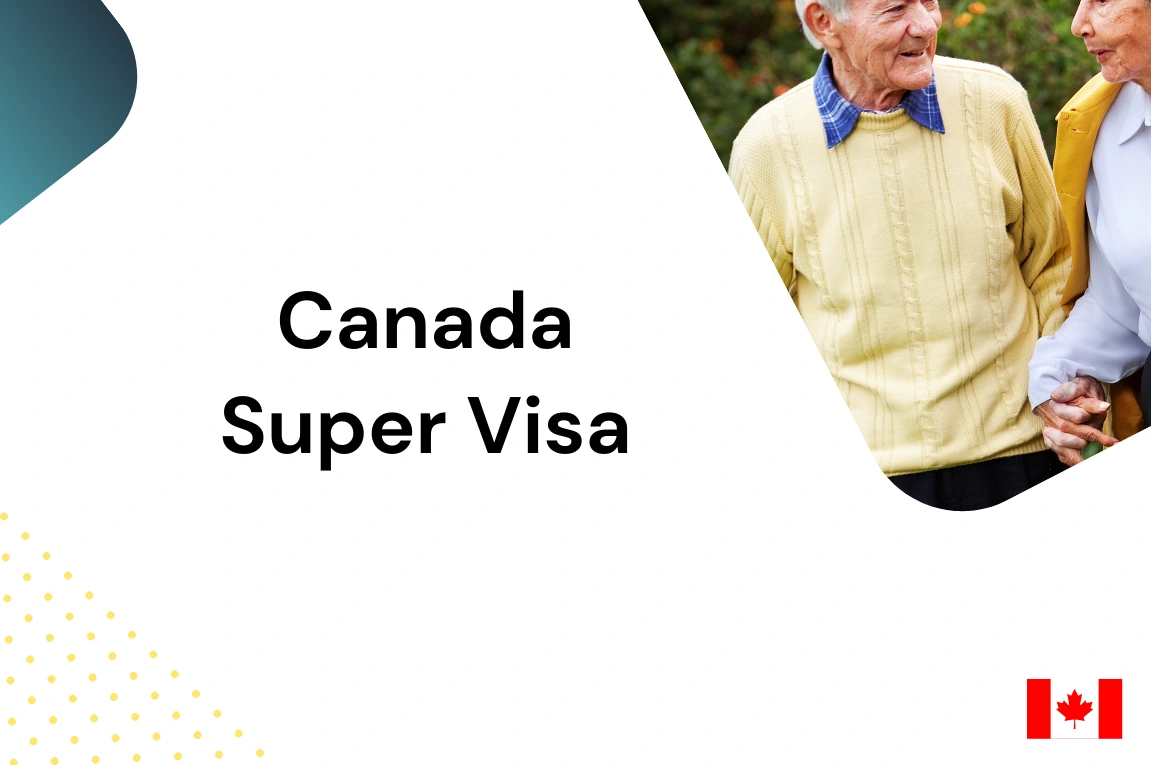
Canada’s Super Visa allows eligible parents and grandparents of Canadian citizens and permanent residents to visit Canada for much longer periods than under ordinary visitor status.
A Super Visa can provide multiple entries for up to 10 years, and an eligible holder can normally stay in Canada for up to five years at a time. It remains a temporary resident pathway, not a permanent residence program.
The program has become particularly relevant in 2026 because Canada has paused new intake under the Parents and Grandparents Program (PGP).
IRCC continues processing existing PGP files but is not accepting new Interest to Sponsor forms or issuing new invitations until further notice. IRCC specifically points families toward the Super Visa as an option for parents and grandparents who want extended visits to Canada.
The other major development is financial.
Starting March 31, 2026, IRCC changed the way Super Visa income eligibility is calculated. A host now has more than one way to meet the income requirement, and in certain cases income earned by the visiting parent or grandparent can be used to cover part of the required amount.
For some families who previously missed the income threshold, this is a meaningful change.
Who the Super Visa Is For
The Super Visa is designed specifically for the parents and grandparents of people established in Canada.
The host in Canada must be the applicant’s child or grandchild and must:
- be at least 18 years old;
- live in Canada;
- be a Canadian citizen, permanent resident or person registered under the Indian Act;
- meet the applicable minimum income requirement;
- and sign a letter promising financial support during the applicant’s stay.
The applicant, meanwhile, must apply from outside Canada, meet the general requirements for temporary entry, complete the required immigration medical examination and provide qualifying private health insurance.
This is different from the Parents and Grandparents Program.
PGP is a permanent residence sponsorship program. The Super Visa gives the parent or grandparent temporary resident status for extended visits.
That distinction affects everything from income rules to health insurance and long-term status in Canada.
The 2026 Income Rules
Before March 31, 2026, the Super Visa income test was much more rigid.
The Canadian host generally had to demonstrate that their income met the applicable Low Income Cut-Off based on the required assessment period.
The new 2026 rules create two different ways to satisfy the financial requirement.
Using the Host’s Income
The first option is the simplest.
The host and their spouse or common-law partner if there is an eligible co-signer, can qualify by showing that their total income met or exceeded the required minimum in either of the two taxation years immediately before the Super Visa application.
This means a host no longer necessarily fails simply because their income dropped below the threshold in the most recent tax year.
If the required income was met in the other one of the two preceding taxation years, that year may be used instead.
The Canada Revenue Agency (CRA) Notice of Assessment is the primary document IRCC asks for under this option.
Adding the Parent or Grandparent’s Income
The second option is one of the most significant Super Visa changes in years.
If the host and eligible co-signer do not reach the full income threshold, they may still qualify if their income in the taxation year immediately before the application reaches at least 75% of the required amount.
The Super Visa applicant’s own income can then be added to cover the remaining shortfall.
The combined income must reach or exceed the required minimum.
There is an additional condition: the parent or grandparent must provide evidence that the income they are contributing will continue while they are in Canada.
IRCC lists supporting evidence such as employment letters, pay records, bank statements showing regular deposits, pension statements and rental-income documentation. The currency in which the applicant earns the income must also be identified.
This prevents the new rule from being interpreted as simply adding savings or an old annual income figure to the host’s income.
The applicant needs to demonstrate continuing income.
Current Super Visa Income Thresholds
IRCC’s current published income table was last updated on July 29, 2025 and remains the table displayed by IRCC for Super Visa applications at the time of this 2026 update.
| Family Size | Minimum Income |
|---|---|
| 1 | CAD $30,526 |
| 2 | CAD $38,002 |
| 3 | CAD $46,720 |
| 4 | CAD $56,724 |
| 5 | CAD $64,336 |
| 6 | CAD $72,560 |
| 7 | CAD $80,784 |
| Each additional person | Add CAD $8,224 |
The relevant number is based on family size, not simply the number of parents applying.
That distinction can change the required income substantially.
Super Visa Fees Canada in 2026
A detailed breakdown of government fees, biometrics, medical insurance and additional application expenses.
Federal IRCC Fee Breakdown
| Cost Item | Amount | Requirement |
|---|---|---|
| Super Visa Application | CAD $100 | Per applicant |
| Individual Biometrics | CAD $85 | If required |
| Family Biometrics | CAD $170 | Maximum eligible family fee |
| Visitor Extension | CAD $100 | Per applicant |
Additional Application Expenses
A major variable expense. Coverage of at least CAD $100,000 is required, subject to Super Visa insurance rules.
Required immigration medical examination conducted by an authorized panel physician. Costs vary by location.
Additional costs depend on document requirements, country of application and applicable visa application centre services.
Calculating Family Size
This is one of the easiest parts of the Super Visa application to underestimate.
IRCC does not calculate family size by asking only:
How many parents are coming to Canada?
The calculation can include people who are not travelling with the Super Visa applicant.
IRCC currently includes the Super Visa applicant or applicants, the host, the host’s spouse or common-law partner, dependent children of the host or their spouse, certain previous Super Visa applicants who are still covered by an invitation, and people for whom the host or co-signer still has an active sponsorship undertaking.
A Typical Family
Suppose a Canadian permanent resident wants both parents to come to Canada.
The host is married and has one dependent child.
Family size is not two.
It is:
1 host + 1 spouse + 1 dependent child + 2 visiting parents = family size of 5.
The applicable current income threshold would therefore be CAD $64,336, not the threshold for two people.
Previous Sponsorships Matter
The calculation can become more complicated when the host or their spouse has sponsored someone previously.
If an earlier sponsorship undertaking is still in effect, the person covered by that undertaking may still need to be counted.
The same issue can arise where the host or spouse has already invited parents or grandparents under another valid Super Visa arrangement.
For that reason, family-size calculations should be completed before comparing income against the threshold.
Read More: Spousal Sponsorship Canada ↗
Using a Co-Signer
The host’s spouse or common-law partner can potentially co-sign the Super Visa invitation and add their qualifying income to the host’s income.
Other relatives cannot simply be used for this purpose.
For example, a host’s brother or sister cannot become the co-signer just because their income would help the family reach the threshold.
The co-signer is also included in the family-size calculation.
The practical question is therefore not just how much additional income the co-signer brings into the calculation, but also whether the household composition changes the required threshold.
What Counts as Proof of Income
The required documentation depends partly on which of the two 2026 income options is being used.
Where the host qualifies by meeting the threshold in one of the previous two taxation years, IRCC asks for the relevant CRA Notice of Assessment.
Under the second option, where the host reaches at least 75% and the applicant contributes income, IRCC provides a broader range of possible documents.
Relevant documents may include a CRA Notice of Assessment, T4 or T1, recent pay records, an employer letter describing position and salary, bank statements showing employment, pension or investment income, pension statements, and proof of rental income.
For income being contributed by the parent or grandparent, evidence must also support the proposition that the income will continue during the Canadian stay.
This is important for retirees in particular.
Pension income may be relevant if properly documented and continuing, while simply demonstrating that the applicant has money in a bank account is not the same as proving continuing income under the new rule.
The Invitation Letter
Every Super Visa application requires a letter of invitation from the child or grandchild in Canada.
It is more than a general letter saying the family would like the parent to visit.
IRCC requires the letter to include the host’s commitment to financially support the applicant during the authorized stay and information about the people included in the income/family-size calculation. The name and date of birth of each person counted must be included.
The application also needs evidence of the host’s status in Canada.
Depending on the host’s situation, this may include a Canadian citizenship certificate, Canadian birth certificate, PR card, Confirmation of Permanent Residence or other accepted proof of status.
Evidence establishing the parent-child or grandparent-grandchild relationship will also be required.

Health Insurance Requirements
Private medical insurance is one of the defining requirements of the Super Visa.
A regular Visitor Visa does not impose the same specific Super Visa insurance requirement.
For a Super Visa, the applicant must have qualifying health insurance valid for a minimum of one year from the date of entry to Canada.
The policy must provide at least CAD $100,000 in emergency coverage and cover:
| Required Coverage | Super Visa Requirement |
|---|---|
| Health care | Yes |
| Hospitalization | Yes |
| Repatriation | Yes |
| Minimum emergency coverage | CAD $100,000 |
| Minimum policy period | 1 year from entry |
| Proof required on entry | Yes |
A quote from an insurance company is not sufficient.
The policy must be paid in full or through an accepted instalment arrangement with a deposit.
Foreign Insurance Companies
Another important change occurred before the 2026 income reform.
Super Visa insurance is no longer necessarily limited to Canadian insurers.
A policy can also come from a company outside Canada if the insurer:
- is authorized by Canada’s Office of the Superintendent of Financial Institutions under the Insurance Companies Act to provide accident and sickness insurance;
- appears on OSFI’s list of federally regulated financial institutions;
- and issued or made the policy while conducting insurance business in Canada.
Foreign-issued policies must contain the required statement showing the policy was issued while the insurer was doing insurance business in Canada.
Insurance brokers and claims administrators are not themselves insurance companies, so appearing through a broker does not establish that the underlying insurer satisfies the rule.
Insurance Must Continue During the Stay
Buying one year of insurance to obtain the visa does not mean the holder can remain uninsured afterward.
IRCC says Super Visa holders should renew their coverage if the policy expires before they leave Canada.
Proof of valid coverage should also be available whenever the person enters Canada because border officers may ask to review it.
Immigration Medical Examination
Super Visa applicants must complete an immigration medical examination.
This requirement applies because the program allows extended stays and is specifically built around parents and grandparents visiting Canada for long periods.
Having a medical condition does not automatically mean the Super Visa will be refused.
The medical assessment considers the applicable Canadian inadmissibility rules.
Unlike sponsored spouses and certain dependent children in permanent residence applications, Super Visa applicants are temporary residents and do not receive a blanket exemption from all medical inadmissibility considerations.
Cases involving a significant chronic condition, anticipated long-term treatment or a previous medical inadmissibility concern may therefore require closer assessment.
See Medical Inadmissibility in Canada for the broader rules.
Five Years at a Time in Canada
For current Super Visa applicants, one of the largest advantages over an ordinary Visitor Visa is the authorized length of stay.
People who applied for a Super Visa on or after June 22, 2023 are eligible for stays of up to five years at a time.
The visa itself can provide multiple entries for up to 10 years, subject to factors such as passport validity.
These are two different concepts:
Visa validity determines how long the visa can potentially be used to seek entry.
Authorized stay determines how long the person may remain in Canada after a particular entry.
Holding a ten-year Super Visa does not mean the person automatically receives ten continuous years of visitor status.
Extending a Super Visa Stay
A parent or grandparent who wants to remain in Canada beyond the authorized period can apply from inside Canada to extend their visitor status.
IRCC confirms that Super Visa holders can request extensions of up to two additional years at a time.
The extension is made through a visitor record.
A visitor record is not a new visa. It extends the person’s authorized visitor status inside Canada.
The current federal fee to extend visitor status is CAD $100 per person.
The extension should be requested before the current authorized period expires.
Super Visa vs Visitor Visa
The two documents both provide temporary resident status, but they serve different purposes.
| Issue | Super Visa | Regular Visitor Visa |
|---|---|---|
| Intended applicant | Parent or grandparent of eligible Canadian host | General visitors |
| Maximum stay per entry | Up to 5 years | Usually up to 6 months |
| Multiple-entry validity | Up to 10 years | Can also be valid for years, subject to passport/visa decision |
| Host income threshold | Required | No specific Super Visa MNI |
| One-year private insurance | Required | Not a general Visitor Visa requirement |
| Immigration medical exam | Required | Depends on circumstances |
| Host invitation | Required | Not universally required |
| PR status | No | No |
IRCC itself advises people who intend to stay for six months or less to consider a regular Visitor Visa rather than a Super Visa.
For parents who want occasional short visits, the additional income, insurance and medical requirements of a Super Visa may therefore be unnecessary.
For someone who wants to spend several years with children or grandchildren in Canada, the Super Visa offers a very different level of flexibility.
Super Visa vs PGP
The Super Visa and Parents and Grandparents Program solve two different immigration problems.
| Issue | Super Visa | PGP |
|---|---|---|
| Immigration status | Temporary resident | Permanent resident |
| Current 2026 availability | Open | New intake paused |
| Stay in Canada | Up to 5 years at a time | Indefinite as a PR, subject to PR obligations |
| Health insurance | Private policy required | Different PR health/admissibility framework |
| Income test | Super Visa MNI rules | PGP sponsorship income rules |
| Sponsor undertaking | No 20-year PGP undertaking | 20 years outside Quebec |
| Applicant must leave at end of authorized stay | Yes | Not applicable once PR is granted |
| PR card | No | Yes after becoming PR |
| Potential citizenship later | Not through Super Visa alone | Possible after PR if citizenship requirements are eventually met |
The Super Visa should therefore not be described as a replacement for permanent residence.
It is an alternative family-reunification mechanism for extended temporary stays.
That distinction is especially important in 2026 because PGP is currently paused for new applications.
Families whose long-term objective remains permanent residence should continue monitoring PGP developments while considering whether the Super Visa can meet their short- or medium-term reunification needs.
For the permanent route, see Parents and Grandparents Program Canada 2026 and the site’s broader Canada Permanent Residence section.
Applying From Outside Canada
A Super Visa application must be submitted while the parent or grandparent is outside Canada.
IRCC also requires the visa to be printed through a visa office outside Canada for applicants who need a physical visa.
The application should establish several issues together:
| Area | Evidence Typically Relevant |
|---|---|
| Relationship | Birth/civil records establishing parent or grandparent relationship |
| Host status | Canadian citizenship, PR or registered Indian status |
| Host finances | Income documentation and family-size calculation |
| Invitation | Signed invitation and promise of financial support |
| Insurance | Qualifying one-year policy |
| Medical | Immigration medical examination |
| Temporary intent | Purpose of visit and circumstances showing applicant will respect temporary status |
| Identity | Passport and required personal documents |
| Biometrics | Where required |
IRCC also assesses the same fundamental temporary-resident considerations that apply to other visitors.
An officer can consider the purpose of the visit, the applicant’s family and financial circumstances, ties outside Canada and whether they are satisfied that the person will leave Canada at the end of the authorized stay.
A five-year authorized stay does not remove the requirement to qualify as a genuine temporary resident.
Visa-Exempt Parents and Grandparents
A person from a visa-exempt country can still apply for Super Visa status.
If approved, IRCC may issue a letter confirming that the applicant satisfies the Super Visa requirements rather than placing a visa counterfoil in the passport.
Someone travelling to Canada by air may separately need an electronic travel authorization (eTA) linked to their passport.
This is important because “visa-exempt” does not mean the Super Visa program has no value.
The Super Visa can still provide the extended authorized stay of up to five years.
Dependants and Applications for Both Parents
IRCC does not allow dependants to simply be added to a Super Visa application.
The program is specifically for eligible parents and grandparents.
Where both parents are eligible and want Super Visas, each person needs to qualify and apply appropriately.
However, both visiting parents are included when calculating the host’s family size.
This is why a household inviting two parents can face a materially higher income threshold than a household inviting only one.
Processing Time
There is no single worldwide Super Visa processing time.
IRCC currently states that processing time varies by country.
The time can also be affected by:
- application completeness;
- how easily IRCC can verify the information provided;
- biometrics;
- medical processing;
- requests for additional documents;
- and the individual visa office’s inventory.
For that reason, quoting one processing figure for “Super Visa Canada” can be misleading.
A parent applying from one country can face a different estimate from a parent applying from another.
Applicants should check IRCC’s current processing-time tool for the country from which they are applying rather than relying on an old global estimate.
The site’s Canada Visitor Visa page can also provide useful context on temporary resident processing and documentation.
Refusal Risks
Meeting the income and insurance requirements does not guarantee approval.
A Super Visa is still a temporary resident visa.
IRCC must be satisfied that the applicant meets the Super Visa rules and is also admissible and genuinely seeking temporary entry.
Several issues can therefore become important.
Temporary Intent
An applicant may want to stay with family for several years, but still needs to satisfy IRCC that they will comply with the authorized temporary stay.
The officer may look at the purpose of travel, financial circumstances, family relationships, ties outside Canada and the overall credibility of the proposed visit.
Incorrect Income Calculation
A host can appear to satisfy the threshold while actually using the wrong family size.
Previous undertakings, dependent children or existing Super Visa invitees can change the calculation.
Weak Income Evidence
The new 75% rule does not allow families to simply state that a parent has income abroad.
The applicant must document that income and show it will continue during the Canadian stay.
Insurance Problems
A quote, an unqualified foreign insurer or a policy without the required coverage can create problems.
The insurer and policy must satisfy the specific Super Visa requirements.
Medical or Other Inadmissibility
Super Visa applicants remain subject to Canadian admissibility rules.
Issues involving medical inadmissibility, criminal history or previous immigration problems can require additional analysis.
The site already has dedicated guidance on Medical Inadmissibility, Criminal Inadmissibility and Temporary Resident Permits, which can be linked naturally from this section.
Working or Studying on a Super Visa
A Super Visa gives its holder visitor status.
It does not by itself provide authorization to work in Canada.
A person who wants to work must separately qualify for an appropriate Canadian work permit.
Similarly, the fact that someone can remain in Canada for several years on a Super Visa does not automatically give them unrestricted authorization to study. Study-permit rules continue to apply where a study permit is required.
This distinction matters because the length of a Super Visa stay can make it feel similar to longer-term immigration status, but legally it remains temporary visitor status.
For Canadian work-permit options, see the site’s broader Work in Canada section.
What Happens at the Canadian Border
Approval of a Super Visa allows the holder to travel to Canada and seek entry.
Final admission is still determined at the border.
The traveller should be ready to demonstrate that they continue to satisfy the conditions relevant to their Super Visa, including valid insurance.
IRCC specifically requires proof of the health insurance policy to be available for review by border officers and requires valid coverage for each entry.
For current Super Visa holders who meet the requirements, the authorized stay is normally up to five years at a time.
The exact end of authorized status should always be checked rather than assumed.
Frequently Asked Questions
Super Visa holders can stay in Canada for up to 5 years at a time per entry. The Super Visa itself is a multi-entry visa valid for up to 10 years (or until passport expiry).
Yes. Parents and grandparents can apply for an extension of up to 2 years at a time from within Canada before their authorized stay expires.
The required income threshold depends on total family size (including the host, dependents, and visiting parents). Based on the Low Income Cut-Off (LICO) table, the threshold starts at CAD $30,526 for 1 person and CAD $38,002 for 2 people, increasing with each additional household member.
Yes, under IRCC rules effective March 31, 2026. The Canadian host (and eligible co-signer) must first meet at least 75% of the income threshold from the preceding tax year, after which the parent’s continuing foreign income can be added to meet the remaining balance.
Potentially, yes. Under the 2026 guidelines, hosts and co-signers can meet the full required income threshold in either of the two taxation years immediately preceding the application.
No. Only the host’s legally recognized spouse or common-law partner can act as a co-signer. Siblings or other relatives cannot co-sign a Super Visa invitation.
Not necessarily. A foreign insurance company can be used if it complies with Canadian regulatory standards (including OSFI requirements) and is authorized to issue policies for insurance business in Canada.
The insurance policy must provide at least CAD $100,000 in emergency medical coverage (covering healthcare, hospitalization, and repatriation) and must be initially valid for at least 1 full year from the date of entry.
Generally no. A Super Visa grants temporary resident visitor status, and holders are explicitly required to maintain private medical insurance. Provincial health coverage eligibility depends on specific provincial laws and should not be assumed.
No. A Super Visa confers visitor status only and does not grant authorization to work. A separate work permit would be required if the individual independently qualifies for one.
No. Initial Super Visa applications must be submitted from outside Canada. However, parents already inside Canada on a Super Visa can apply to extend their authorized stay before it expires.
They serve different purposes: PGP grants permanent residence, whereas the Super Visa provides long-term temporary visitor status. In 2026, the Super Visa is a key alternative as new intake for the PGP is paused while Super Visa applications remain open.
Final Takeaway
The Super Visa has become a more important family-reunification option in 2026.
Parents and grandparents can potentially stay with their children or grandchildren in Canada for up to five years at a time, while the visa can support multiple entries over a period of up to ten years.
At the same time, it remains a temporary resident program. Applicants still need to demonstrate temporary intent, complete a medical examination, carry qualifying private health insurance and meet Canada’s admissibility requirements.
The biggest 2026 change is financial.
Since March 31, families have more flexibility in satisfying the income requirement. A host can use qualifying income from either of the two previous taxation years, or—in appropriate cases—reach at least 75% of the threshold and combine that income with continuing income earned by the visiting parent or grandparent.
That flexibility can help families who previously missed the threshold, but it also makes the calculation more detailed.
Family size needs to be established correctly first. Previous sponsorships and existing Super Visa arrangements can affect that number. The right supporting documents then depend on which income method is being used.
With new PGP intake currently paused, families should view the two programs according to their actual objective: the Parents and Grandparents Program is the permanent residence route when available, while the Super Visa is the active option designed for extended temporary family reunification.