You have received an offer of admission from a Canadian institution, gathered your financial documents, and submitted your study permit application. Then, instead of an approval, you receive a refusal letter from Immigration, Refugees and Citizenship Canada (IRCC).
The letter may say the officer was not satisfied with your financial resources, the purpose of your visit, or your intention to leave Canada at the end of your authorized stay.
But what does that mean for your education plans?
A Canadian study permit refusal does not automatically prevent you from applying again. In many circumstances, applicants can submit a new application, provided they continue to meet the requirements. However, the reasons for the previous refusal must be addressed.
There are also situations where the more appropriate response may involve asking IRCC to reconsider a decision or seeking judicial review through the Federal Court of Canada.
These options serve different purposes, and choosing between them requires understanding why the original application was refused.
Why Does Canada Refuse Study Permit Applications?
A university’s decision to admit you and IRCC’s decision to issue a study permit are separate assessments.
Canadian universities and colleges evaluate applicants against their academic admission requirements.
IRCC, on the other hand, assesses whether applicants meet Canada’s immigration requirements, including their financial capacity, purpose of study, admissibility, and ability to comply with the conditions of temporary residence.
An applicant may therefore satisfy every academic requirement of a university and still have their study permit refused.
According to IRCC, applications may be refused when an officer is not satisfied that the applicant:
- Has a valid letter of acceptance from an eligible institution.
- Has sufficient financial resources to study and support accompanying family members.
- Meets medical requirements, when applicable.
- Has a genuine purpose for studying in Canada.
- Will leave Canada at the end of their authorized period of stay.
Other eligibility, admissibility, and documentation issues may also affect the decision.
The specific reasons depend on the individual application.
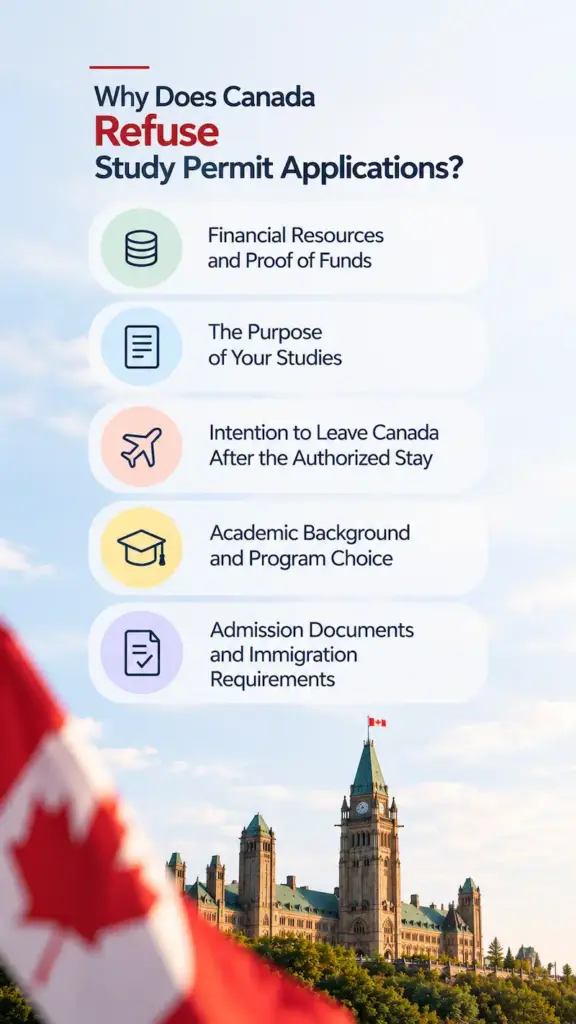
Financial Resources and Proof of Funds
Financial concerns are an important consideration in Canadian study permit applications.
IRCC requires international students to demonstrate that they have sufficient resources to pay their tuition fees, support themselves and accompanying family members, and cover transportation costs.
Applicants must be able to demonstrate this financial capacity without relying on employment in Canada.
However, financial eligibility is not simply about showing a bank balance that exceeds a published minimum.
IRCC also assesses the source of the funds, their availability, and whether the applicant can realistically finance the proposed studies.
Consider an applicant whose tuition is CAD 25,000 for the first year.
The applicant submits a bank statement showing CAD 55,000, which appears sufficient to cover tuition and living expenses.
However, most of the money was transferred into the account shortly before the application, and the documents do not explain where it came from.
The officer may have concerns about whether the funds are genuinely available to the applicant.
In this situation, submitting another bank statement showing the same amount may not resolve the issue.
The applicant may need to provide additional documentation establishing the source of the funds and their availability for educational expenses.
For applications submitted on or after September 1, 2026, IRCC’s minimum annual living-expense requirement for one student studying outside Quebec is CAD 23,448, excluding tuition and transportation costs.
The required amount increases when family members accompany the student. Quebec applies separate financial requirements.
Importantly, financial thresholds depend on the date and circumstances of the application. A new application must satisfy the requirements applicable when it is submitted.
Proof of Funds for a Canada Study Permit ↗
The Purpose of Your Studies
Another reason for refusal concerns whether the officer is satisfied that the applicant’s principal purpose in Canada is to study.
The educational program must make sense in the context of the applicant’s circumstances.
For example, imagine a professional with eight years of experience in financial management who applies to a Canadian master’s program in business analytics.
The applicant may be able to explain how the program builds on their experience and supports a transition into data-driven financial management.
Now consider the same applicant applying to an unrelated entry-level program without explaining why they have chosen to change fields.
Changing careers or pursuing a lower-level credential is not automatically disqualifying.
However, the applicant may need to provide a clearer explanation of their educational objectives.
The officer may consider the applicant’s academic background, professional history, program choice, and the information provided about their future plans.
A study plan can help explain these connections, but it does not replace the other eligibility requirements.
The objective is not to invent a more attractive explanation. It is to provide a credible, evidence-supported account of why the proposed studies make sense.
Intention to Leave Canada After the Authorized Stay
Canadian study permits authorize temporary residence.
Applicants must satisfy the immigration officer that they will leave Canada when their authorized stay ends, unless they obtain another legal authorization to remain.
This requirement sometimes creates confusion because Canada also offers certain international graduates opportunities to apply for work permits and permanent residence.
Canadian immigration law recognizes the concept of dual intent.
Under section 22(2) of the Immigration and Refugee Protection Act, an intention to become a permanent resident does not automatically prevent someone from qualifying for temporary residence.
For example, an international student may genuinely intend to study in Canada and hope to qualify for permanent residence in the future.
Those intentions are not necessarily contradictory.
However, the applicant must still satisfy the officer that they will comply with the conditions of temporary residence if their longer-term immigration plans do not materialize.
Applicants should not assume that mentioning an interest in permanent residence automatically results in refusal.
Equally, they should not assume that a possible future immigration pathway removes the need to satisfy temporary residence requirements.
Academic Background and Program Choice
An applicant’s academic history can also influence how an officer evaluates their study plans.
For instance, a student who recently completed a bachelor’s degree in computer science may have a readily understandable reason for pursuing a master’s degree in artificial intelligence.
An applicant seeking a second bachelor’s degree in a different field may also have a legitimate academic objective.
The second applicant, however, may need to explain why another undergraduate qualification is appropriate and how it relates to their goals.
Neither scenario guarantees approval or refusal.
Officers assess the application as a whole.
A significant change in academic direction, a long study gap, or an unusual program choice should be explained accurately when relevant.
Admission Documents and Immigration Requirements
Some applications encounter difficulties because the required immigration documents are missing, invalid, or inconsistent.
A valid letter of acceptance from a Designated Learning Institution (DLI) is a fundamental requirement for most study permit applicants.
Post-secondary institutions are also required to verify acceptance or enrolment documents through IRCC’s verification process.
In addition, most applicants need a Provincial Attestation Letter (PAL) or Territorial Attestation Letter (TAL), unless an exemption applies.
Students planning to study in Quebec must meet the province’s requirements for a Quebec Acceptance Certificate (CAQ).
These documents serve different purposes.
A university’s acceptance letter confirms admission to an academic program. A PAL/TAL concerns the applicable provincial or territorial allocation requirements. A CAQ addresses Quebec’s temporary selection requirements.
None of these documents independently guarantees that IRCC will approve a study permit.
It is also important to distinguish a refused application from one that IRCC returns without processing because it is incomplete or does not meet submission requirements.
These outcomes may have different implications for a subsequent application.
Understanding Your Study Permit Refusal Letter
The refusal letter is the starting point for evaluating what happened.
It identifies the grounds on which the application was refused.
An applicant may receive more than one reason.
For example, the officer might express concerns about both the applicant’s financial capacity and the purpose of their studies.
Addressing only one of those concerns may leave significant problems unresolved.
Officer Decision Notes Are Now Provided With Most Refusals
A major change took effect on July 29, 2025.
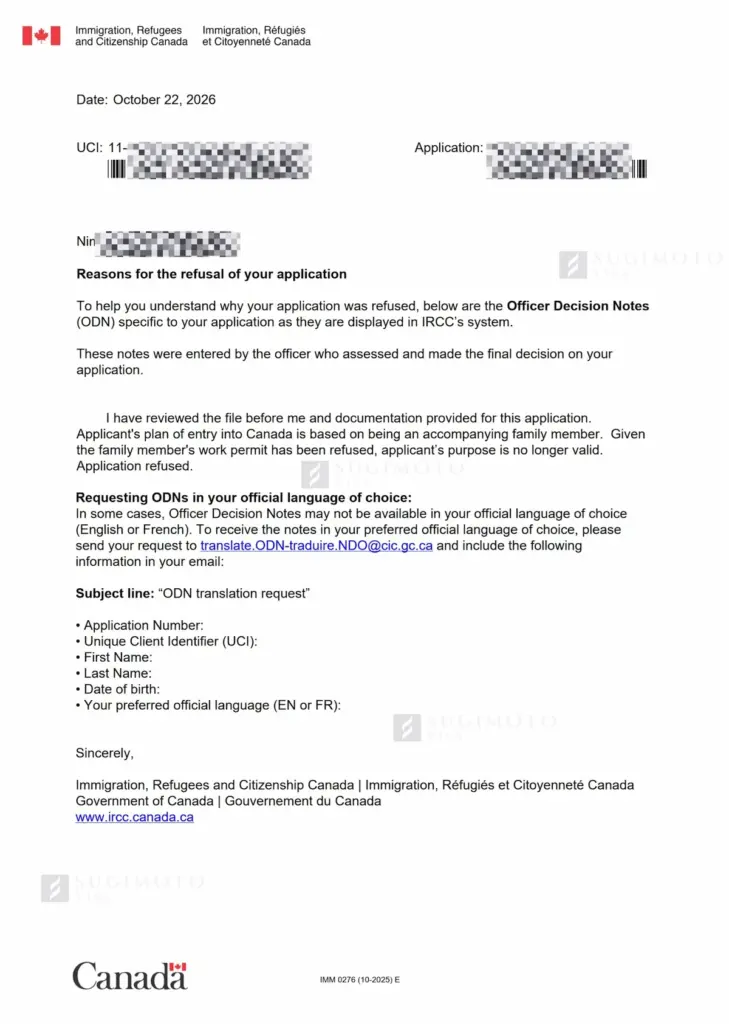
Since that date, IRCC has included officer decision notes with the refusal letters for most temporary residence applications.
This includes study permit applications and study permit extensions.
The notes provide the officer’s explanation of the decision and may offer more detail than the refusal letter alone.
For example, a refusal letter might identify financial resources as a concern.
The accompanying officer notes may clarify whether the concern involved insufficient funds, the source of a deposit, the availability of financial support, or another issue.
This information can be valuable when assessing whether a new application would address the actual reasons for refusal.
However, IRCC may withhold portions of the notes to protect sensitive or legally restricted information.
Do You Still Need GCMS Notes?
Before July 2025, many applicants requested their Global Case Management System (GCMS) records after receiving a refusal.
This was often necessary because standard refusal letters provided limited detail.
With the introduction of automatically provided officer decision notes, obtaining a separate GCMS record is no longer the automatic first action for every refused study permit application.
Nevertheless, requesting additional records may still be useful in some circumstances.
For example, an applicant may want to examine information that was not included in the decision notes or obtain a more complete administrative record.
Records may be requested through Canada’s Access to Information and Privacy (ATIP) processes, subject to the applicable eligibility and consent requirements.
Access to Information Act requests generally cost CAD 5.
Applicants outside Canada who are not Canadian citizens or permanent residents may need an eligible person in Canada to submit a request on their behalf with appropriate consent.
It is important to remember that requesting GCMS records does not suspend deadlines for judicial review.
If an applicant is considering a legal challenge, they should not assume they can wait for an ATIP response before addressing a court deadline.
Can You Reapply After a Canada Study Permit Refusal?
Yes. In most circumstances, a previous study permit refusal does not prevent an applicant from submitting another application.
IRCC confirms that applicants may generally reapply at any time unless the decision letter indicates otherwise.
However, the ability to reapply should not be confused with the likelihood of receiving a different decision.
If the circumstances and evidence remain essentially unchanged, another application may be refused for similar reasons.
For this reason, the central question is not how quickly a person can submit another application.
It is whether there is sufficient new information or a meaningful change in circumstances to address the previous refusal.
What Should Change Before You Reapply?
The necessary changes depend on the reasons provided by IRCC.
| Reason Identified in the Refusal | What May Need Further Attention |
|---|---|
| Insufficient financial resources | Financial capacity, available funds, tuition obligations and living expenses |
| Unclear source of funds | Evidence explaining income, savings, transfers or financial sponsorship |
| Concerns about the purpose of study | Academic objectives, relevance of the program and supporting educational or professional history |
| Concerns about leaving Canada | Evidence relevant to temporary residence and the applicant’s ability and intention to comply with immigration conditions |
| Questions about academic progression | Explanation of program choice, career changes or previous educational experience |
| Missing or invalid documents | Corrected documentation and compliance with current application requirements |
| Medical or admissibility concerns | The specific legal or medical issue identified by IRCC |
These are not universal solutions.
The response must be tailored to the officer’s actual concerns and the applicant’s circumstances.
For example, an applicant refused because the officer was not satisfied with the purpose of their studies may not benefit from simply increasing the balance in their bank account.
Likewise, preparing a longer study plan will not necessarily address a refusal based on inadequate financial evidence.
Is a New Study Plan Enough?
Not necessarily.
A study plan or letter of explanation can help communicate information that was unclear in the previous application.
However, it does not independently establish eligibility.
Consider an applicant whose previous application did not explain why they selected a graduate program in supply chain management.
A revised explanation might connect the program to the applicant’s previous logistics experience, identify relevant course content, and clarify the applicant’s professional objectives.
Supporting employment records, academic documents or other relevant evidence may reinforce that explanation.
This is different from simply rewriting the original study plan with more persuasive language.
A revised statement should accurately describe the applicant’s circumstances and be consistent with the rest of the application.
Do You Need a New PAL or TAL After a Refusal?
This is an important requirement for students applying again under Canada’s current international student regulations.
If IRCC has refused your study permit application, you generally cannot reuse the same PAL/TAL for a new application.
IRCC explicitly distinguishes a refused application from an application that was returned without processing or voluntarily withdrawn before a final decision.
For a new application following an actual refusal, applicants who are required to provide a PAL/TAL must obtain a new attestation letter.
This applies even if the previous PAL/TAL would otherwise still fall within its original validity period.
For example, suppose a student receives a PAL in February 2026 and submits a study permit application in March.
The application is refused in May.
The student cannot simply submit another application using that same PAL because it has not yet reached December 31, 2026.
A new PAL/TAL is required unless the applicant qualifies for an exemption.
What About Master’s and PhD Students?
Since January 1, 2026, students applying for degree-granting master’s or doctoral programs at public Designated Learning Institutions are exempt from the PAL/TAL requirement.
This means an eligible graduate applicant may not need a PAL/TAL when submitting a new study permit application following a refusal.
However, the exemption depends on the institution and academic program.
It does not automatically extend to every graduate certificate, graduate diploma, or program offered by a private institution.
Applicants should verify that their institution and program meet the exemption requirements.
Can You Reuse a CAQ After a Study Permit Refusal?
Quebec has different rules.
According to IRCC, an applicant may generally reuse the same valid CAQ when reapplying after a study permit refusal, regardless of the outcome of the previous application, provided the applicable conditions are satisfied.
Changing the level of study or the institution may affect whether the existing CAQ remains usable.
Therefore, a student planning to attend a university in Quebec should assess their provincial authorization separately from the federal PAL/TAL rules applicable elsewhere.
A refusal does not necessarily mean that the student must automatically restart the entire CAQ process.
Reapplying, Requesting Reconsideration or Seeking Judicial Review
A refused applicant may encounter several possible options, but these options should not be treated as interchangeable.
The appropriate course depends on the nature of the refusal, the available evidence, and whether there is a potentially reviewable error in the decision.
| Option | Purpose | Important Limitation |
|---|---|---|
| New study permit application | Obtain a new decision based on a new application | Must meet current requirements; previous concerns should be addressed |
| Request for reconsideration | Ask IRCC to revisit its decision | Discretionary; not a formal appeal or guaranteed review process |
| Federal Court judicial review | Challenge a decision on applicable legal or procedural grounds | Strict deadlines and legal procedures apply |
Reapplying With Additional Evidence
A new application is often worth considering when the refusal identifies concerns that can be addressed with additional documentation or changed circumstances.
For example, an applicant may now have confirmed graduate funding that was unavailable when the original application was submitted.
Another applicant may have obtained clearer documentation concerning the source of their financial support.
A new application allows IRCC to assess the revised circumstances and supporting evidence.
However, it is a new immigration application, not a continuation of the previous one.
The applicant must satisfy the requirements in effect at the time of the new submission.
This may involve obtaining an updated letter of acceptance, a new PAL/TAL, or other documents.
Requesting Reconsideration
In some circumstances, an applicant may ask IRCC to reconsider a refusal decision.
For example, the applicant may believe that a material document was overlooked or that the decision contains an identifiable factual error.
A reconsideration request should explain the specific concern and identify relevant evidence already available in the application record.
However, reconsideration is discretionary.
There is no general formal appeal process for refused temporary residence applications, and IRCC is not required to reopen a file merely because an applicant disagrees with the decision.
A reconsideration request should therefore not be presented as a guaranteed alternative to reapplying or judicial review.
It also does not automatically suspend the time limits for pursuing judicial review.
Judicial Review in the Federal Court of Canada
When an applicant believes that IRCC’s decision involved an error of law, procedural unfairness, or an unreasonable assessment, judicial review may be an option.
Judicial review is not simply an opportunity to submit an improved study plan or ask a judge to reconsider the application from the beginning.
The Federal Court examines whether the administrative decision meets the applicable legal standards.
The process normally begins with an application for leave and judicial review.
An applicant must first obtain the Court’s permission, known as leave, before the case proceeds to a full judicial review hearing.
The standard filing deadlines are:
- 15 Days
For a matter arising in Canada.
- 60 Days
For a matter arising outside Canada.
These deadlines generally run from notification of, or awareness of, the decision being challenged.
The distinction concerns where the immigration matter arose; it should not be reduced to a simple assumption based solely on the applicant’s current physical location.
A person considering judicial review should obtain legal advice promptly because an incorrect calculation of the deadline may affect their ability to challenge the decision.
The Court may allow an extension of time in certain circumstances, but applicants should not assume that an extension will be granted.
Does Winning a Judicial Review Mean Your Study Permit Will Be Approved?
No.
If a judicial review succeeds, the Court may set aside the original decision and return the matter to the appropriate decision-maker for reconsideration.
This does not automatically result in a study permit approval.
The application may be reassessed and a new decision made.
Applicants should also understand that immigration consultants cannot represent clients in Federal Court judicial proceedings.
Federal Court immigration litigation requires a Canadian lawyer authorized to practise law, unless the applicant represents themselves.
Applicants considering judicial review should seek advice from an appropriately qualified lawyer.
How Much Does It Cost to Apply Again?
The standard federal processing fee for a study permit application is CAD 150.
If you submit a new application following a refusal, you generally need to pay the processing fee again.
IRCC does not ordinarily refund the processing fee simply because a study permit application was refused.
Biometrics may involve an additional fee.
However, biometrics previously provided for a temporary residence application generally remain valid for 10 years, even if the application was refused.
Applicants with valid biometrics may not need to provide them again for a new study permit application.
Tuition deposits and university application fees are separate from IRCC’s government fees.
Their refund or deferral policies depend on the institution.
Students whose study permits have been refused should contact their educational institution before the relevant registration or tuition-refund deadline.
What Happens to Your University Admission After a Refusal?
A study permit refusal does not automatically cancel an admission offer.
However, whether an offer can be deferred depends on the institution and the academic program.
For example, a university may permit a student admitted for September to defer admission to the following January or September intake.
Another program may not allow deferrals and may require the applicant to submit a new admission application.
Research-based master’s and doctoral programs may also have specific expectations related to research supervision, funding, or the start of an academic project.
A student should therefore confirm whether their original admission remains valid before submitting a new study permit application.
An updated letter of acceptance may be required if the start date or other admission details have changed.
If a new PAL/TAL is required, the applicant should also confirm whether the institution can obtain another attestation letter.
Deferring admission does not guarantee that a new PAL/TAL will be available.
Should You Change Universities After a Refusal?
Changing institutions may be appropriate when the original educational program no longer meets the applicant’s objectives.
However, changing universities simply because the previous application was refused does not necessarily resolve the reasons for refusal.
If the concerns relate to financial capacity or the credibility of the applicant’s educational plans, those issues may remain relevant at another institution.
The decision to change programs should be supported by genuine academic and practical considerations.
Applicants should also verify that the new institution is a Designated Learning Institution and understand whether the selected program meets their longer-term objectives, including any plans related to post-graduation work eligibility.
Canada Study Permit Refusal Rates by Country
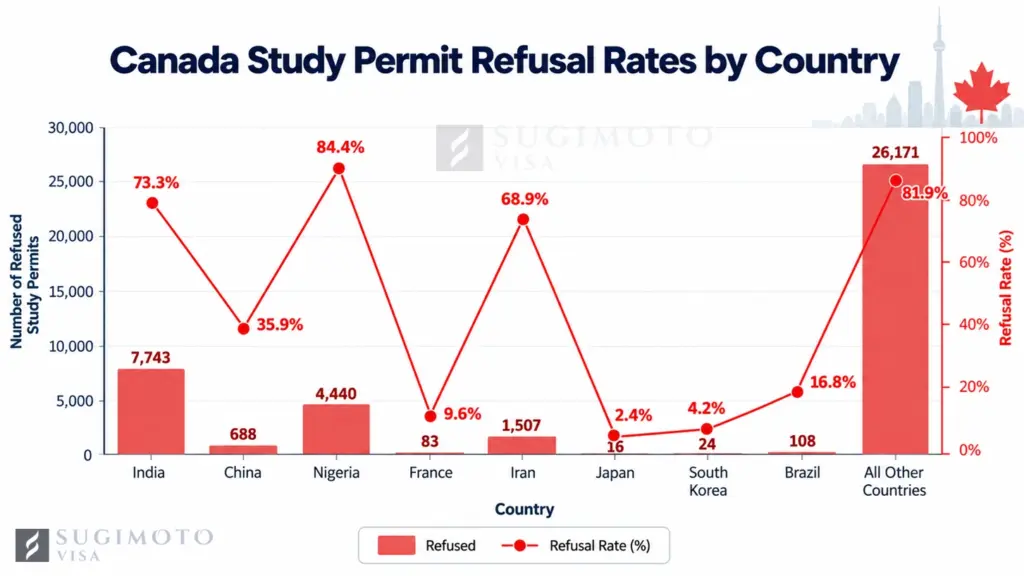
The refusal rate shows the percentage of study permit applications refused among all applications approved or refused during the reporting period. Withdrawn applications are excluded.
| Country | Approved | Refused | Approval Rate | Refusal Rate |
|---|---|---|---|---|
| India | 2,820 | 7,743 | 26.7% | 73.3% |
| China | 1,228 | 688 | 64.1% | 35.9% |
| Nigeria | 823 | 4,440 | 15.6% | 84.4% |
| France | 780 | 83 | 90.4% | 9.6% |
| Iran | 679 | 1,507 | 31.1% | 68.9% |
| Japan | 664 | 16 | 97.6% | 2.4% |
| South Korea | 541 | 24 | 95.8% | 4.2% |
| Brazil | 535 | 108 | 83.2% | 16.8% |
| All Other Countries | 5,765 | 26,171 | 18.1% | 81.9% |
Refusal Rate Analysis:
Nigeria, India, and Iran recorded relatively high study permit refusal rates in this dataset. However, a country’s refusal rate does not explain why an individual application was rejected. Immigration officers assess each application based on its supporting documents, financial circumstances, study plan, and eligibility requirements.
Canada Study Permit Approval Rates by Country
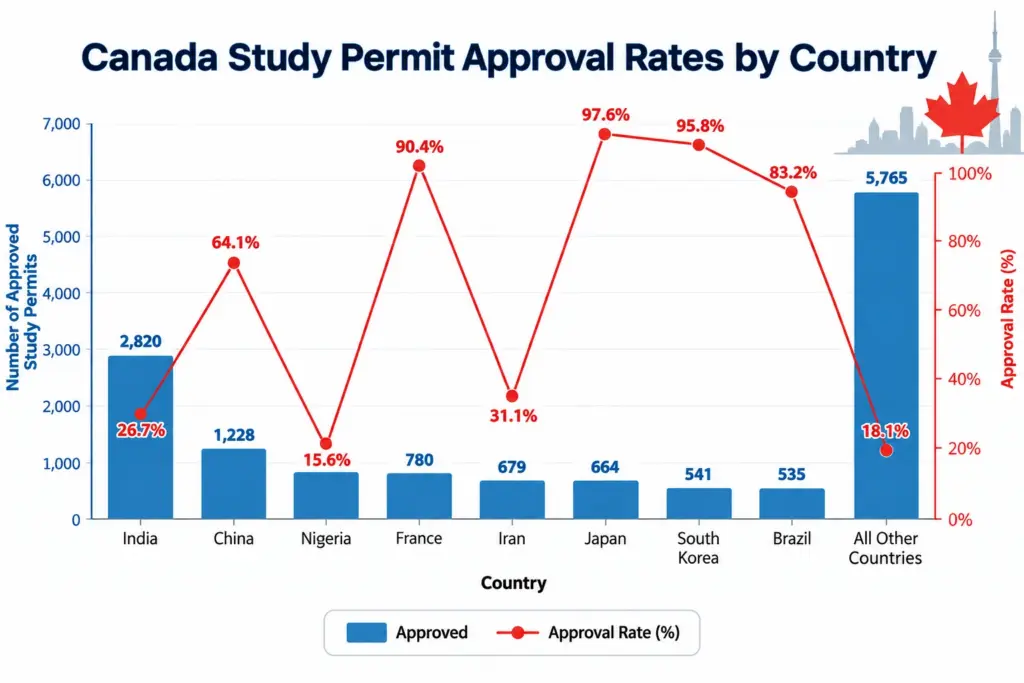
The approval rate represents the percentage of study permit applications approved out of the total applications approved or refused. Rates exclude withdrawn applications.
Approval Rate Analysis:
Approval rates vary considerably by country. Japan, South Korea, and France recorded relatively high approval rates, while Nigeria, India, and Iran had lower rates. These differences provide a broader picture of study permit decisions but do not determine the outcome of an individual application.
Can a Previous Study Permit Refusal Affect Future Applications?
A previous refusal becomes part of the applicant’s immigration history.
However, a study permit refusal does not automatically make someone inadmissible to Canada or permanently prevent them from obtaining a future visa or permit.
The circumstances surrounding the refusal matter.
For example, an application refused because the officer was not satisfied with the applicant’s financial resources is different from an application involving a finding of misrepresentation.
The first may be addressed through a future application supported by appropriate evidence.
The second can have more serious legal consequences.
Do You Have to Declare a Previous Refusal?
Yes, when the application asks about previous visa or permit refusals, the applicant must answer accurately.
Canadian study permit application forms require applicants to disclose relevant previous refusals, including refusals by Canada or other countries.
The requirement is not limited to previous Canadian study permit applications.
An applicant should not omit a refusal simply because it occurred several years earlier or involved a different type of visa.
If necessary, an explanation can identify the previous application, the refusal, and any relevant changes in circumstances.
What if the Refusal Involves Misrepresentation?
Providing false information or misleading documents can result in serious immigration consequences.
Under Canadian immigration law, a finding of misrepresentation can result in a period of inadmissibility, commonly five years.
Depending on the circumstances, additional consequences may apply.
Applicants remain responsible for the accuracy of the information submitted in their applications, even when a representative prepares the documents.
However, an ordinary study permit refusal should not automatically be described as a finding of misrepresentation.
The refusal letter and underlying decision must be examined carefully to establish whether that issue was actually identified.
Applicants facing allegations or findings of misrepresentation should seek qualified professional advice before submitting another application.
What if Your Study Permit Extension Was Refused While You Were in Canada?
Applicants whose study permit applications are refused from outside Canada may be in a different immigration position from students whose extension applications are refused while they are already in Canada.
If you were studying in Canada and applied to extend your study permit before it expired, you may have benefited from maintained status while the extension was being processed.
If IRCC refuses that application after your previous permit has expired, your maintained status generally ends when the refusal decision is made.
You must then determine whether you are eligible to restore your temporary resident status or pursue another lawful option.
Restoration applications are subject to separate eligibility requirements and time limits.
Submitting a new application does not automatically restore your authorization to study or work.
For students already in Canada, the impact of a refusal on their immigration status should be assessed promptly.
Questions About Canada Study Permit Refusals
In most cases, there is no mandatory waiting period. You can reapply as soon as you are ready, unless your decision letter explicitly states otherwise. However, submitting a new application immediately with the same documents will likely yield the same result. You should take the time to address the officer’s specific concerns before reapplying.
There is no formal administrative appeal process for temporary residence applications like study permits. However, depending on the reasons for the refusal, you can reapply with stronger evidence, submit a reconsideration request if IRCC made a clear factual error, or file an application for leave and judicial review with the Federal Court of Canada (which has strict deadlines: 15 days if inside Canada, 60 days if outside Canada).
While you may reuse valid banking history, simply submitting unchanged bank statements usually leaves the officer’s initial financial concerns unresolved. If IRCC questioned the source, sufficiency, or genuine availability of your funds, you must provide clearer documentation, such as proof of fund source, updated balances, or a detailed financial explanation.
No, a previous refusal does not guarantee a future rejection, as each application is assessed on its own merits. However, your refusal forms part of your permanent IRCC record, and you must declare it truthfully. Officers will compare your new submission against the prior decision to check whether previous concerns have been resolved.
Yes, you can apply using an acceptance letter (Letter of Acceptance / Provincial Attestation Letter) from a different Designated Learning Institution (DLI). However, changing schools does not automatically fix past refusal grounds; your new program must make logical sense in light of your academic background, career progression, and study plan.
Making an Informed Decision After a Study Permit Refusal
When a study permit is refused, the most useful information is often found in the details of the decision rather than the refusal itself.
Two applicants may receive refusals that appear similar but involve very different circumstances.
One may need additional financial documentation. Another may need to explain an unusual academic decision. A third may have grounds to question whether the officer properly considered the evidence submitted.
Those situations should not automatically lead to the same response.
For some applicants, a new application supported by additional evidence may be appropriate. Others may need advice about reconsideration or judicial review.
The decision should also account for university deadlines, the availability of updated admission documents, PAL/TAL requirements, and the applicant’s current immigration status.
Sugimoto Visa provides professional immigration consulting services to international students who want to understand the reasons for a Canadian study permit refusal and evaluate their eligibility for a new application.
A review of the refusal letter, officer decision notes, and original supporting documents can help identify the issues that should be addressed before deciding whether to reapply.
Where a refusal raises questions requiring Federal Court proceedings, advice from a qualified Canadian lawyer may be necessary.
Official Sources: