A student receives an offer of admission from a university in Montreal and begins preparing a Canadian study permit application.
The university is a recognized Designated Learning Institution, the student has sufficient financial resources, and the program meets their academic objectives.
However, there is an additional immigration requirement that distinguishes studying in Quebec from studying in most other Canadian provinces.
Before applying for a Canadian study permit, the student will normally need authorization from the Government of Quebec.
This authorization is known as the Quebec Acceptance Certificate (CAQ) for studies, or Certificat d’acceptation du Québec pour études.
The CAQ is issued through Quebec’s temporary selection process for international students.
It confirms that the student has met the applicable provincial requirements to pursue their intended studies.
However, obtaining a CAQ does not automatically authorize someone to enter Canada or begin a program that requires a federal study permit.
The student must also satisfy Immigration, Refugees and Citizenship Canada’s requirements.
For 2026, several important rules affect CAQ applications, including updated financial thresholds, institution-specific application limits, and requirements concerning changes of educational institution.
Understanding these rules before accepting an admission offer can help students avoid unnecessary delays, incomplete applications, and difficulties when extending their studies.
What Is a Quebec Acceptance Certificate (CAQ)?
A Quebec Acceptance Certificate for studies is a provincial immigration authorization issued by Quebec’s Ministère de l’Immigration, de la Francisation et de l’Intégration (MIFI).
It is generally required for foreign nationals who intend to pursue a study program lasting more than six months in Quebec.
The CAQ forms part of Quebec’s temporary selection system.
Most international students must obtain this provincial authorization before submitting their federal study permit application.
Why Does Quebec Require a CAQ?
Quebec administers its own selection process for international students under the applicable provincial and federal immigration arrangements.
The province assesses whether applicants satisfy its requirements for temporary selection for studies.
These requirements concern matters such as admission, financial capacity, and the obligations associated with studying in Quebec.
After obtaining the appropriate provincial authorization, the student must still apply to the federal government for a study permit.
The two governments therefore perform different functions.
Quebec determines whether the applicant meets its requirements for temporary selection.
IRCC decides whether the applicant qualifies for the Canadian immigration authorization required to study.
Is a CAQ the Same as a Study Permit?
No. A CAQ and a Canadian study permit are separate documents issued by different authorities.
| Feature | Quebec Acceptance Certificate | Canadian Study Permit |
|---|---|---|
| Issuing authority | Government of Quebec – MIFI | Government of Canada – IRCC |
| Purpose | Provincial authorization for studies | Federal authorization to study in Canada |
| Application process | Quebec’s temporary selection system | IRCC study permit application |
| Financial assessment | Quebec’s applicable financial requirements | Federal assessment, including Quebec-specific requirements |
| Immigration status | Does not independently grant federal temporary resident status | Authorizes study subject to permit conditions |
| Required for most programs over six months in Quebec | Yes | Yes |
The distinction matters when planning an application.
A student who receives a CAQ but has not obtained the required study permit cannot assume they are authorized to begin their studies in Canada.
Likewise, an applicant who wishes to study in Quebec cannot normally rely on a federal study permit application without providing the required provincial authorization.
CAQ vs CSQ: Are They the Same?
The CAQ should not be confused with the Certificat de sélection du Québec (CSQ).
A CAQ for studies concerns temporary authorization to study in Quebec.
A CSQ is associated with Quebec’s permanent immigration selection process.
These certificates serve different purposes.
Receiving a CAQ does not mean a student has been selected for permanent residence.
Similarly, completing studies in Quebec does not automatically provide access to a CSQ or permanent resident status.
Who Needs a CAQ to Study in Quebec?
Most foreign nationals pursuing programs lasting longer than six months in Quebec need a CAQ for studies.
This requirement can apply to students attending universities, colleges, vocational training institutions, language programs, and other qualifying educational institutions.
The exact requirement depends on the applicant’s immigration circumstances and the academic program.
01University Students
International students admitted to bachelor’s, master’s, and doctoral programs in Quebec generally require a CAQ unless a specific exemption applies.
For example, a student admitted to an undergraduate program at McGill University would normally need to obtain the appropriate Quebec authorization before applying for a federal study permit.
The same general requirement applies to eligible graduate students at universities such as Concordia University, Université de Montréal, and Université Laval.
Importantly, the CAQ requirement is not eliminated simply because the institution is publicly funded.
02College and CEGEP Students
International students entering qualifying college programs generally need a CAQ when their studies last more than six months.
Quebec’s college education system includes CEGEPs offering pre-university and technical education.
- Students may pursue qualifications such as the Diploma of College Studies (DCS), also known as the Diplôme d’études collégiales (DEC).
- Other institutions offer programs leading to an Attestation of College Studies (ACS), or Attestation d’études collégiales (AEC).
These credentials have different academic structures, but the provincial immigration requirement can apply to all of them.
Applicants should verify the educational institution’s designation and the authorization requirements associated with their specific program.
03Vocational Training Students
Vocational training programs may also require a CAQ.
For example, a student pursuing a Diploma of Vocational Studies (DVS), known in French as a Diplôme d’études professionnelles (DEP), may need provincial authorization.
However, vocational programs can have different federal PAL/TAL requirements from ordinary college and university programs.
The CAQ and federal attestation rules should therefore be evaluated separately.
Students Taking French or English Language Courses
A student attending a qualifying language program in Quebec for more than six months will generally need the appropriate study authorization.
For example, an applicant planning to attend an eight-month French-language program at an eligible educational institution should normally assess both the CAQ and study permit requirements.
However, not every language course is treated identically.
Quebec specifically states that individuals who want to take French courses offered by the Government of Quebec cannot obtain a CAQ for studies for that purpose.
This is different from an international student applying to an eligible institutional language program.
Applicants should identify the course provider, delivery format, and actual duration before deciding which immigration authorization is required.
Quebec Acceptance Certificate (CAQ) Requirement
Several categories of foreign nationals may study in Quebec without obtaining a CAQ.
However, the exemptions are specific.
A student should not assume that every exemption from a federal study permit automatically applies in the same way to every Quebec educational arrangement.
01Programs Lasting Six Months or Less
Students pursuing a program lasting six months or less may qualify for an exemption from the CAQ requirement.
For example, a visitor who intends to complete a standalone four-month language course may not need a CAQ or study permit under the ordinary short-study exemption.
However, the course must genuinely qualify as a short program.
A student cannot avoid the CAQ requirement by dividing a longer academic program into separate study periods of less than six months.
Quebec explains that when a short period of study forms part of a program whose total duration exceeds six months, a CAQ is generally required.
Students must also satisfy the federal immigration requirements applicable to their circumstances.
Permission to study without a study permit does not automatically provide authorization to work.
02Refugees and Protected Persons
Certain individuals with refugee or protected person status in Canada are exempt from the CAQ requirement.
The precise exemption depends on the person’s status and circumstances.
Students should verify their documentation rather than assuming that making a refugee claim automatically places them in every exemption category.
03Certain Scholarship Recipients
Some students participating in federal assistance programs may qualify for a CAQ exemption.
Quebec identifies examples associated with programs supported by the Commonwealth, Global Affairs Canada, or La Francophonie.
However, receiving an ordinary university entrance scholarship does not automatically qualify a student for this exemption.
The funding program must meet the applicable criteria.
04Certain Work Permit Holders
Some foreign workers may qualify to study without obtaining a CAQ.
One relevant category concerns individuals whose associated federal work permit application was received by IRCC on or before June 7, 2023.
A temporary public policy also permits certain qualifying workers to study without a study permit.
For eligible workers in Quebec, the corresponding CAQ exemption took effect on September 4, 2026.
These exemptions depend on specific federal and provincial requirements.
Simply holding a valid work permit does not mean every worker is automatically exempt.
05Minor Children
Certain minor children studying in Quebec may also qualify for exemptions.
For example, an accompanying child already in Quebec who is required to attend elementary or secondary school may qualify when their parent holds an appropriate temporary work or study status.
Different rules apply depending on the child’s immigration circumstances and the parents’ status.
Families should check the applicable provisions before assuming that every accompanying child needs a separate CAQ.
06Fully Online Programs
Quebec distinguishes programs undertaken online from programs that require physical attendance.
The province does not issue a CAQ for an entirely online study program, whether the applicant is in Quebec or abroad.
However, Quebec also states that an online program requiring physical presence in the province can trigger the need for a CAQ and study permit, even when the required period of attendance is relatively short.
Applicants considering hybrid or distance-learning programs should therefore verify the institution’s attendance requirements.
The label online program is not sufficient to determine the immigration requirements.
CAQ Requirements for International Students in 2026
Applicants must satisfy Quebec’s conditions for temporary selection for studies.
These include admission to an appropriate educational institution, financial capacity, payment of the required fees, and compliance with the obligations associated with the authorization.
Admission to an Educational Institution
The applicant must normally obtain admission to an appropriate educational institution in Quebec.
The admission letter should contain the information needed for provincial immigration assessment.
Some institutions issue conditional admission offers.
Applicants should ensure the document satisfies MIFI’s requirements and reflects the intended program.
- The institution’s identifying information
- Program name and credential
- Academic start and end dates
- Number of credits or course hours
- Tuition fees
- Relevant scholarships or funding
- Required internship information
- Conditions attached to admission
Important: An outdated admission letter may create difficulties if the student has deferred their studies or changed programs.
International students must demonstrate sufficient financial resources for the costs associated with studying in Quebec.
Quebec’s financial requirements include tuition, transportation, and basic living needs.
The required amount depends partly on the number of people included in the financial assessment.
Financial evidence must also demonstrate that the funds are available and can realistically be used for the intended expenses.
A bank balance alone does not necessarily establish that every requirement has been satisfied.
CAQ holders must comply with Quebec’s study-related obligations.
As a general rule, students are expected to make their studies their principal activity and maintain the required academic status.
There are exceptions for certain immigration categories.
Students should understand that receiving a CAQ creates continuing obligations.
The authorization is not simply a document obtained before arrival and then forgotten.
Students must maintain appropriate health and hospitalization insurance for the duration of their studies.
This requirement also applies to accompanying family members where relevant.
Some international students may qualify for coverage under Quebec’s public healthcare system through applicable arrangements.
Others need private or institutional insurance.
Students should not assume that receiving a CAQ automatically makes them eligible for Quebec’s public health insurance.
The applicable insurance arrangements should be verified before arrival.
Quebec CAQ Financial Requirements in 2026
Quebec updated its financial requirements effective January 1, 2026.
The province uses specific annual amounts for essential living expenses.
These amounts are separate from tuition and transportation costs.
Minimum Financial Resources for Basic Needs
The following figures apply to applications submitted from January 1, 2026.
| Number of Persons | Required Annual Amount (CAD) |
|---|---|
| 1 | $24,617 |
| 2 | $34,814 |
| 3 | $42,638 |
| 4 | $49,234 |
| 5 | $55,045 |
| 6 | $60,299 |
For more than six people, Quebec requires an additional CAD 5,254 per person.
These are the province’s published amounts for essential expenses.
The number of people included in the assessment must be determined according to Quebec’s financial requirements.
What Does the Basic Needs Amount Cover?
The basic needs amount is intended to cover expenses such as accommodation, food, clothing, local transportation, health and hospitalization insurance, and other essential living costs.
It includes costs associated with settling in Quebec.
However, the basic needs amount does not include university or college tuition and international transportation costs.
Students must account for those expenses separately.
Example: A Single Student in Montreal
Consider an international student admitted to a one-year university program in Montreal.
The tuition is CAD 25,000.
The student is applying alone.
Their financial plan must account for:
| Expense | Amount |
|---|---|
| Annual tuition | CAD 25,000 |
| Quebec’s 2026 basic needs requirement | CAD 24,617 |
| International transportation | Additional |
| Total financial resources needed | Tuition + basic needs + transportation |
This is an illustrative example rather than a quotation from a particular university.
The important point is that CAD 24,617 does not represent the complete financial requirement.
A student with that amount available but no resources for tuition or travel may not satisfy the applicable financial conditions.
Can Scholarships Reduce the Amount You Need?
Scholarships and other financial assistance can contribute to the applicant’s financial resources.
However, the actual terms of the award matter.
A scholarship covering tuition can help establish that tuition expenses are funded.
A stipend may help demonstrate resources for living expenses.
The applicant should provide documentation showing the amount, duration, and conditions of the award.
For example, a doctoral student may receive a university funding package that combines scholarships and research-related payments.
The package should be evaluated to determine what expenses it covers and whether additional resources are necessary.
Receiving a scholarship does not automatically remove every financial documentation requirement.
Can Your Parents or Another Person Sponsor Your Studies?
Yes. Quebec allows applicants to demonstrate financial support from another person.
However, the financial arrangement must be documented.
The applicant may need to provide a signed declaration of financial support together with the supporting person’s financial evidence.
For example, a student whose parents are funding their education may provide evidence of the parents’ available funds and the required support declaration.
The documents should establish that the financial support is credible and accessible.
A letter promising financial assistance without adequate supporting evidence may be insufficient.
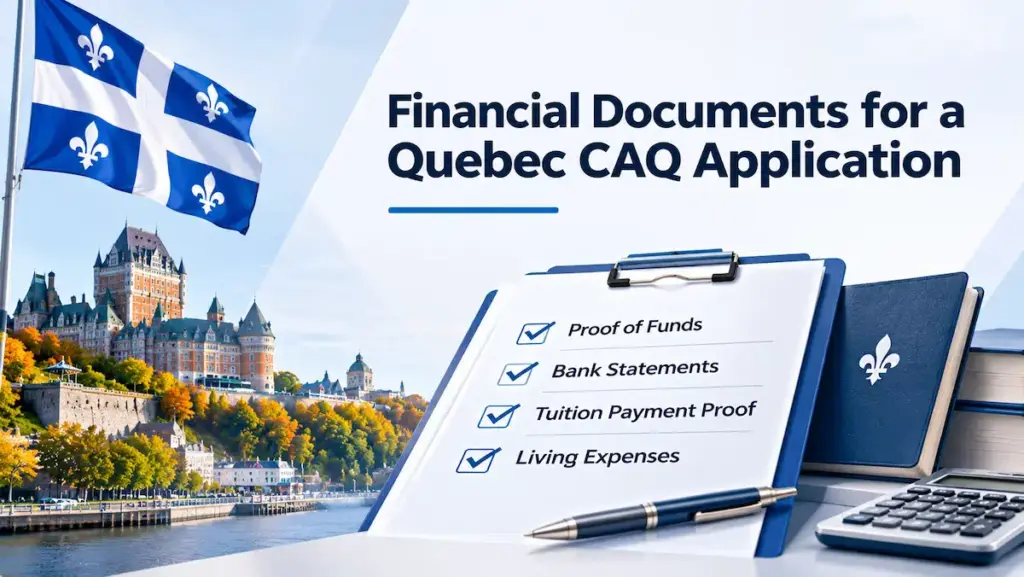
Financial Documents for a Quebec CAQ Application
Quebec accepts different types of evidence to demonstrate financial capacity.
The documents required depend on the applicant’s circumstances.
Bank Statements
Bank statements may be used to demonstrate available personal resources.
Quebec’s published document requirements refer to account statements showing transactions over the previous six months and the current balance.
Relevant accounts may include savings, chequing, or qualifying investment accounts.
The applicant should ensure that the funds are sufficiently documented and accessible.
If substantial funds were recently transferred into an account, additional evidence explaining their source may be useful.
Employment Income
Applicants relying on employment income may need to provide recent pay statements.
Quebec identifies salary documentation covering the previous four months, together with evidence from the account into which the income was deposited.
This can help establish the applicant’s ongoing financial circumstances.
However, future income should not automatically be treated as a substitute for the funds required to finance studies.
Scholarships and Student Loans
An official scholarship letter can demonstrate financial assistance.
The document should specify the amount, the payment arrangements, and the period covered.
A student loan issued by a financial institution may also be considered when supported by the appropriate documentation.
The applicant should confirm whether the funds are available for tuition, living expenses, or both.
Tuition Already Paid
Proof of full or partial tuition payment can also support a financial application.
For example, a student who has already paid the first semester’s tuition may provide the institution’s official receipt.
However, tuition already paid does not independently establish that living expenses and other costs are covered.
Where Do You Submit Your Financial Documents?
This is an important procedural distinction in Quebec’s CAQ system.
Not every international applicant is instructed to submit their financial evidence in exactly the same way.
Quebec’s current instructions identify specific countries and territories of residence whose applicants must provide financial documents through Arrima.
These include:
- Canada
- France
- Austria
- United States
- Mexico
- Hong Kong
- Monaco
- Greenland
- Réunion Island
- Saint-Pierre-et-Miquelon
For applicants residing in other countries or territories, Quebec instructs them to present their financial evidence to the Canadian visa office processing their study permit application.
The federal authorities then assess financial capacity using Quebec’s applicable requirements.
This distinction concerns where the financial evidence is assessed.
It does not remove the obligation to demonstrate sufficient financial resources.
Example: Two Applicants With Different Countries of Residence
Consider two applicants accepted into the same master’s program in Quebec.
The first applicant currently resides in France.
The second resides in a country not included in Quebec’s list of territories requiring financial evidence through Arrima.
Both must satisfy the applicable financial requirements.
However, the first applicant must follow Quebec’s instructions to submit financial proof through Arrima.
The second generally presents the required financial evidence during the federal study permit process.
Applicants should follow the document checklist generated for their circumstances.
Proof of Funds for a Canada Study Permit ↗
How to Apply for a Quebec Acceptance Certificate
The CAQ application process is administered by Quebec’s immigration ministry.
Applicants use the online temporary selection application and the Arrima platform.
Arrima is involved in payment and document submission, but the process should not be confused with Quebec’s separate permanent immigration application procedures.
Preparing Your Application
Before submitting an application, the student should have a valid passport, the educational institution’s admission letter, tuition information, and the necessary payment method.
Applicants relying on another person’s financial assistance should also prepare the required sponsor information.
The names entered in the application must correspond to the passport and the Arrima account.
Differences between identity information in these systems can complicate processing.
Creating an Arrima Account
Applicants must create an Arrima account to manage the required payment and document submission.
The account details should match the information provided in the online temporary selection application.
Applicants should use an email address they can access throughout the application process.
Important notifications may be sent electronically.
Completing the Online Application
The online temporary selection application requires information about the applicant and intended studies.
Applicants should have the relevant information available before beginning.
Quebec’s current instructions state that the online application must be completed in one session because it cannot be saved and resumed later.
Students should therefore prepare the relevant documents and details beforehand.
Paying the Application Fee
After submitting the online application, the applicant must pay the required fee through Arrima.
Quebec currently allows one hour after submission for the payment.
The application is not considered submitted until the payment has been received.
For applications submitted in 2026, the fee is CAD 135.
Uploading Supporting Documents
After payment, the applicant receives the information needed to submit supporting documents.
Quebec states that a file number is provided within approximately 48 hours after payment.
Applicants then use Arrima to submit the documents required by their personalized checklist.
Under the current process, applicants have 15 days to upload the required documentation.
Documents must be complete, legible, accurate, and submitted in the specified format.
Required documents issued in a language other than English or French must be accompanied by an appropriate certified translation.
Receiving the CAQ Decision
If MIFI approves the application, the applicant receives an electronic letter confirming issuance of the CAQ for studies.
This is the document used for the subsequent federal study permit application.
Applicants should retain the letter and ensure the information accurately reflects their circumstances.
The authorization should identify the relevant study period, educational level, and institution where applicable.
Approval of the CAQ does not guarantee approval of the federal study permit.
Quebec CAQ Application Fee and Processing Time
For 2026, Quebec publishes a fee of CAD 135 for an application for temporary selection for studies.
The amount is adjusted annually, generally on January 1.
Students applying in 2027 should verify the updated fee before paying.
Is the CAQ Fee Refundable?
The application fee is generally non-refundable if the application is refused or rejected.
However, Quebec distinguishes between refused or rejected applications and applications determined to be inadmissible under its application management rules.
Certain inadmissible applications can result in a refund.
Students should not assume that every unsuccessful application produces the same refund outcome.
How Long Does CAQ Processing Take?
Quebec’s current service standard states that a decision is issued within 25 business days in approximately 80% of complete applications.
The processing period begins after MIFI receives all the required information, payment, and supporting documents.
The 25-business-day figure is not a guarantee.
An incomplete application may require additional processing time.
Students should also distinguish CAQ processing from federal study permit processing.
The two applications are assessed separately.
An applicant should not assume that receiving the CAQ within 25 business days means their Canadian study permit will also be approved within that period.
Federal Study Permit Fees
After receiving a CAQ, most applicants must pay the federal study permit processing fee.
The standard IRCC study permit application fee is CAD 150.
Applicants who need to provide biometrics generally pay an additional CAD 85, unless a specific exemption or different fee arrangement applies.
These federal charges are separate from the Quebec CAQ fee.
CAQ Application Limits in 2026 and 2027
Quebec introduced institution-specific limits on the number of applications accepted under its International Student Program.
These limits are relevant to prospective students because admission to an educational institution does not necessarily mean unlimited access to the CAQ application process.
Application Limits From December 2025 to December 2027
Quebec established application limits covering the period from December 17, 2025, to December 16, 2027.
The framework sets separate maximum numbers for two annual periods.
The limits apply to vocational, college, and university studies.
They are assigned to institutions, school service centres, or school boards according to the applicable rules.
The Government of Quebec also revised certain institutional limits in July 2026.
What Happens When an Institution Reaches Its Limit?
If the applicable maximum has been reached, a new applicant may be unable to submit a CAQ application for that institution unless they qualify for an exemption.
This can create a situation in which an applicant holds an academic admission offer but cannot immediately proceed with the provincial application.
For example, a college may continue to provide information about a program while the number of available CAQ applications is restricted.
Applicants should therefore check the institution’s current position before paying non-refundable deposits.
Are CAQ Renewals Included in the Limits?
Some renewals are exempt.
Quebec provides an exemption for students continuing the same program at the same educational institution and academic level.
Applicants must supply the required supporting documents.
However, an applicant changing institutions or beginning a different academic program should not automatically assume that the renewal exemption applies.
Other exemptions also exist under Quebec’s application management rules.
The exact category must be verified.
Is a CAQ the Same as a PAL or TAL?
Not exactly.
A Provincial Attestation Letter (PAL) or Territorial Attestation Letter (TAL) is part of Canada’s federal study permit application system.
For students studying in Quebec, the province’s CAQ attestation generally serves the relevant federal attestation function.
However, the CAQ remains a provincial authorization with its own eligibility requirements.
IRCC generally accepts the Quebec attestation confirming issuance of a CAQ in place of a separate PAL/TAL.
The attestation must meet the applicable federal requirements.
For CAQ applications subject to the newer attestation rules, IRCC requires the relevant statement confirming that the applicant has a place within Quebec’s allocation or is exempt from it.
Older documents are subject to specific transitional provisions.
Applicants should use the valid attestation issued for their circumstances.
Since January 1, 2026, applicants entering eligible degree-granting master’s and doctoral programs at public Designated Learning Institutions have been exempt from the federal PAL/TAL requirement.
However, this does not eliminate Quebec’s CAQ requirements.
Consider a student admitted to an eligible PhD program at a public university in Montreal.
The student may qualify for the federal PAL/TAL exemption.
Nevertheless, they will generally still need a CAQ for studies before applying for their study permit.
The provincial authorization and federal exemption serve different purposes.
Graduate certificates and graduate diplomas should not automatically be treated as master’s degrees.
An applicant admitted to a graduate certificate at a Quebec institution may still be subject to the federal attestation rules.
The academic designation of the credential matters.
Students should verify whether the program is an actual degree-granting master’s or doctoral program before assuming an exemption applies.
How Long Is a Quebec CAQ Valid?
The validity of a CAQ depends on the approved study period and the terms of the authorization.
Quebec’s regulatory framework allows a maximum validity period of 49 months for a CAQ for studies.
However, that does not mean every student receives a CAQ valid for 49 months.
The actual validity depends on the program and individual circumstances.
Students should rely on the dates shown in their authorization.
Does the CAQ Automatically Remain Valid Until Graduation?
Not necessarily.
A student may need additional time to complete their degree.
For example, research delays, changes in academic scheduling, or other circumstances may cause studies to continue beyond the original expected completion date.
If the CAQ will expire before the student completes the program, a new application for temporary selection may be required.
The student may also need to extend their federal study permit.
The two authorizations should be reviewed together.
How to Renew a CAQ in Quebec
A student must generally apply for a new CAQ when their studies will continue beyond the validity of the existing authorization.
Quebec recommends submitting the application at least three months before the CAQ and study permit expire.
However, students should also consider federal processing times and any documents that may take additional time to obtain.
Documents Required for Renewal
Renewal applications generally require more information than an initial application.
Quebec may request evidence demonstrating that the student complied with the conditions of the previous CAQ.
Relevant documents may include:
- Official academic transcripts.
- Confirmation of enrolment.
- A letter from the educational institution.
- Evidence of health and hospitalization insurance.
- Updated financial documentation, where required.
- An explanation of changes or interruptions in studies.
The exact documentation depends on the student’s circumstances.
For example, a doctoral student who has completed coursework and is writing a dissertation may need institutional confirmation of their continued academic registration.
A student who interrupted studies due to illness may need appropriate supporting medical documentation.
Do You Also Need to Extend Your Study Permit?
Usually, if the student’s existing federal study permit will expire before the completion of studies.
Receiving a new CAQ does not automatically extend a federal study permit.
The student must submit the appropriate application to IRCC.
Students who apply to extend their federal study permits before expiry may qualify to remain in Canada under maintained status while their applications are processed.
However, maintaining status does not remove the need to comply with the applicable study permit conditions.
Changing Schools or Programs in Quebec
Changing an educational institution can affect both the provincial CAQ and the federal study permit.
The requirements depend on the type of change and the authorization previously issued.
Changing to Another University or College
Quebec’s current rules generally require a new CAQ when a student changes educational institutions.
However, an important exception applies to certain older CAQs.
A student holding a valid CAQ issued before December 6, 2024, may be permitted to change institutions at the same educational level without obtaining a new CAQ.
For CAQs issued on or after that date, the exemption does not generally apply.
The institution listed on the authorization may therefore be important.
Example: Transferring Between Two Universities
Consider a student who receives a CAQ in 2026 to study at University A.
After completing one semester, the student receives admission to University B in Quebec.
Both institutions offer recognized university programs.
However, the original CAQ is associated with University A.
The student will generally need to apply for a new CAQ for University B.
They must also assess the federal requirements for changing DLIs.
Under current IRCC rules, post-secondary students generally need a new study permit for the new DLI.
The student should not assume that obtaining a new university admission letter is sufficient to begin studying at the second institution.
Changing Your Level of Study
A student moving from a bachelor’s degree to a master’s degree generally needs a new CAQ.
The same principle applies to a student moving from a master’s degree to a doctoral program.
The new academic level must be reflected in the provincial authorization.
However, a change of specialization within the same educational level and institution may be treated differently.
Students should verify whether their particular change affects the existing CAQ conditions.
Changing Programs at the Same Institution
A program change within the same university may not always require a new CAQ if the educational level, institution, and other applicable conditions remain unchanged.
For example, a student changing from one bachelor’s specialization to another at the same university may be in a different position from someone moving into a master’s degree.
However, the new program’s expected completion date and the conditions of the existing authorization still matter.
If the studies extend beyond the CAQ’s expiry date, a new application may be necessary.
Changing DLIs Under Federal Rules
IRCC introduced stricter rules for post-secondary students changing institutions on November 8, 2024.
Students generally need to apply for a new study permit when moving to another DLI.
For students already in Canada, this normally means applying to extend the current permit for the new institution.
The student generally must receive approval before starting at the new DLI.
Limited exceptions exist when the previous institution closes, loses designation, or experiences certain other specified circumstances.
Students should coordinate the CAQ and federal study permit requirements before transferring.
What Happens if Your CAQ Application Is Refused?
A refusal or rejection can occur when an application does not satisfy Quebec’s requirements.
For example, an applicant may fail to demonstrate the required financial capacity or provide sufficient documentation.
Other problems may involve the admission documents, application conditions, or compliance with the current program management rules.
However, not every unsuccessful application is decided for the same reason.
A student may have funds available but fail to demonstrate them adequately.
For example, bank statements may be incomplete or fail to show the information required by the authorities.
A sponsor may provide a support letter without sufficient financial documentation.
The problem is not always the total amount of money.
It may concern whether the evidence establishes that the required resources are genuinely available.
An application may be delayed or rejected if required documents are missing, illegible, or inconsistent.
For example, the applicant’s admission letter may contain outdated program dates.
The passport information entered into the application may also differ from the supporting documents.
Applicants should ensure that their information is accurate and that the submitted documents meet the formal requirements.
Quebec’s institution-specific application limits create another consideration.
An application may be inadmissible if the institution has reached its applicable limit and the applicant does not qualify for an exemption.
This differs from a refusal based on the student’s financial capacity or other substantive requirements.
The distinction matters because the procedures and refund outcomes may differ.
Can You Appeal a CAQ Refusal?
Quebec provides an administrative review process for certain decisions.
Applicants may request a review of eligible refusals or rejections involving temporary selection for studies.
However, this process is subject to specific conditions.
Administrative Review Deadline
Under Quebec’s current rules, a request for administrative review must normally be received within 90 calendar days after the contested decision.
The applicant must identify the decision being challenged and explain the grounds for requesting a review.
An administrative review is not simply an opportunity to submit an entirely new application without addressing the original decision.
The request must satisfy the relevant legal and procedural requirements.
When Is Administrative Review Appropriate?
Quebec identifies grounds for review including certain significant factual or legal errors and qualifying new information that could not reasonably have been supplied earlier.
Not every disagreement with the original assessment is sufficient.
For example, an applicant who believes the ministry overlooked an important document may need to determine whether the circumstances meet the review criteria.
There are also decisions that are excluded from administrative review.
Applicants should therefore examine the specific refusal notice and the current review rules.
Administrative Review vs a New Application
A new application and an administrative review are different procedures.
In some circumstances, a new application may be appropriate when the applicant has corrected deficiencies or their circumstances have changed.
However, Quebec warns that submitting a new application in the same immigration stream while an administrative review is underway can result in termination of the review process.
Applicants should understand the consequences before choosing which procedure to pursue.
Does a CAQ Guarantee a Canadian Study Permit?
No. A CAQ confirms that the applicant has satisfied the applicable provincial requirements for temporary selection for studies.
However, IRCC conducts its own federal assessment.
That assessment includes financial resources, admissibility, genuine study intentions, and the conditions governing temporary residence.
For example, an applicant may receive a CAQ but fail to satisfy IRCC that their financial resources are sufficient or appropriately documented.
Another applicant may encounter concerns related to their proposed studies or immigration history.
The federal study permit application can therefore be refused even when the CAQ has been approved.
The two decisions must be treated separately.
Can You Reuse a CAQ After a Study Permit Refusal?
Potentially. Under IRCC’s current rules, applicants can generally reuse a valid CAQ when submitting a new study permit application, including after a previous refusal, provided the relevant conditions are met.
A change in educational level generally requires a new CAQ.
Changing institutions may also require a new authorization, depending on when the CAQ was issued and the applicant’s circumstances.
Applicants should also verify that the CAQ remains valid and that the underlying admission arrangements are still current.
A previous federal refusal does not automatically mean the CAQ itself has been cancelled.
Can You Work in Quebec With a CAQ?
A CAQ does not independently provide authorization to work in Canada.
Employment rights depend on federal immigration law and the conditions of the student’s study permit or other work authorization.
Eligible international students may work while studying, subject to IRCC’s rules.
For example, qualifying study permit holders may generally work up to 24 hours per week off campus during regular academic sessions.
Different rules apply to qualifying scheduled breaks and on-campus employment.
However, receiving a CAQ does not automatically make every student eligible to work.
A visitor attending a short language course without a study permit should not assume that the ordinary international student employment rules apply.
Does a CAQ Make You Eligible for a PGWP?
No. The Quebec Acceptance Certificate concerns provincial authorization for studies.
Post-Graduation Work Permit eligibility is determined under federal immigration rules.
An applicant may study at a legitimate Quebec educational institution and still complete a program that does not qualify for PGWP.
For example, eligibility can depend on the institution, credential, program length, field of study, and other conditions.
Some Quebec vocational programs also have specific duration thresholds.
Students should verify the actual PGWP requirements before selecting a program.
A valid CAQ is not a substitute for that assessment.
Planning Your Studies in Quebec
Quebec offers a distinct academic environment, with English-language and French-language universities, colleges, and vocational training institutions.
However, its immigration requirements also differ from those in most other Canadian provinces.
For many international students, obtaining a CAQ is an essential part of preparing for a Canadian study permit application.
The process requires more than receiving admission and paying the provincial application fee.
Applicants must consider financial requirements, institutional application limits, document submission procedures, and the conditions attached to their authorization.
Students already studying in Quebec may also need to renew their CAQ or obtain a new one when changing institutions or educational levels.
The provincial and federal requirements should be assessed together, particularly when a student intends to transfer to another school or extend their studies.
Official Sources: